244 / 249
Peru
Echoes of the Andes
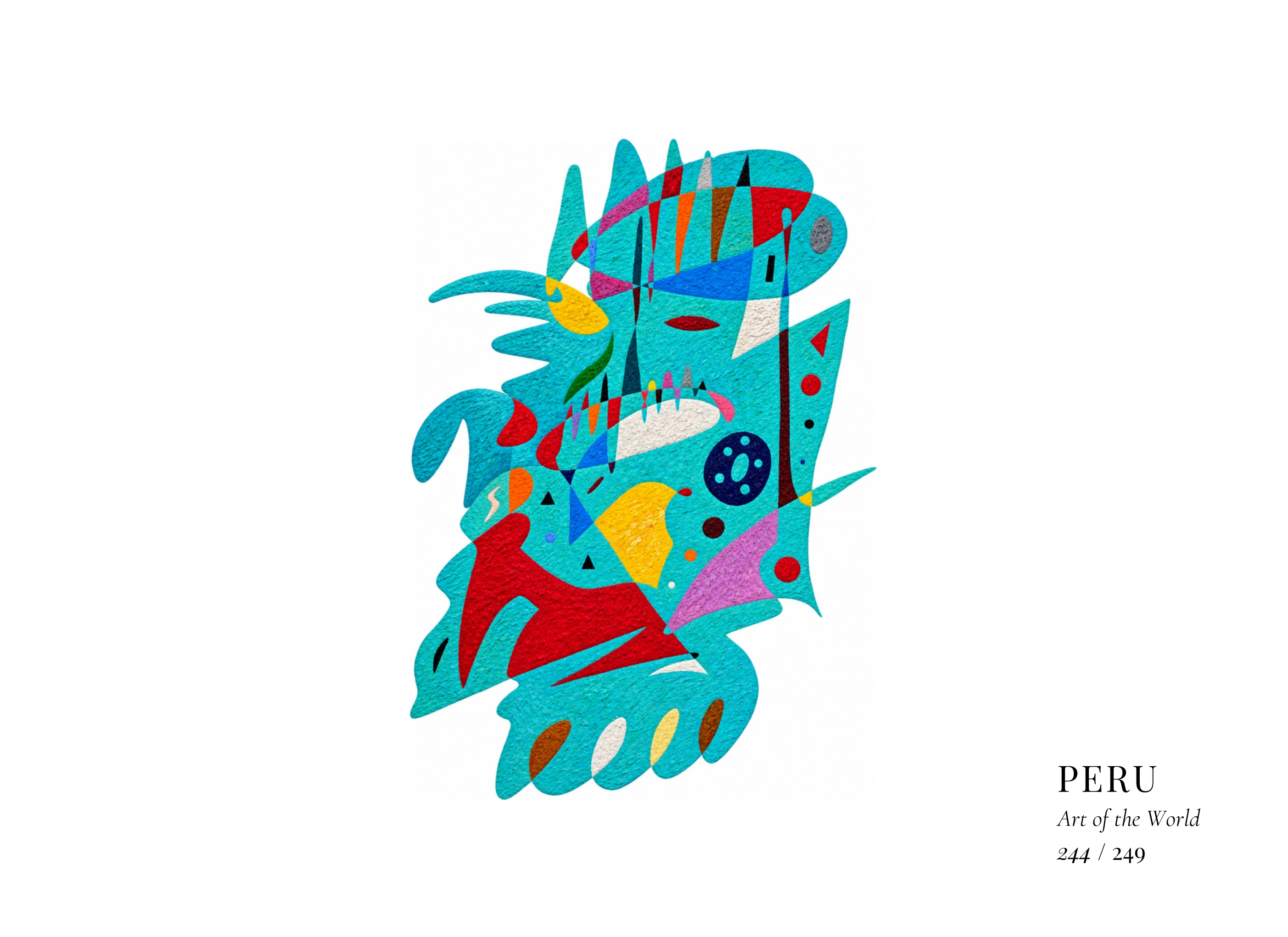
Description
The composition's turquoise structure rises through layered, irregular forms animated by red, yellow, violet, blue and white. Sharp vertical extensions contrast with rounded lower elements, while circles, wedges and narrow lines establish a complex internal rhythm. Dense impasto gives the surface material intensity, yet openings of white space keep the composition expansive. Its interlocking divisions and shifting scales suggest Peru’s remarkable geographical and cultural plurality, while the upward movement can be read as an evocation of historical continuity and renewal.
Cultural Context
Peru extends from the Pacific coast across the Andes to the Amazon basin, embracing exceptional geographic and historical depth. Ancient societies including Caral, Chavín, Moche and Nazca preceded the Inca Empire, whose political and architectural achievements centred on Cusco. Spanish colonial rule transformed the region before Peru achieved independence in the nineteenth century.
Peruvian culture brings together Indigenous, European, African and Asian inheritances. Quechua, Aymara and numerous Amazonian languages enrich its cultural landscape alongside Spanish. Weaving, ceramics, metalwork, music, dance, literature and celebrated culinary traditions sustain connections between ancient knowledge and contemporary creativity.
Exhibition Context
A turquoise field contains watchful eyes, a pale band of toothlike marks and scattered red, yellow and blue points. The composition can appear as a face, a group or an invented terrain. Peru's Andean societies and the Inca Empire before Spanish conquest make such a densely inhabited image evocative, but its graphic marks should not be claimed as a deciphered Andean script. Their shifting relation lets different presences share the same cultural landscape without resolving into one official portrait.