246 / 249
Suriname
Many Currents, One Nation
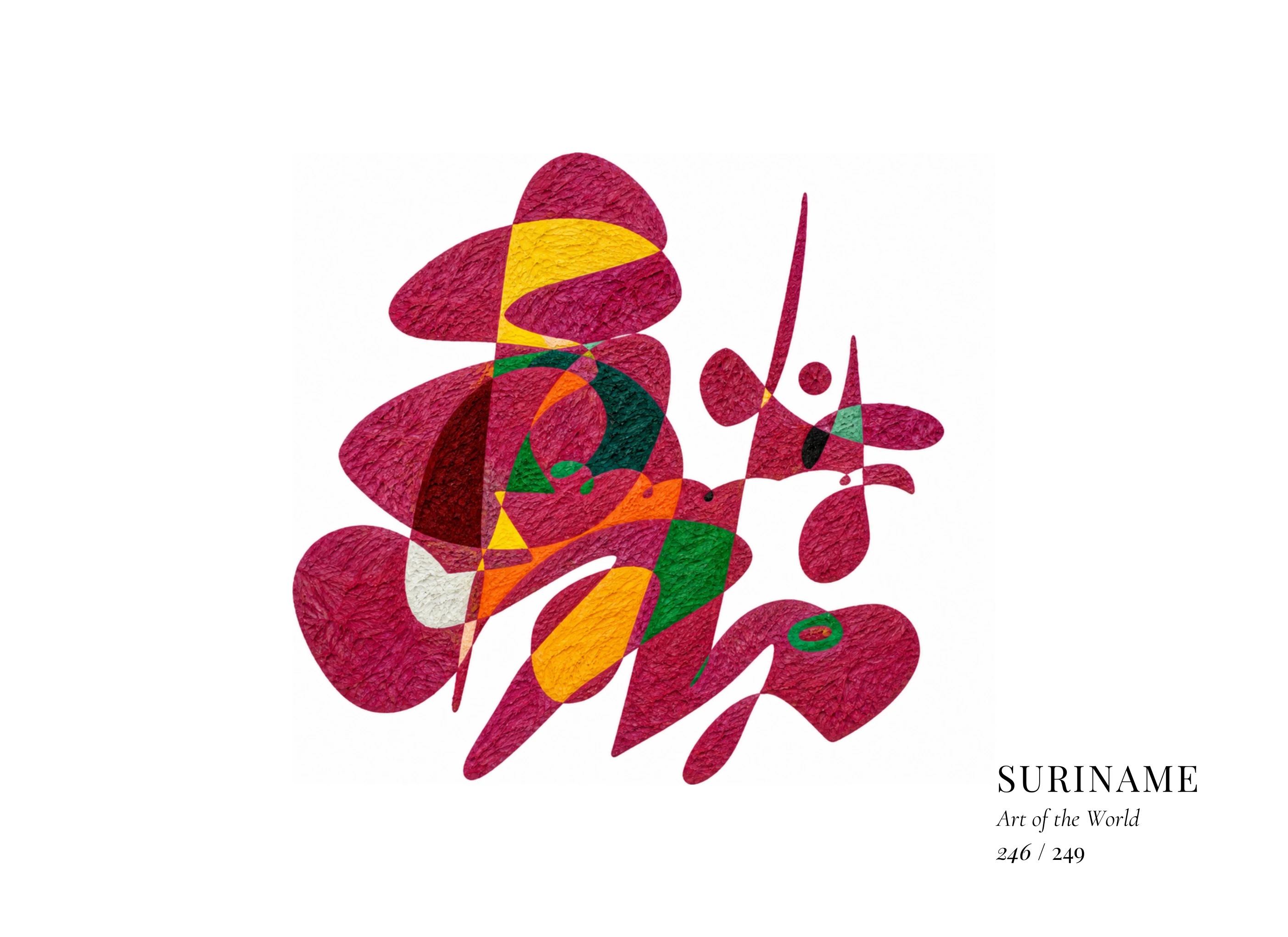
Description
The artwork is dominated by deep rose and magenta, articulated by yellow, orange, green, white and dark accents. Rounded masses intersect with narrow points, detached forms and sweeping internal curves, while the dense impasto gives every colour physical presence. White negative spaces separate yet visually connect the composition. These overlapping shapes suggest Suriname’s cultural plurality: distinct elements maintaining their individuality while participating in a larger visual rhythm of coexistence and continuity.
Cultural Context
Suriname lies on South America’s Atlantic coast, between Guyana and French Guiana, with vast tropical forests extending deep into the interior. Indigenous societies long inhabited these lands, later joined through colonial history by African, Asian and European communities. Independence from the Netherlands in 1975 opened a new chapter in its national development.
Suriname’s identity is remarkably plural. Dutch is the official language, while Sranan Tongo, Sarnami, Javanese, Maroon and Indigenous languages contribute to a richly multilingual society. African, Hindustani, Javanese, Indigenous, Chinese and European inheritances meet in music, storytelling, religious traditions, textiles, woodcarving, cuisine and contemporary arts.
Exhibition Context
A bright magenta head and rounded winglike lobes gather around small green and yellow marks, with the body repeatedly opening toward white space. Suriname's Indigenous, African, Dutch colonial and Asian indenture histories created a remarkably varied society. The painting's connected but individually legible parts invite a reading of that plurality, without assigning a colour to a community. Its outward-facing figure seems built by encounter rather than emerging from one origin.