
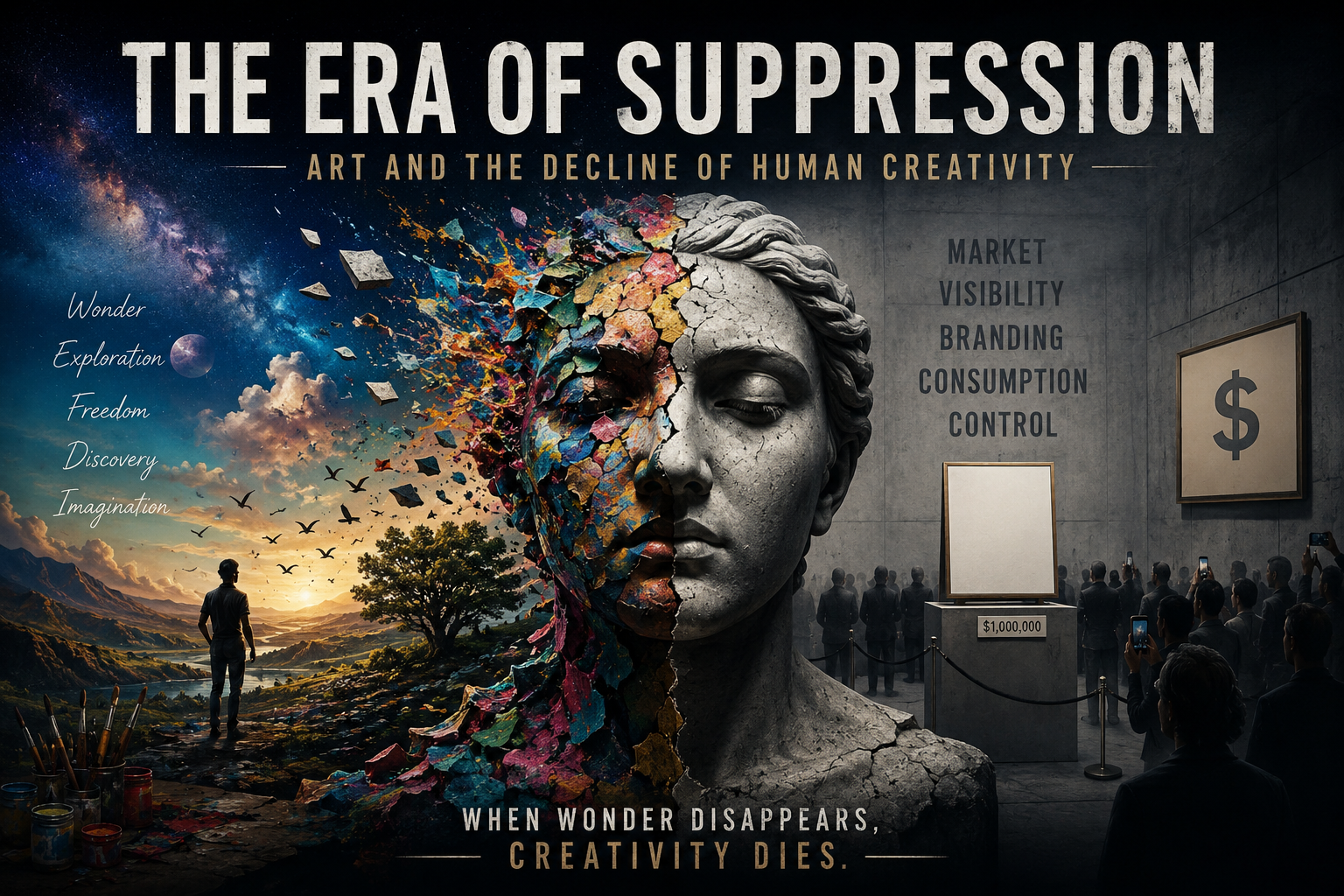
The Era of Suppression: Art and the Decline of Human Creativity
A civilizational thesis on creativity, art, and suppression
11 Jun 2026Preface
This essay was not written as a critique of individual artists, movements, or institutions. It emerged from a broader concern regarding the condition of contemporary civilization and its relationship to creativity, discovery, and human freedom.
Throughout history, art has served as one of humanity’s most sensitive instruments for exploring reality. It has revealed unseen structures, challenged established assumptions, and provided access to dimensions of experience that cannot be measured by economic, political, or technological systems alone. For this reason, the condition of art often reflects the condition of civilization itself.
The observations presented in the following pages arise from the conviction that the difficulties facing contemporary art are not isolated cultural phenomena. They are symptoms of deeper transformations affecting the entire structure of modern life. The growing dominance of commercial values, institutional validation, constant distraction, and economic dependency has altered not only the production of art, but also the conditions necessary for creativity to flourish.
The purpose of this essay is therefore not to defend a particular aesthetic position, nor to advocate for a return to any historical period. Its purpose is to investigate the relationship between artistic decline and a broader civilizational shift away from exploration and toward administration, consumption, and control.
If art appears increasingly disconnected from discovery, it may be because society itself has become disconnected from the unknown. If creativity appears constrained, it may be because the structures surrounding contemporary life no longer encourage the freedom upon which creativity depends.
What follows is an attempt to examine these questions and to consider whether the crisis of contemporary art is, in reality, a reflection of a much larger crisis: the gradual erosion of humanity’s capacity for wonder.
The Era of Suppression: Art and the Decline of Human Creativity
The crisis of contemporary art is often discussed in terms of style, politics, institutions, or markets. Yet these explanations fail to address a deeper question: why does so much contemporary art appear disconnected from the spirit of discovery that once defined artistic creation?
The problem is not simply artistic. It is civilizational.
Art has always reflected the conditions of the society from which it emerges. When civilizations pursue exploration, art becomes exploratory. When civilizations pursue understanding, art becomes investigative. When civilizations become consumed by commerce, administration, and self-preservation, art inevitably follows the same trajectory.
The contemporary world presents itself as the most advanced period in human history. Never before have individuals possessed such access to information, technology, and communication. Yet beneath this appearance of progress lies a paradox. The expansion of information has not produced a corresponding expansion of imagination. On the contrary, creativity appears increasingly constrained by economic pressures, social conformity, and the relentless demand for visibility.
Art was once an investigation into existence. It sought to confront the unknown, explore the limits of perception, and reveal dimensions of reality that could not be measured or fully explained. The artist functioned as an explorer, venturing into territories that remained inaccessible to ordinary experience.
Today, this role has been largely replaced by another. The artist increasingly operates as a participant within a commercial ecosystem governed by markets, institutions, branding, and attention. Success is often measured less by discovery than by visibility. The question is no longer what has been revealed, but how effectively it can be promoted.
This transformation reflects a broader change within civilization itself. Human beings increasingly inhabit systems that consume the time and freedom necessary for genuine creativity. Economic dependency, perpetual productivity, digital distraction, and social performance occupy the mental space once reserved for contemplation and exploration. The result is a subtle but profound form of suppression.
Unlike the overt censorship of previous eras, contemporary suppression rarely prohibits thought directly. Instead, it overwhelms thought with noise. Individuals are not prevented from exploring the unknown; they are simply given little opportunity to do so. Their attention is fragmented, their imagination commercialized, and their aspirations redirected toward measurable forms of success.
Under such conditions, creativity does not disappear. It becomes marginalized.
The consequences are visible throughout contemporary culture. Art becomes increasingly commercial. Institutions reward participation over excellence. Visibility eclipses mastery. Recognition replaces achievement. The pursuit of meaning is gradually displaced by the pursuit of market value.
This does not imply that talent has vanished. Rather, talent no longer occupies the central position it once held. A civilization that struggles to recognize excellence inevitably struggles to produce it. The standards that once distinguished artistic achievement become obscured by systems more concerned with circulation than discovery.
The decline of art therefore cannot be understood in isolation. It is one manifestation of a broader civilizational crisis: the diminishing capacity of humanity to engage with mystery, uncertainty, and the unknown.
Every great creative age was driven by a willingness to confront questions without guaranteed answers. Exploration, whether artistic, scientific, philosophical, or spiritual, emerged from a recognition that reality contained undiscovered dimensions. Contemporary civilization increasingly privileges certainty, efficiency, and predictability. In doing so, it narrows the space in which genuine discovery can occur.
The crisis of art is therefore not the cause of the problem. It is the symptom.
The deeper issue concerns humanity's changing relationship with freedom itself. Creativity requires more than technical ability. It requires intellectual independence, time for reflection, and the courage to pursue questions that may not produce immediate rewards. When these conditions disappear, creativity inevitably declines.
The future of art depends upon the future of civilization. If humanity continues to prioritize consumption over exploration, visibility over truth, and commerce over discovery, artistic decline will persist. If, however, humanity rediscovers the value of the unknown, art may once again become what it was always meant to be: a vehicle for investigating existence itself.
The challenge before us is therefore larger than the reform of artistic institutions. It is the restoration of a culture capable of wonder.
For without wonder, there can be no exploration. Without exploration, there can be no discovery. And without discovery, both art and civilization lose their reason for existence.
Notes
- This essay approaches contemporary art not as an isolated cultural problem, but as a symptom of a wider civilizational condition.
- The term “suppression” is used here to describe indirect forms of limitation: economic pressure, distraction, institutional conformity, market dependence, and the loss of time for independent thought.
- “Creativity” is understood not only as artistic production, but as the human capacity to investigate existence, confront the unknown, and imagine new structures of meaning.
- The criticism of commercialization is not a rejection of the art market itself, but of a cultural condition in which market value becomes more important than discovery, mastery, and meaning.
Bibliography
- Adorno, Theodor W. Aesthetic Theory. University of Minnesota Press, 1997.
- Baudrillard, Jean. The Consumer Society: Myths and Structures. Sage Publications, 1998.
- Benjamin, Walter. The Work of Art in the Age of Mechanical Reproduction. 1935.
- Debord, Guy. The Society of the Spectacle. Zone Books, 1994.
- Marcuse, Herbert. One-Dimensional Man. Beacon Press, 1964.
- Ortega y Gasset, José. The Dehumanization of Art. Princeton University Press, 1968.
- Virilio, Paul. The Information Bomb. Verso, 2000.