27 / 249
American Samoa
Ancestral Order, Living Form
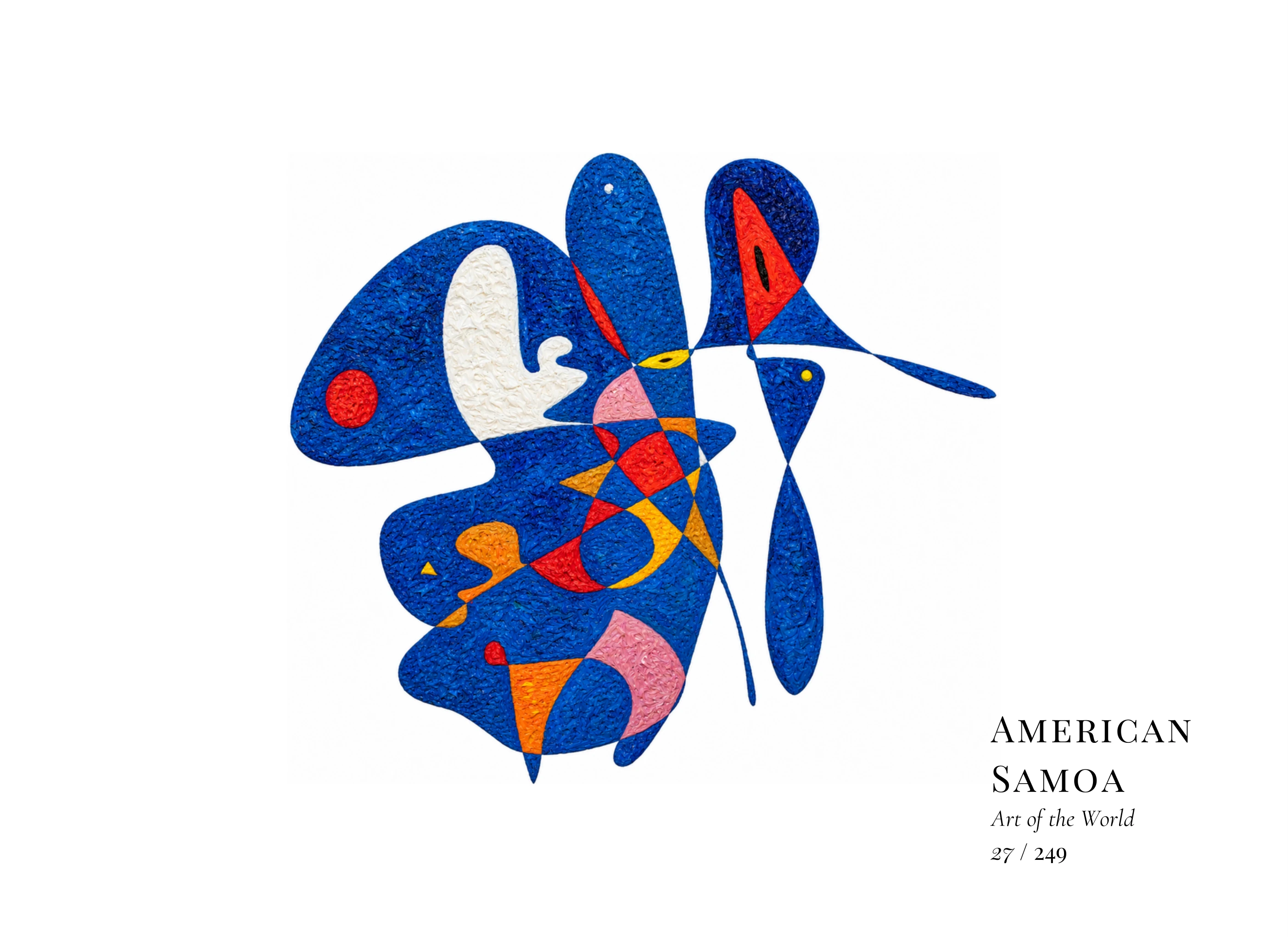
Description
The artwork gathers deep ultramarine forms around a compact, intensely coloured centre. Red, orange, yellow and pink geometries pulse against the dominant blue, while white space cuts decisively through the composition. Rounded masses contrast with narrow suspended forms and long pointed extensions, giving the image both weight and delicacy. Its dense impasto strengthens the sense of accumulated experience. The structure suggests a visual idea of cohesion: distinct forms maintaining their individuality while remaining bound within a larger, evolving order.
Cultural Context
American Samoa lies in the South Pacific, forming the eastern part of the Samoan archipelago. Settled by Polynesian voyagers over many centuries, the islands developed complex systems of kinship, chiefly authority and communal stewardship. Today they constitute an unincorporated territory of the United States while retaining a strongly Samoan social foundation.
Fa‘a Samoa — the Samoan way — remains fundamental to cultural identity, emphasising extended family, community, ceremony and customary leadership. Samoan and English are widely used, while oratory, tattooing, dance, choral music, weaving, carving and architectural traditions sustain knowledge across generations. Cultural continuity here is active rather than merely preserved.
Exhibition Context
A blue head and long slender beak emerge from a body crossed by red and white pieces. The form hints at a bird, but its limbs never settle into a natural anatomy. American Samoa's Polynesian chiefly traditions and its relationship with the United States provide a way to read those intersecting parts as a continuing local identity within a wider political tie. The figure leans forward rather than standing as a static badge, keeping inherited custom and ongoing change in motion.