167 / 249
Azawad
Memory Without a Single Centre
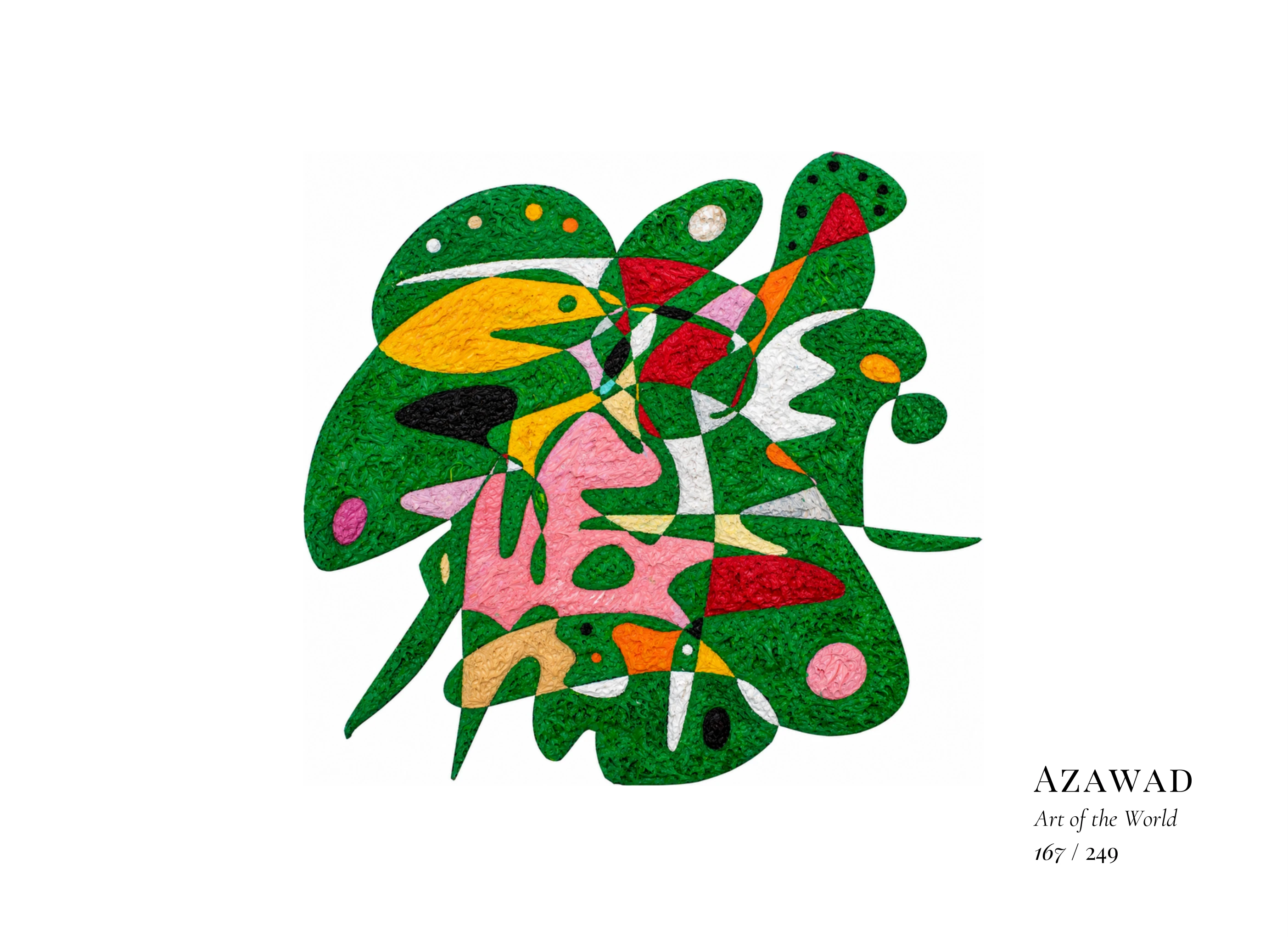
Description
The artwork builds its structure from a dominant, densely textured green, penetrated by vivid yellow, crimson, pink, white, orange and black. Rounded expanses meet pointed fragments, narrow extensions and tightly compressed intersections. The centre is particularly intricate, with colours converging without losing their separate identities, while detached forms loosen the outer silhouette. This visual plurality can be read as an evocation of layered memory: numerous histories occupying the same field without being reduced to a single narrative.
Cultural Context
Azawad is the name used for a vast Saharan and Sahelian region of northern Mali, encompassing areas around Timbuktu, Gao and Kidal. For centuries, trans-Saharan commerce connected its communities with North and West Africa, while centres such as Timbuktu became renowned for Islamic scholarship, manuscript culture and intellectual exchange. The region remains internationally recognised as part of Mali.
Its cultural inheritance is notably plural, shaped by Tuareg, Songhai, Arab, Fulani and other communities. Tamasheq, Songhay varieties, Arabic and additional languages accompany traditions of oral poetry, music, leatherwork, metalwork, textiles and manuscript scholarship. These practices reflect generations of mobility, learning and cultural encounter across the Sahara and Sahel.