70 / 249
Basque Country
A Language Older Than Borders
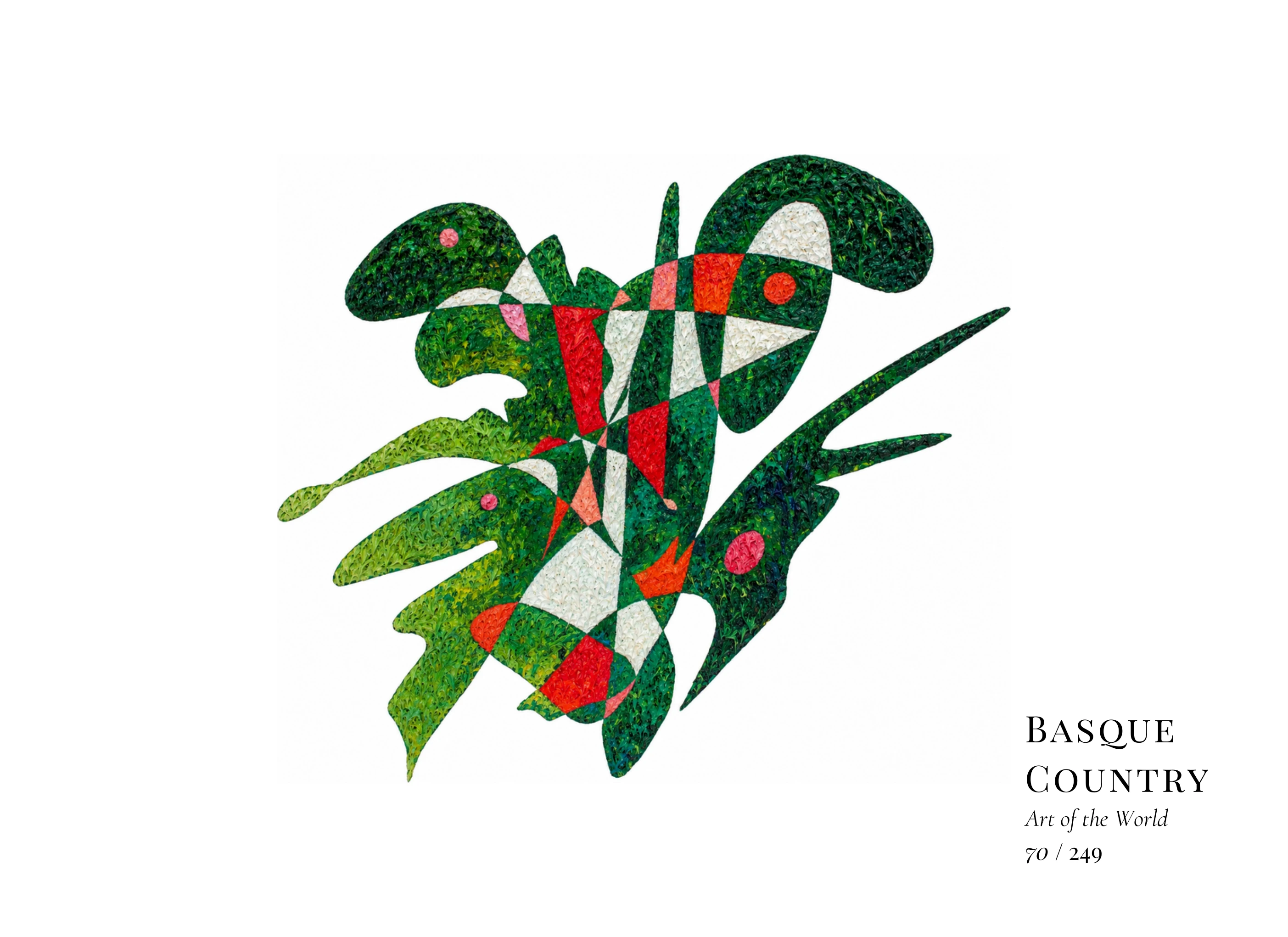
Description
The artwork is dominated by layered greens, from luminous moss tones to near-black depths, punctuated by crimson, pink and white. Its silhouette expands through lobes, blades and elongated projections, while the centre compresses colour into a tightly interlocked geometry. White passages create flashes of structural clarity against the dense impasto. The composition suggests identity as something both inherited and actively constructed: a network of forms maintaining coherence through transformation rather than uniformity.
Cultural Context
The Basque Country spans the western Pyrenees and adjoining Atlantic territories in northern Spain and south-western France. Its historical development has been shaped by distinctive local institutions, maritime enterprise, pastoral communities, commerce and industrialisation. Across changing political structures, a strong consciousness of place and inherited custom has remained central to Basque life.
Euskara, the Basque language, is a remarkable foundation of cultural identity and is unrelated to the Indo-European language family. Oral traditions, bertsolaritza improvised verse, dance, music, architecture, gastronomy, sculpture and contemporary design reveal a culture capable of preserving deep inheritance while continually renewing its forms.
Exhibition Context
Green forms curve around several red eyes, while long edges break away from the body in different directions. The Basque Country's language, local institutions and maritime traditions persist across a Spanish-French border, making a form with several orientations especially suggestive. Its overlapping outlines seem connected below the surface even where they separate at the tips. The painting does not provide a map of the border; it asks how a recognisable identity continues across divided political space.