163 / 249
Chechen Republic of Ichkeria
A Geometry That Refuses Silence
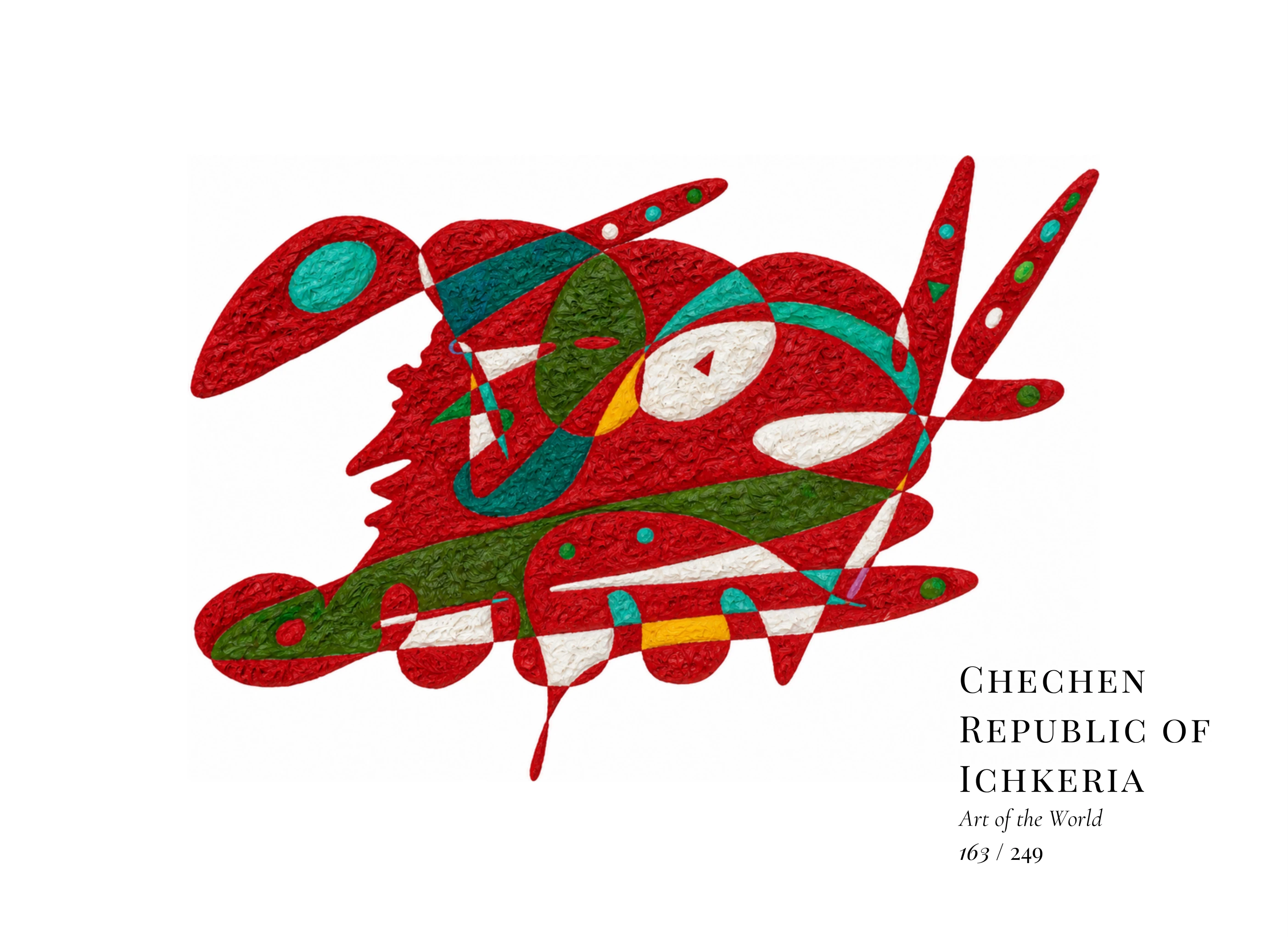
Description
The artwork gathers extraordinary pressure within a predominantly crimson field. Olive and turquoise passages curve through it like counterforces, while white wedges cut sharply across the dense impasto. Long projecting blades, suspended coloured points and abrupt intersections give the silhouette a restless, uncompromising momentum. Yet the structure does not disintegrate: disparate forms repeatedly return towards a concentrated centre. It can be read as an image of persistence— fractured, contested and intensely alive—where visual tension itself becomes a form of continuity.
Cultural Context
The Chechen Republic of Ichkeria emerged from the political upheavals accompanying the dissolution of the Soviet Union, declaring independence in 1991 in the territory of Chechnya in the North Caucasus. The region lies between the Caucasus mountains and the northern plains, a landscape long traversed by communities, empires and competing centres of power. Chechen historical memory reaches far beyond the twentieth century, shaped by indigenous social structures, Islam, encounters with the Russian Empire and Soviet rule, including the collective trauma of wartime deportation and subsequent return. Chechen cultural identity is strongly associated with the Chechen language, belonging to the Nakh branch of the Northeast Caucasian languages, and with traditions of oral history, poetry, music and dance. Family and community memory have helped transmit narratives across generations, while distinctive tower architecture remains among the most recognisable achievements of the region’s historical built environment. Contemporary literature, performance and visual culture continue this inheritance through changing circumstances and dispersed communities.