19 / 249
Cook Islands
The Architecture of Navigation
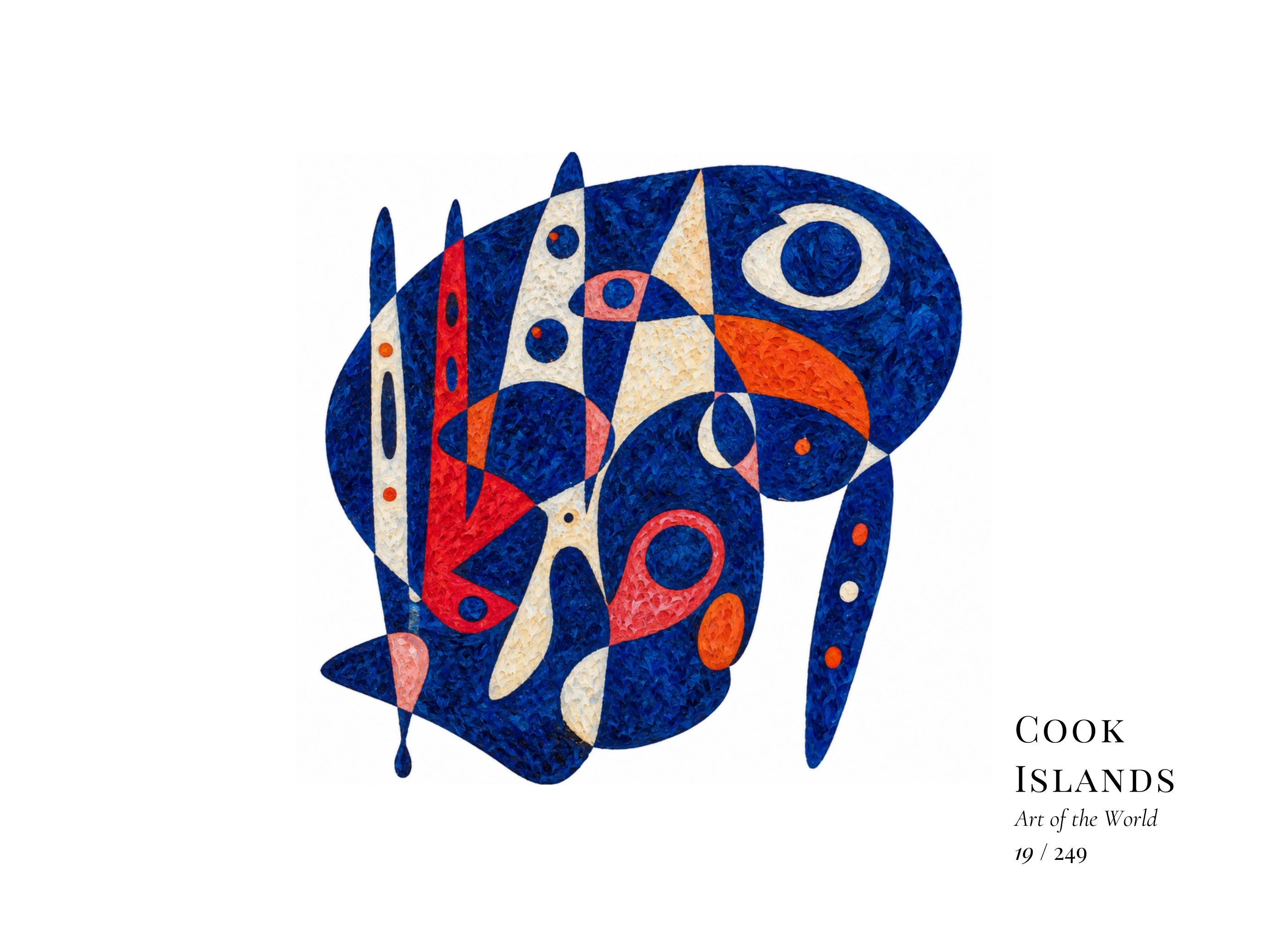
Description
The artwork possesses an almost architectural density. Deep cobalt and midnight blue establish a monumental field through which ivory columns, crimson wedges, coral loops and orange crescents advance and recede. Circular openings recur like visual anchors, while tall pointed forms establish a strong vertical cadence. A detached, tapering element on the right disrupts the compact silhouette and creates a charged interval of white. Thick impasto makes every division materially emphatic. The composition suggests navigation not as a literal journey but as an ordering intelligence: separate forms hold their course within a complex, interconnected structure.
Cultural Context
The Cook Islands comprise fifteen islands scattered across a vast expanse of the South Pacific, ranging from the mountainous volcanic landscapes of the southern group to the coral atolls of the north. Polynesian navigators settled these islands over many centuries, sustaining connections across an ocean understood through stars, currents, winds and inherited knowledge. European encounters began from the sixteenth century; the islands later became a British protectorate and were subsequently administered by New Zealand. Since 1965, the Cook Islands have governed themselves in free association with New Zealand.
Cook Islands Māori culture remains fundamental to national identity, expressed through distinct island communities, genealogies and dialects. Oral traditions preserve histories of voyaging and ancestry, while music, choral singing, dance and drumming remain prominent forms of collective expression. Tīvaevae quilting transforms fabric into elaborate compositions of colour and pattern, while carving, weaving and ceremonial practices reveal the continuing vitality of inherited knowledge. Christianity, introduced during the nineteenth century, has also become deeply integrated into cultural and musical life.