201 / 249
Crimea
The Peninsula of Layered Memory
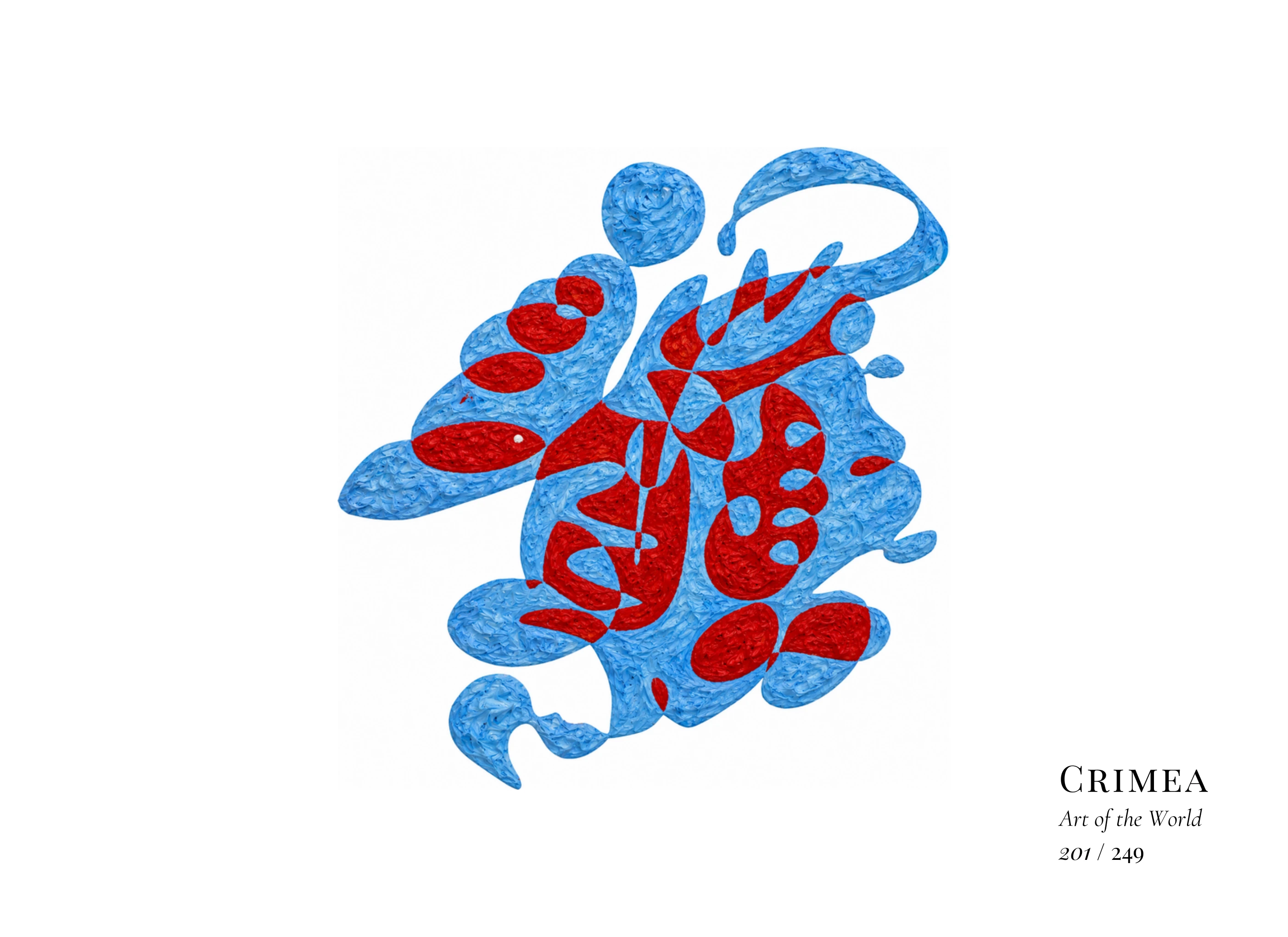
Description
The artwork reduces its palette to icy blue and intense crimson, producing an unusually concentrated visual argument. Red crescents, loops, wedges and enclosed forms press through a pale, heavily worked ground; some converge densely at the centre while others drift towards the perimeter. Long arcs and detached elements stretch the silhouette beyond its compact core. White space enters as active interruption rather than emptiness. The composition can be read as evoking accumulated memory: distinct layers remain visible, compressed into a structure whose tensions never erase its underlying coherence.
Cultural Context
Crimea projects into the Black Sea, joined to the Eurasian mainland by the narrow Isthmus of Perekop and marked by steppe in the north and mountains along its southern coast. Its history contains successive Scythian, Greek, Roman, Byzantine, Genoese and other presences, followed by the Crimean Khanate, closely connected with the Ottoman world. Incorporated into the Russian Empire in 1783, Crimea later formed part of the Soviet Union and was transferred to the Ukrainian SSR in 1954. Since 2014, the peninsula has been controlled by Russia while internationally recognised by most states as part of Ukraine.
Crimea’s cultural inheritance is correspondingly plural. Crimean Tatars, with their Turkic language and Islamic traditions, are indigenous to the peninsula and have maintained a powerful cultural identity despite the mass Soviet deportation of 1944 and later return. Ukrainian, Russian, Armenian, Greek, Karaite and other communities have also contributed to its historical fabric. Architecture, poetry, music, embroidery, cuisine and religious buildings preserve traces of these overlapping worlds, making cultural memory inseparable from successive encounters and continuities.