242 / 249
Donetsk People’s Republic
Identity Under Pressure
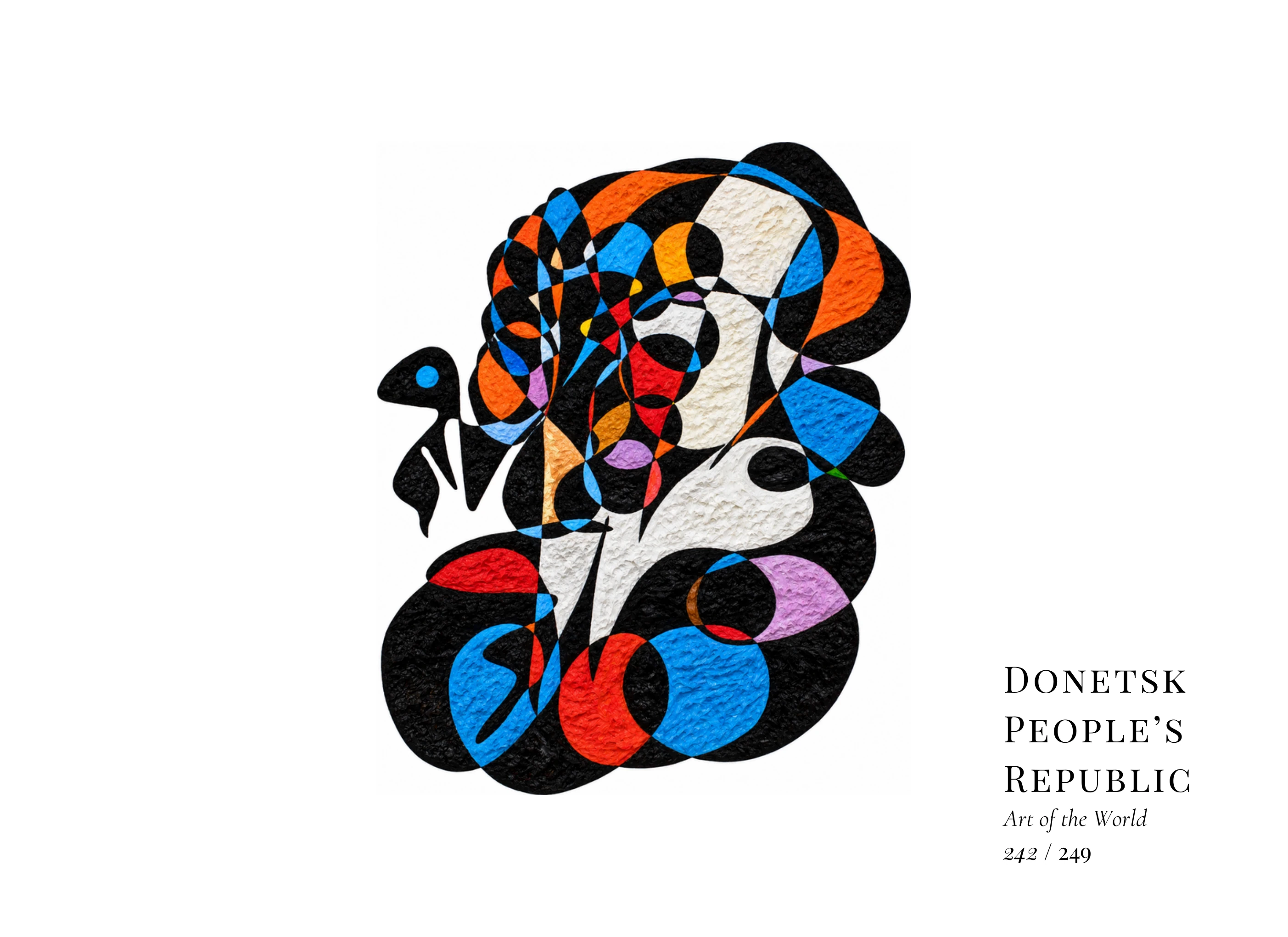
Description
The artwork is exceptionally dense, with black acting as both background and structural framework. Orange, blue, crimson, ivory and muted violet emerge through interlocking crescents, discs, wedges and narrow passages. Large pale forms provide temporary visual stability, yet they are repeatedly interrupted by darker divisions. A small detached figure-like configuration at the left intensifies the surrounding white space, while the central mass remains tightly compressed. The composition suggests identity under pressure: multiple forms coexist within a structure of continual interruption, their individuality preserved through contrast rather than uniformity.
Cultural Context
The Donetsk People’s Republic was proclaimed in 2014 in Ukraine’s Donetsk region, within the wider Donbas, a landscape of steppe, coalfields and heavily industrialised cities. Donbas developed rapidly from the nineteenth century through coal mining, metallurgy, railways and migration, becoming one of Eastern Europe’s major industrial regions. Russia announced the annexation of the Donetsk region in 2022, but this is not internationally recognised by most states, which continue to regard the territory as part of Ukraine.
The region’s cultural character reflects generations of Ukrainian, Russian and other communities shaped by urbanisation and industrial life. Ukrainian and Russian literary, musical and religious traditions have long intersected here, alongside the distinctive social culture of mining and manufacturing settlements. Theatre, monumental architecture, public sculpture and popular music became important elements of the modern urban landscape. Family histories and local attachments continue to give Donbas a powerful sense of place despite profound political change.