57 / 249
Faroe Islands
A Culture Built Against Distance
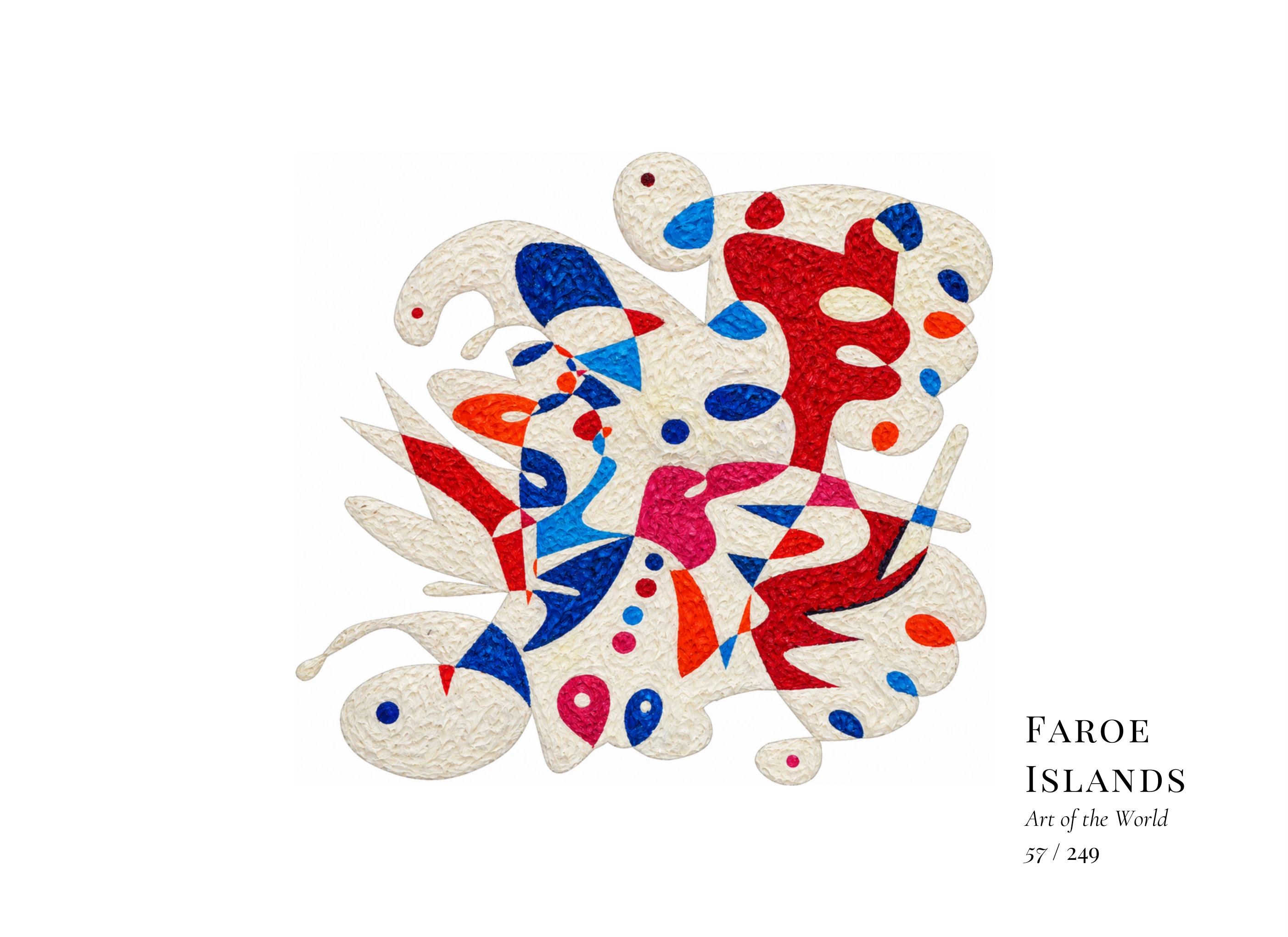
Description
The artwork is dominated by textured ivory, animated by intense crimson, turquoise, cobalt and magenta. Its irregular silhouette expands through hooks, blades, loops and isolated fragments, while coloured compartments accumulate around a dense central network. White negative spaces penetrate the structure, creating pauses within its energetic rhythm. Thick impasto gives even the pale passages substantial physical weight. The composition suggests cohesion without uniformity: dispersed forms remain bound by repeated colours and intersecting lines, evoking a culture whose strength has developed through connection across physical distance.
Cultural Context
The Faroe Islands form a North Atlantic archipelago of eighteen mountainous islands between Scotland, Iceland and Norway. Settled by Norse communities during the early medieval period, they developed a maritime society shaped by limited farmland, demanding seas and close connections with the wider Scandinavian world. The islands became associated with the Norwegian crown and later Denmark; today they are a self-governing territory within the Kingdom of Denmark, with extensive authority over their domestic affairs.
Faroese identity is anchored in the Faroese language, descended from Old Norse, and in a strong tradition of storytelling, ballads and communal performance. The chain dance preserves lengthy narrative songs through collective movement, while knitting, wool production, boatbuilding and vernacular grass-roofed architecture reflect generations of adaptation to the North Atlantic environment. Contemporary literature, music, visual art and design have extended these traditions into a confident modern culture.