34 / 249
French Polynesia
A Civilisation Written Across Water
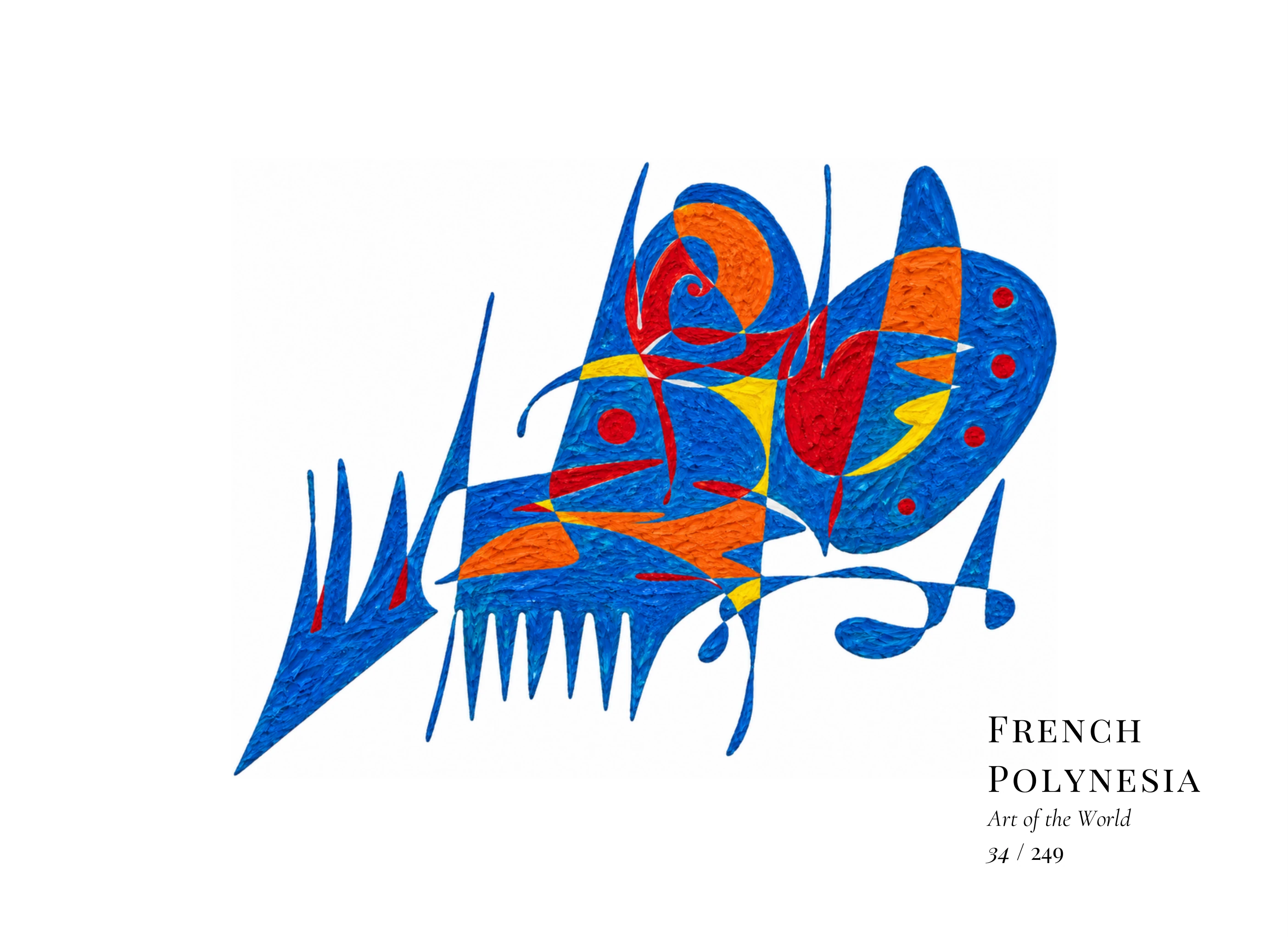
Description
The artwork is propelled by an intense field of blue, articulated by crimson, orange and small flashes of yellow. Curving internal forms contrast with long vertical needles, pointed lower extensions and detached elements that push decisively into the surrounding white. Dense impasto gives the blue physical depth, while repeated arcs and intersecting lines create a strong directional rhythm. The composition suggests connection across separation: its forms appear dispersed yet remain visually dependent upon one another, evoking a culture shaped by navigation, exchange and enduring relationships across immense distances.
Cultural Context
French Polynesia extends across a vast region of the South Pacific, comprising more than one hundred islands grouped into the Society, Tuamotu, Gambier, Austral and Marquesas archipelagos. Polynesian navigators settled these distant islands through sophisticated knowledge of stars, currents and winds, creating interconnected societies with distinctive political and sacred traditions. European contact intensified from the eighteenth century, followed by French colonial expansion; today French Polynesia is an overseas collectivity of France with substantial autonomy.
Its cultural identity draws strength from Tahitian, Marquesan, Paumotu and other Polynesian traditions. Indigenous languages coexist with French, while genealogy, oral history and knowledge of the ocean remain powerful sources of belonging. Dance, percussion, tattooing, wood and stone carving, weaving and canoe traditions preserve complex aesthetic vocabularies. Contemporary music, literature and visual culture continue to renew this inheritance across individual island communities.