131 / 249
Gagauzia
Continuity Through Many Worlds
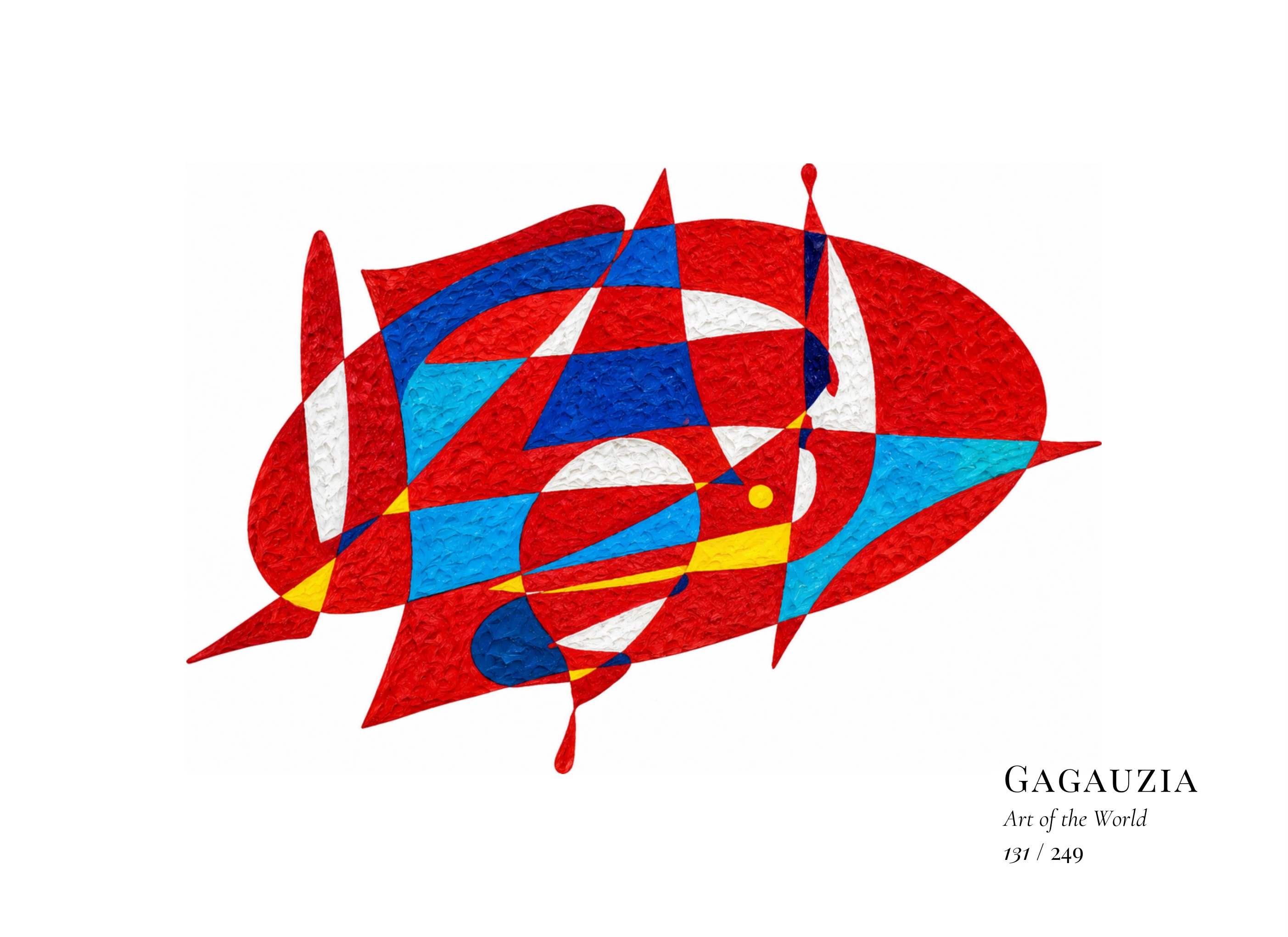
Description
The artwork is built from a powerful crimson structure crossed by brilliant blue, turquoise, white and small flashes of yellow. Broad curved bands are intersected by vertical blades, diagonals and narrow extensions, creating a tightly compressed geometry. Dense impasto intensifies every colour boundary, while pointed projections push the silhouette beyond its central mass. The composition suggests identity formed through convergence: contrasting elements remain distinct yet become inseparable within the whole, evoking a cultural inheritance sustained through adaptation without surrendering its particular character.
Cultural Context
Gagauzia is an autonomous territorial unit in southern Moldova, set within the rolling agricultural landscapes between the lower Danube and the Black Sea region. The Gagauz are a Turkic-speaking people whose historical formation reflects centuries of movement and cultural encounter across the Balkans and northern Black Sea. Many settled in Bessarabia during the nineteenth century under the Russian Empire. Following the dissolution of the Soviet Union and Moldova’s independence, Gagauzia received autonomous status in 1994.
Gagauz identity combines a Turkic linguistic inheritance with an Eastern Orthodox Christian tradition, creating a distinctive cultural synthesis. Gagauz, Romanian and Russian are used within the autonomous region. Oral storytelling, folk songs, dance, embroidery, woven textiles and traditional cuisine preserve communal memory, while contemporary literature and cultural institutions have strengthened the visibility of the Gagauz language and heritage.