73 / 249
Gaza Strip
Memory in a Compressed Landscape
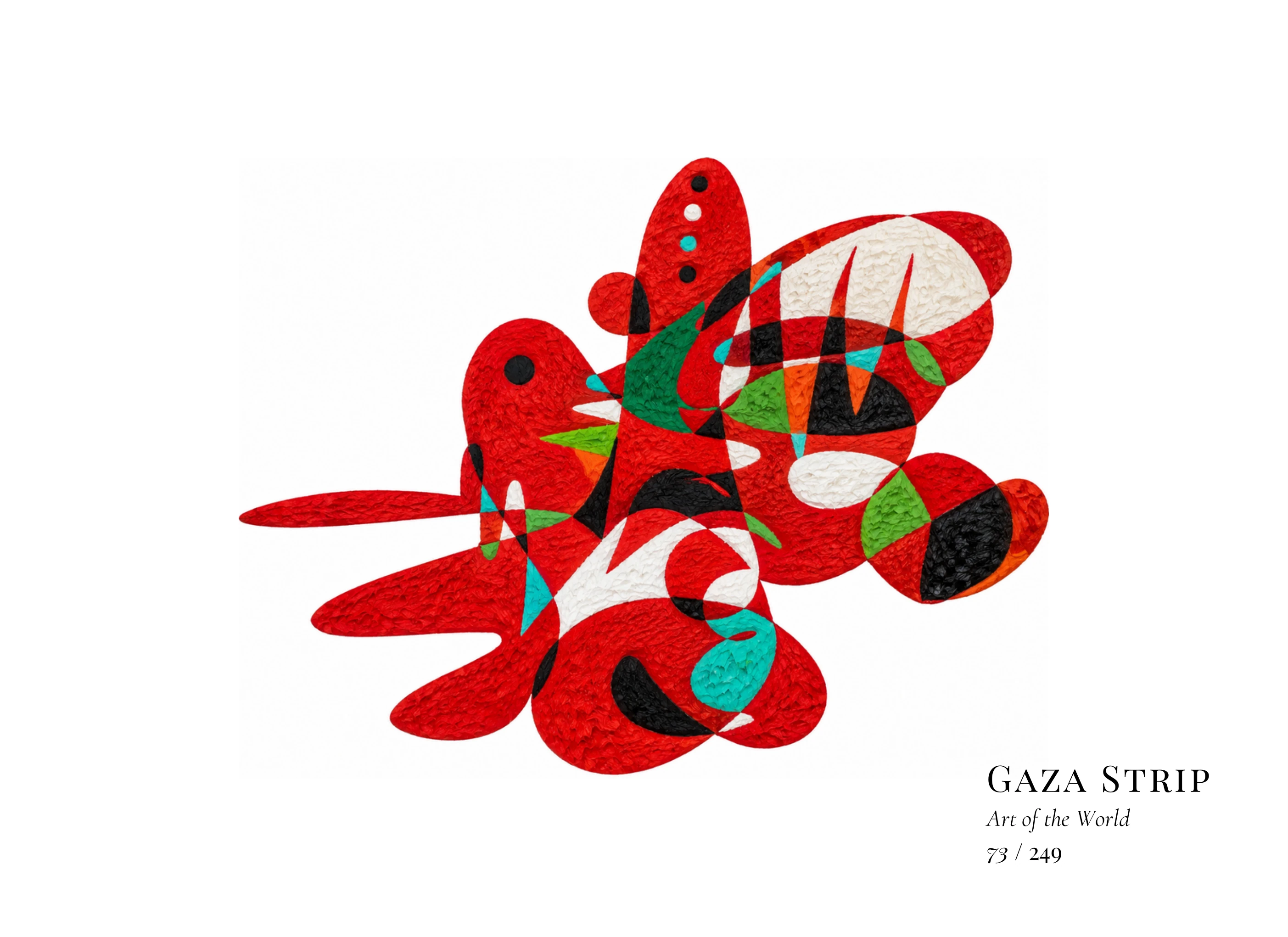
Description
The artwork concentrates crimson into a dense, irregular body crossed by black, white, turquoise and vivid green. Rounded compartments coexist with sharp wedges, narrow intersections and long horizontal extensions. Heavy impasto gives the red field exceptional physical intensity, while white openings and pale forms interrupt its visual weight. The composition suggests memory held within compression: distinct elements press closely together yet retain their individual contours, creating a rhythm of concentration, connection and persistence.
Cultural Context
The Gaza Strip is a narrow Mediterranean territory forming part of the Palestinian territories, bordered by Israel and Egypt. Its principal city, Gaza, has an ancient history shaped by its position on routes linking Egypt, the Levant and the wider Mediterranean. Canaanite, Hellenistic, Roman, Byzantine, Islamic and Ottoman periods contributed successive layers to its development. In the twentieth century Gaza came under British, Egyptian and Israeli administration; since 1994, Palestinian institutions have exercised varying degrees of governance, within a wider history that remains central to Palestinian national experience.
Gaza’s cultural identity belongs to the broader Palestinian and Arab heritage while retaining strong local traditions. Arabic is the principal language, and family histories, oral storytelling and poetry carry memories across generations. Embroidery, weaving, ceramics, cuisine, music and dabke dance connect Gaza with wider Palestinian culture. Historic mosques, churches, markets and domestic architecture testify to centuries of Mediterranean and Levantine exchange.