48 / 249
Gibraltar
The Intelligence of the Threshold
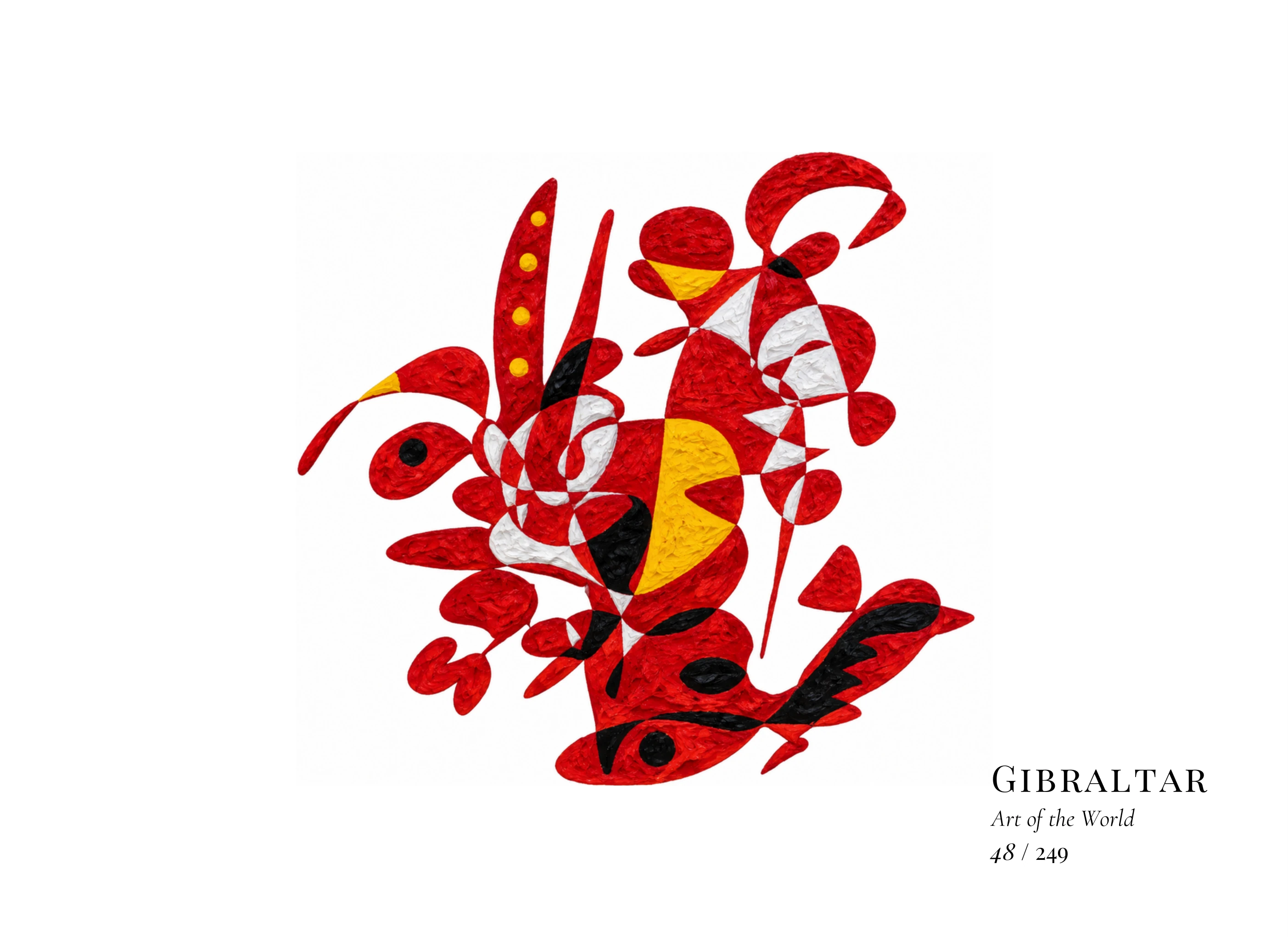
Description
The artwork concentrates its energy in a brilliant crimson field, punctuated by white, black and an emphatic yellow centre. Curved hooks, narrow blades and detached fragments continually extend beyond the compact body, making the surrounding white an active part of the composition. Dense impasto strengthens the physical force of each form, while sharp internal divisions counter the rounded silhouette. The work suggests the dynamics of a threshold: concentrated yet outward-facing, defined by the continual meeting of different directions, histories and cultural currents.
Cultural Context
Gibraltar occupies a limestone promontory at the southern edge of the Iberian Peninsula, commanding the narrow passage between the Mediterranean and Atlantic. Its strategic position has attracted successive Phoenician, Roman, Islamic and Spanish connections. Captured by Anglo-Dutch forces in 1704 and ceded to Britain under the Treaty of Utrecht in 1713, Gibraltar developed as an important fortified harbour and naval centre. Today it is a British Overseas Territory with its own elected government and a distinctive civic identity.
Gibraltarian culture reflects centuries of Mediterranean exchange. English is the official language, while Llanito—a local vernacular combining Andalusian Spanish with strong English influence—expresses the territory’s layered social history. British, Genoese, Maltese, Portuguese, Jewish, Spanish and North African inheritances have contributed to its character. Catholic, Anglican, Jewish, Muslim and Hindu communities form part of a remarkably plural cultural landscape, expressed through festivals, cuisine, music and everyday multilingual life.