112 / 249
Guam
Ancestry at the Pacific Crossroads
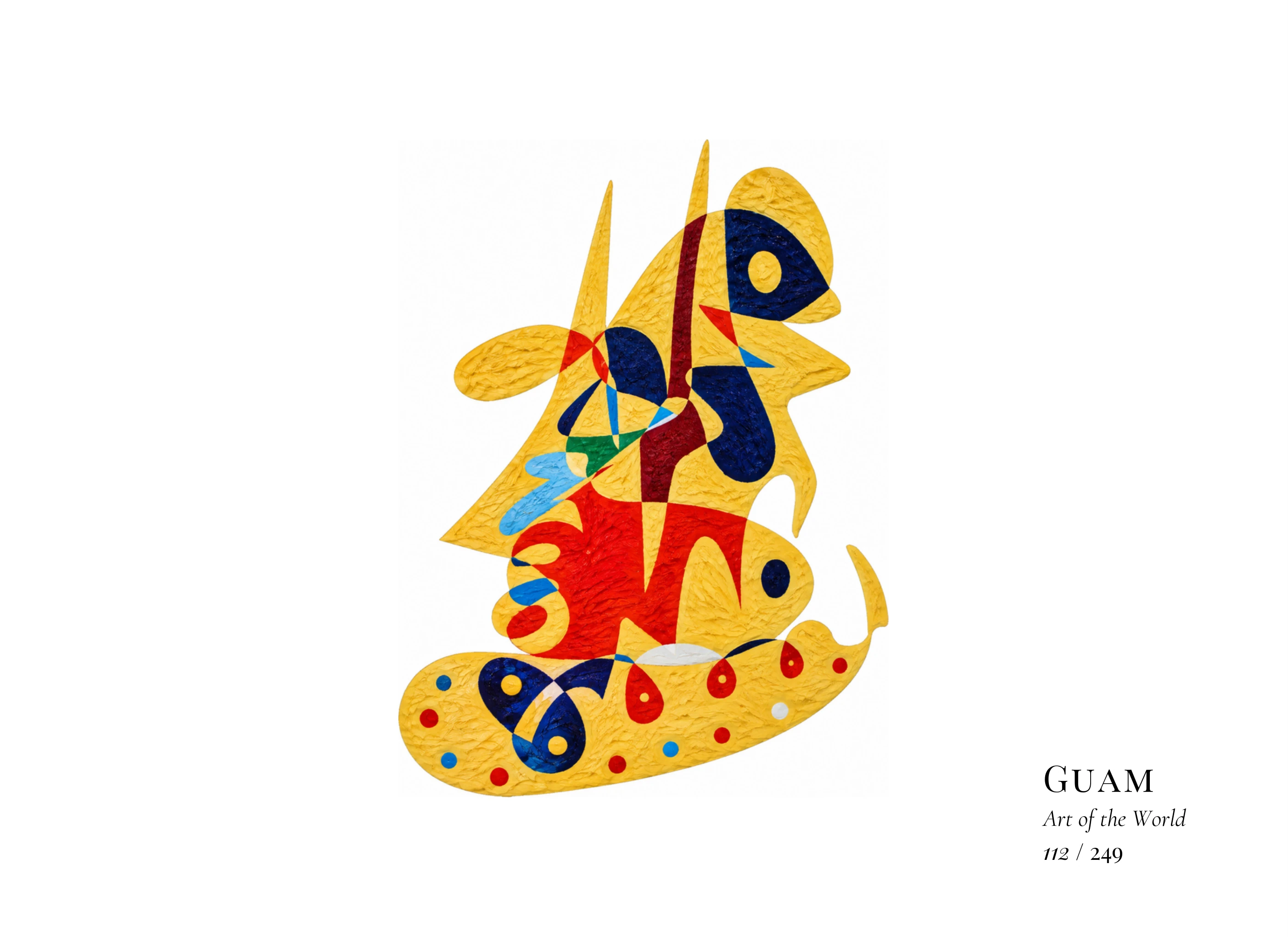
Description
The artwork is dominated by warm ochre, interrupted by deep indigo, crimson, turquoise and small accents of green and white. Its silhouette rises through tall pointed extensions before spreading into a long horizontal base, producing a striking balance between vertical aspiration and grounded weight. Curved compartments, circular inclusions and sharp internal divisions animate the dense impasto. Detached and projecting forms make the surrounding white space active. The composition suggests a culture shaped by successive encounters while retaining a powerful internal coherence: many visual languages coexist without dissolving the structure that holds them together.
Cultural Context
Guam is the largest and southernmost of the Mariana Islands, rising from the western Pacific between East Asia and Micronesia. CHamoru settlement reaches back more than three millennia, producing sophisticated communities whose monumental latte-stone architecture remains a defining archaeological inheritance. Spanish rule began in the seventeenth century, followed by American administration from 1898, interrupted during the Second World War. Today Guam is an unincorporated territory of the United States with a distinct indigenous and island identity.
CHamoru culture remains central to Guam through language, kinship, customary values and enduring relationships with land and sea. Spanish, Filipino, Micronesian, Asian and American influences have contributed further dimensions to contemporary life. Weaving, carving, dance, chant, storytelling and culinary traditions sustain collective memory, while festivals and cultural institutions strengthen the transmission of CHamoru heritage across generations.