80 / 249
Hawaii
The Intelligence of Ancestral Navigation
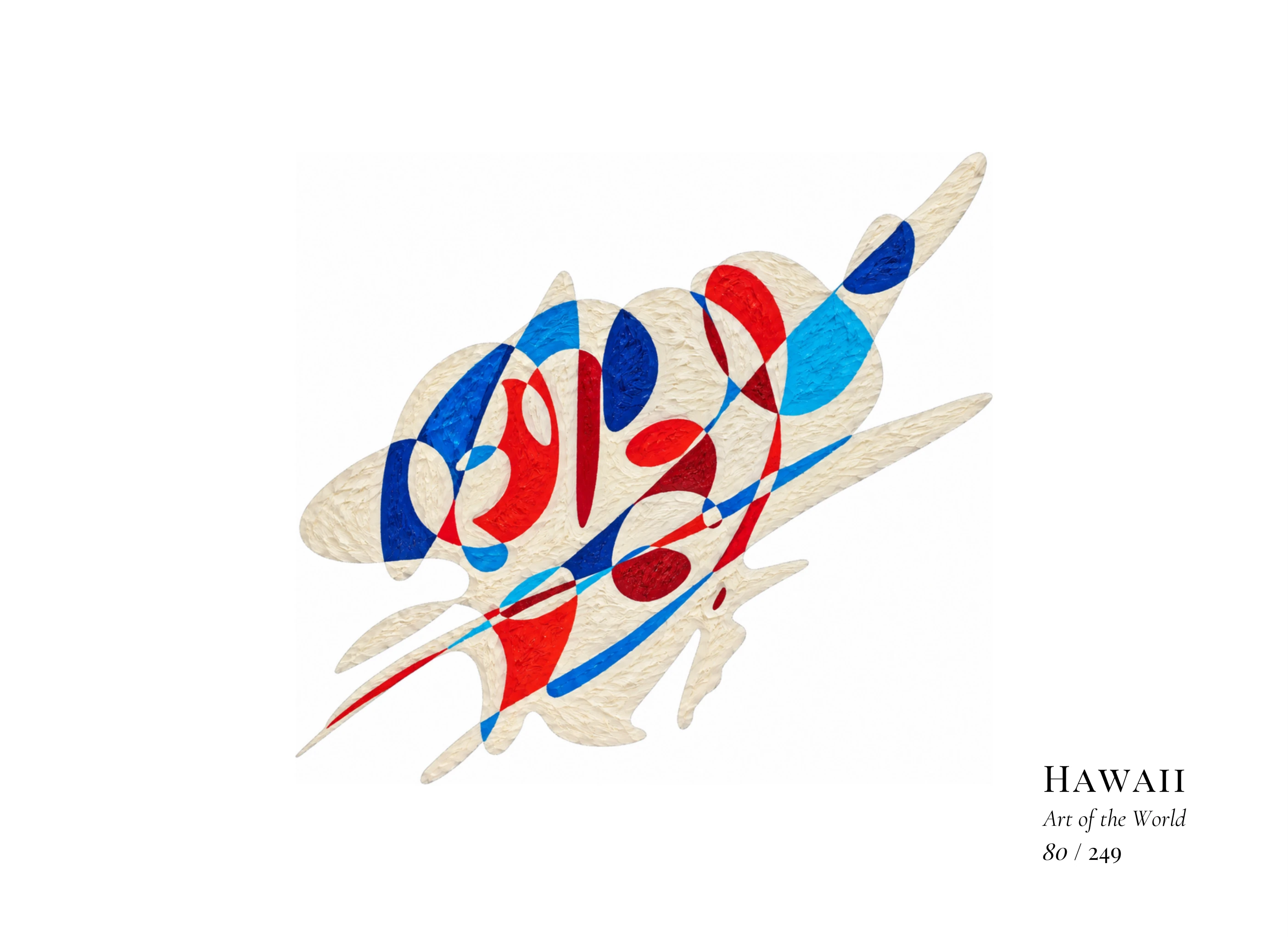
Description
The artwork is dominated by luminous ivory, crossed by cobalt, turquoise and concentrated crimson. Its elongated diagonal silhouette gives the composition exceptional directional energy, reinforced by fine pointed extensions and narrow intersecting lines. Rounded internal forms counter these sharp trajectories, creating a rhythm between enclosure and outward movement. Dense impasto gives the pale ground material presence while the surrounding white remains distinctly open. The work suggests orientation through relationships: separate shapes repeatedly align, cross and redirect one another, evoking navigation as both inherited knowledge and a broader principle of cultural continuity.
Cultural Context
Hawaii is an archipelago in the central Pacific formed by volcanic activity over millions of years. Polynesian voyagers settled the islands centuries before European arrival, developing an organised society sustained by sophisticated agriculture, fishing, navigation and systems of land stewardship. The Hawaiian Kingdom emerged as a unified state under Kamehameha I in 1810 and developed international diplomatic and commercial relations. Following profound political change in the nineteenth century, Hawaii was annexed by the United States in 1898 and became its fiftieth state in 1959.
Native Hawaiian culture is grounded in ʻōlelo Hawaiʻi, genealogy, relationships with land and ocean, and traditions of collective responsibility. Chant, hula, oral history and navigation preserve complex bodies of knowledge, while kapa making, featherwork, carving and weaving demonstrate highly developed artistic practices. A major Hawaiian cultural renaissance from the twentieth century strengthened language education, voyaging traditions, music and indigenous scholarship. Hawaii’s contemporary culture also reflects Asian, Pacific and American communities whose histories have become part of island life.