29 / 249
Ilirida
The Politics of Cultural Continuity
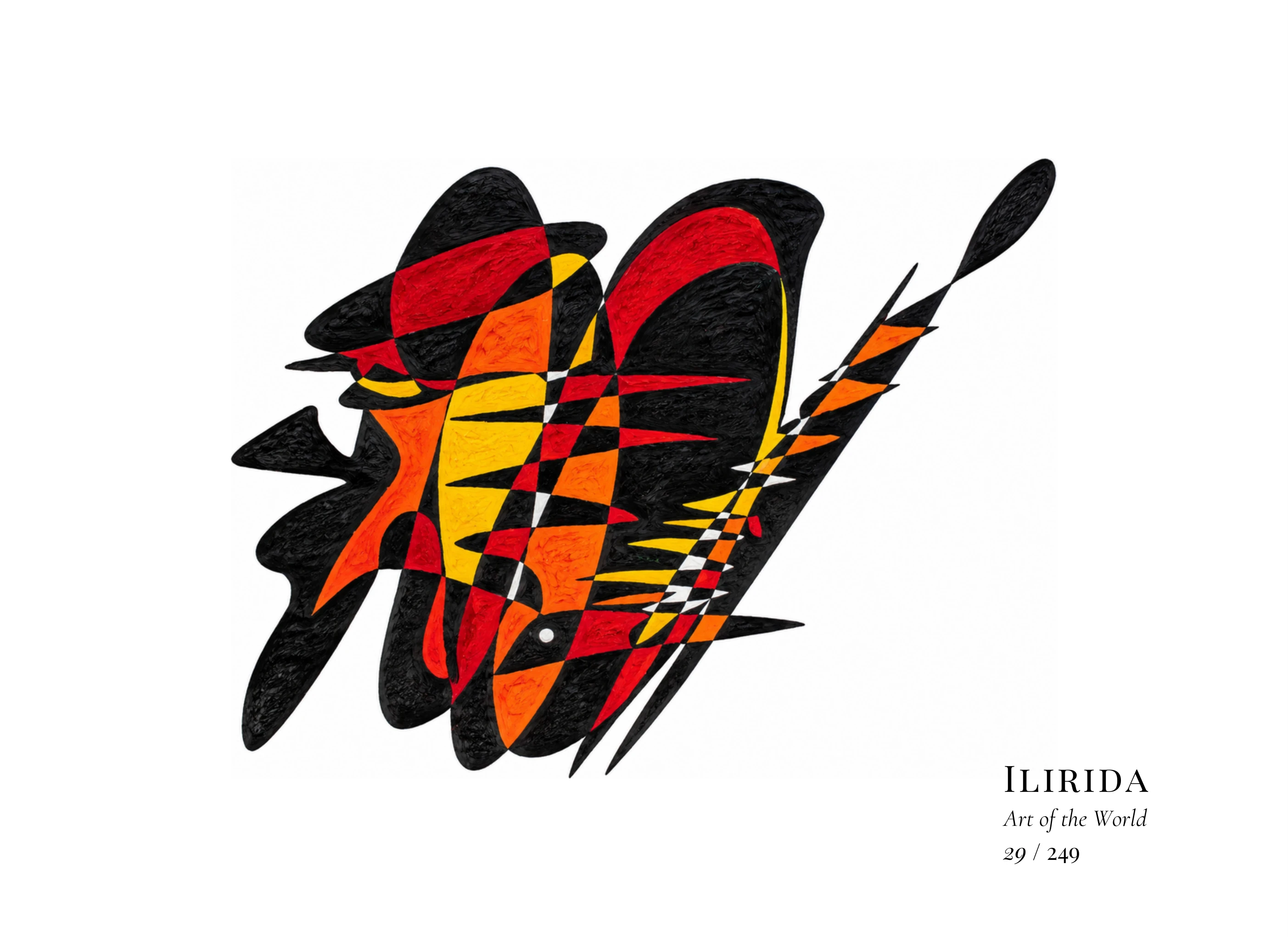
Description
The artwork is dominated by dense black, illuminated by crimson, orange and brilliant yellow. Interlocking compartments create an almost armoured central structure, while narrow diagonals, pointed extensions and a detached upper-right form propel the silhouette outward. White accents appear sparingly, sharpening the internal geometry. The heavy impasto intensifies every division, yet repeated colours bind the fragments together. The work suggests identity constructed through persistence: difference, compression and movement coexist within a structure that remains unmistakably cohesive.
Cultural Context
Ilirida is the name given to a proposed Albanian autonomous entity associated with western and north-western areas of present-day North Macedonia. The concept emerged during the dissolution of Yugoslavia, when questions of political representation, language and constitutional status became especially prominent. Following an unofficial referendum among ethnic Albanians in 1992, activists proclaimed the Republic of Ilirida at Struga. It did not acquire international recognition or established territorial sovereignty, but remains part of the political history surrounding Albanian aspirations for autonomy and representation in North Macedonia.
The cultural setting associated with Ilirida is rooted primarily in the Albanian communities of North Macedonia. Albanian language, oral poetry, folk music, dance, embroidery and family traditions contribute to a heritage connected both to the western Balkans and the wider Albanian cultural world. Towns including Tetovo, Gostivar and Struga have long reflected multilingual and religiously diverse histories, where Albanian, Macedonian, Turkish and other cultural influences have intersected.