81 / 249
Islamic State
The Anatomy of Absolutism
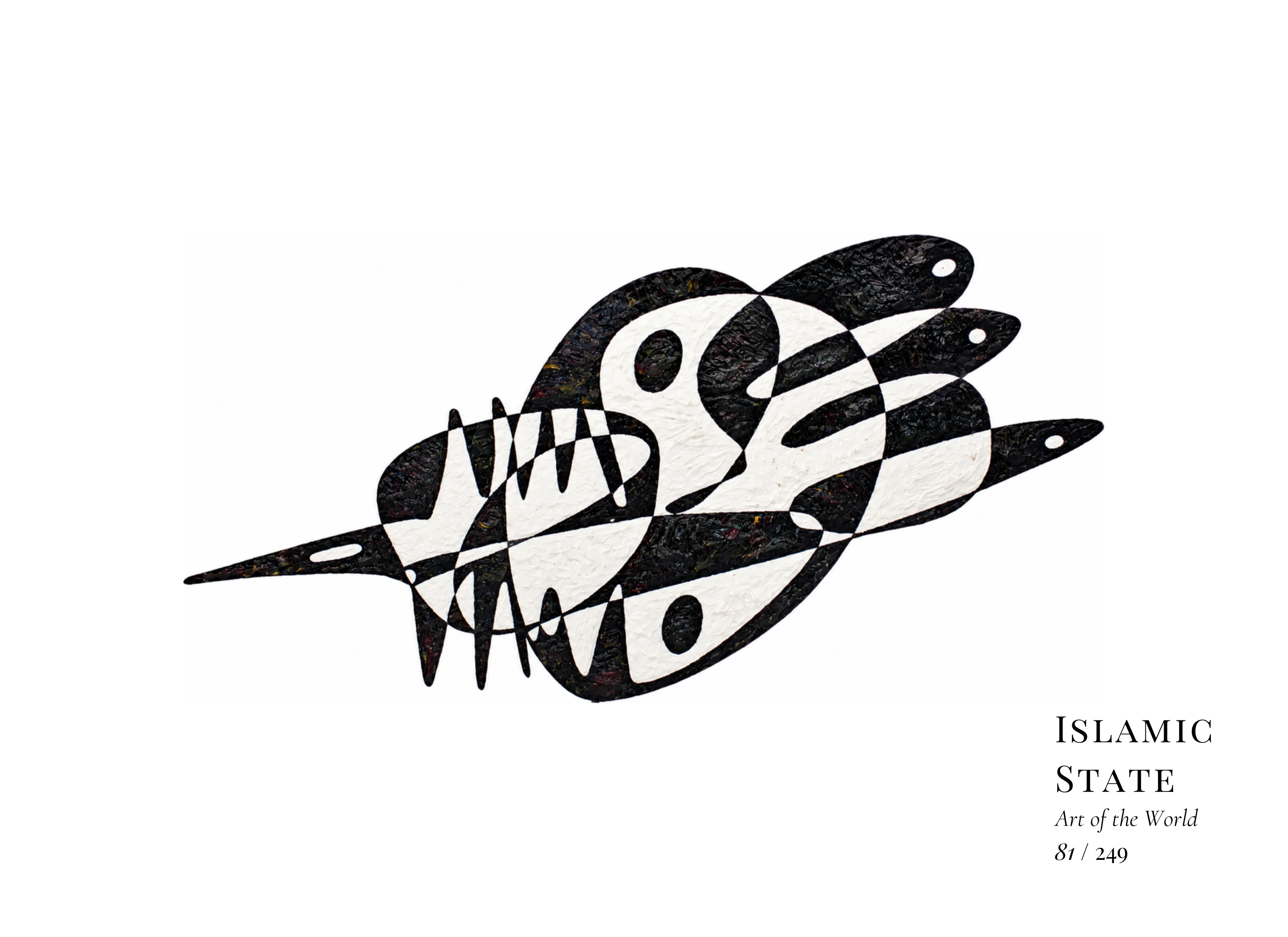
Description
The artwork adopts an unusually restricted black-and-white palette. Thick impasto gives both colours equal material force, while sweeping curves, pointed projections, enclosed circles and alternating bands create a tightly interlocked structure. The silhouette stretches horizontally, its sharp extremities contrasting with a dense central body. Repeated divisions produce a severe visual rhythm, yet white passages continually interrupt the darkness. The composition can be read as an exploration of absolutism and fracture: apparent binary opposition becomes internally unstable, divided by crossings, reversals and competing geometries.
Cultural Context
The Islamic State was not an internationally recognised country, but a self-declared polity created by an extremist organisation that seized territory across parts of Iraq and Syria during the 2010s. Emerging from the upheavals that followed the Iraq War and the Syrian civil war, it proclaimed a “caliphate” in 2014. At its height it controlled major towns, transport routes and archaeological landscapes, but subsequently lost its territorial holdings through campaigns by local and international forces. Its rise remains part of the modern history of Iraq, Syria and the wider Middle East.
The territories it occupied contained exceptionally diverse and ancient cultures, including Arab, Kurdish, Assyrian, Yazidi, Turkmen and other communities, with Muslim, Christian and Yazidi religious traditions among them. Arabic, Kurdish, Syriac and other languages belong to this cultural landscape. Literature, music, architecture, manuscripts, archaeological heritage and oral traditions testify to histories extending across millennia and far beyond the brief existence of the self-declared state.