33 / 249
Jammu and Kashmir
A Palimpsest of Civilisations
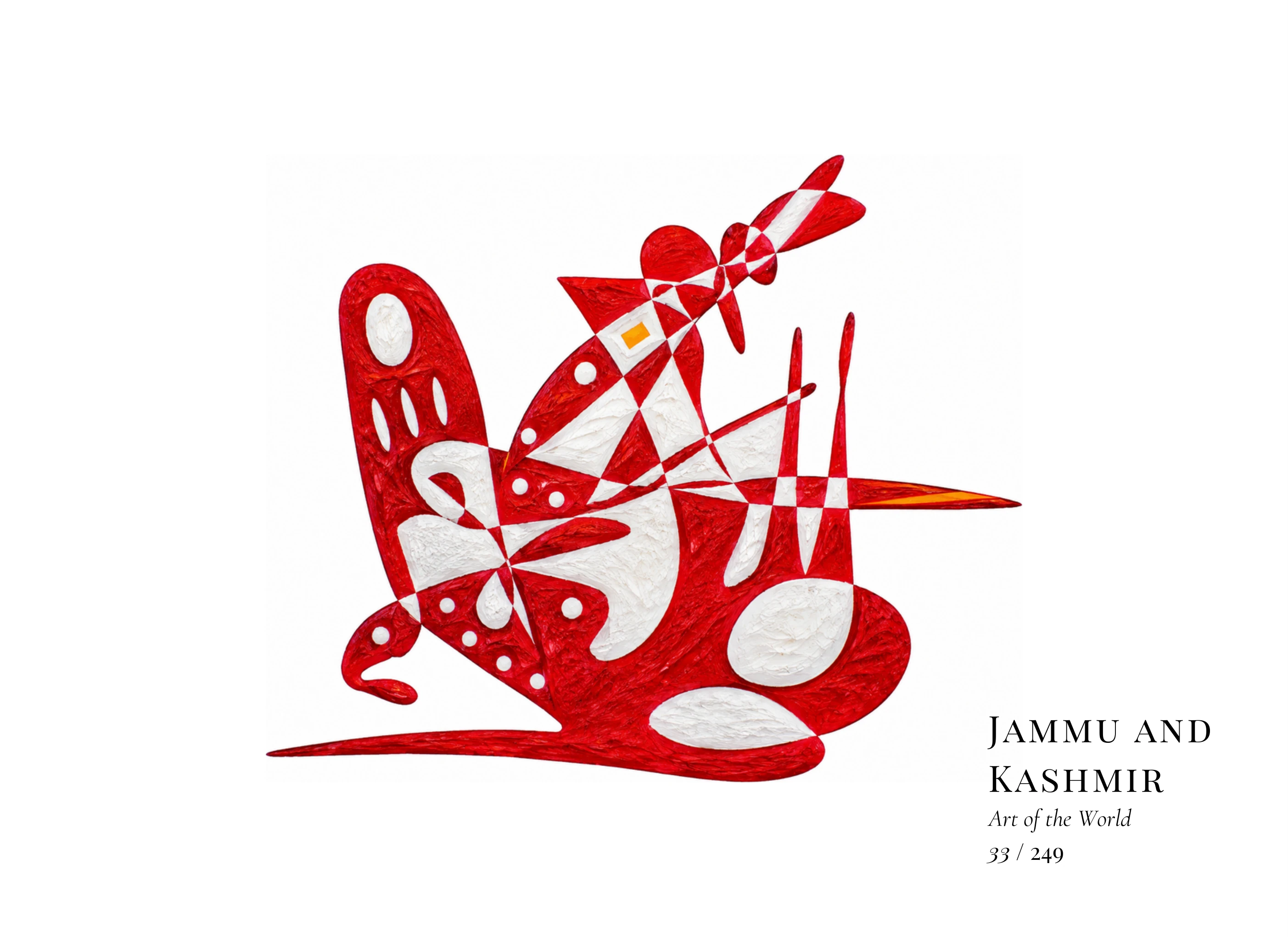
Description
The artwork reduces its visual world almost entirely to crimson and white. Dense impasto gives both colours substantial physical presence, while sweeping curves, pointed extensions and intersecting diagonals create a restless internal geometry. Large pale forms provide temporary calm before being divided by fine red lines and narrow projections. Detached elements and elongated points activate the surrounding white space. The composition can be read as a palimpsest: layers overlap without disappearing, suggesting a cultural landscape whose richness lies in the continued presence of many histories within a single, complex field.
Cultural Context
Jammu and Kashmir occupies a historically significant Himalayan region where South Asia meets Central and Inner Asia. Mountain ranges, high valleys and river systems shaped communities connected by pilgrimage, trade and scholarship. Across centuries the region experienced Hindu and Buddhist traditions, powerful Kashmiri kingdoms, Islamic sultanates, Mughal and Afghan rule, the Sikh Empire and the Dogra dynasty. Since 1947, the wider former princely state has been divided between areas administered by India, Pakistan and China; Jammu and Kashmir is today a union territory administered by India.
Its cultural inheritance is exceptionally plural. Kashmiri, Dogri, Urdu, Hindi, Gojri, Pahari and other languages reflect varied communities and histories. Sanskrit scholarship, Sufi poetry and the traditions of Kashmir Shaivism contributed to an influential intellectual heritage. Carpet weaving, shawl making, wood carving, papier-mâché, embroidery, music and architecture demonstrate remarkable craftsmanship, while oral traditions preserve memory across valleys and generations.