20 / 249
Jersey
A Constitution Shaped by Continuity
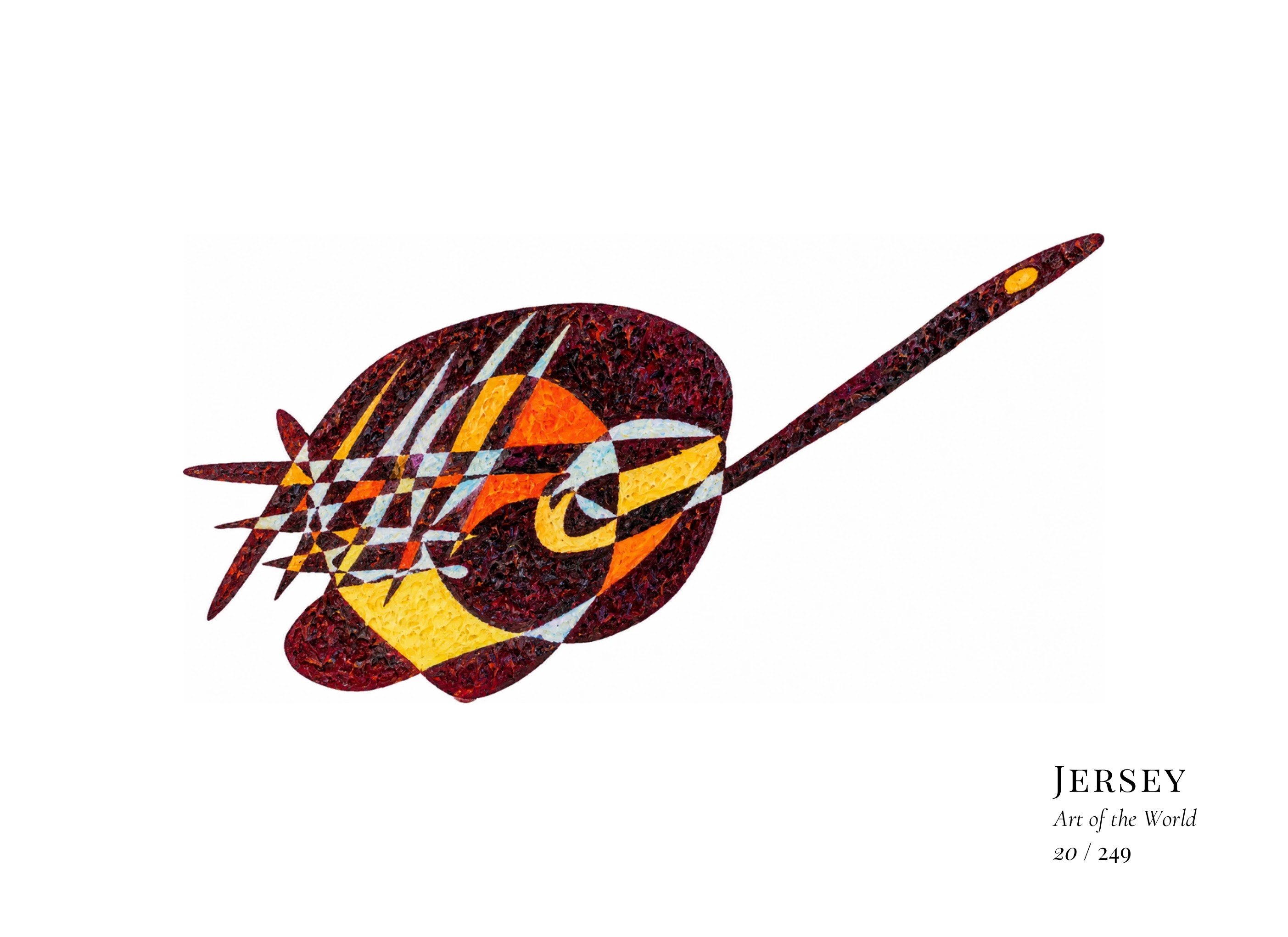
Description
The artwork is dominated by deep burgundy, crossed by a complex lattice of ivory, orange and yellow. Diagonal lines repeatedly intersect the rounded central body, creating an unusually intricate internal architecture. Bright compartments emerge through the darker field, while fine pointed extensions gather at one end and an extraordinary narrow projection stretches far beyond the opposite edge. Dense impasto gives the geometry physical weight despite its directional speed. The composition suggests continuity maintained through structure: crossings, divisions and competing trajectories are held within a coherent visual order, evoking an identity sustained through centuries of adaptation without surrendering its institutional distinctiveness.
Cultural Context
Jersey is the largest of the Channel Islands, lying close to the coast of Normandy while maintaining a constitutional relationship with the British Crown. Its political inheritance reaches back to the medieval Duchy of Normandy; when mainland Normandy passed from English control in the thirteenth century, Jersey remained attached to the English Crown while preserving its own institutions. Today it is a self-governing Crown Dependency with an independent legal system, parliament and distinctive constitutional traditions.
Jersey’s culture combines Norman, British and maritime inheritances. English and French have long shaped public life, while Jèrriais, the island’s traditional Norman language, remains an important expression of local identity. Stone architecture, farming, fishing and seafaring traditions reflect the island’s historical economy. Literature, folklore, music and contemporary cultural initiatives continue to preserve and reinterpret its linguistic and communal inheritance.
Exhibition Context
A dark rounded form anchors a long, narrow point projecting far into white space; gridded colour gathers around its centre. Small Jersey is not visually made small here: its reach is longer than its body. That disproportion offers a way to see an island with a Norman constitutional inheritance connected to the British Crown and wider maritime networks. The pointed projection is no identifiable ship or causeway, but it gives the painting the feeling of a local identity reaching into a larger world.