162 / 249
Karakalpakstan
A Culture of Enduring Forms
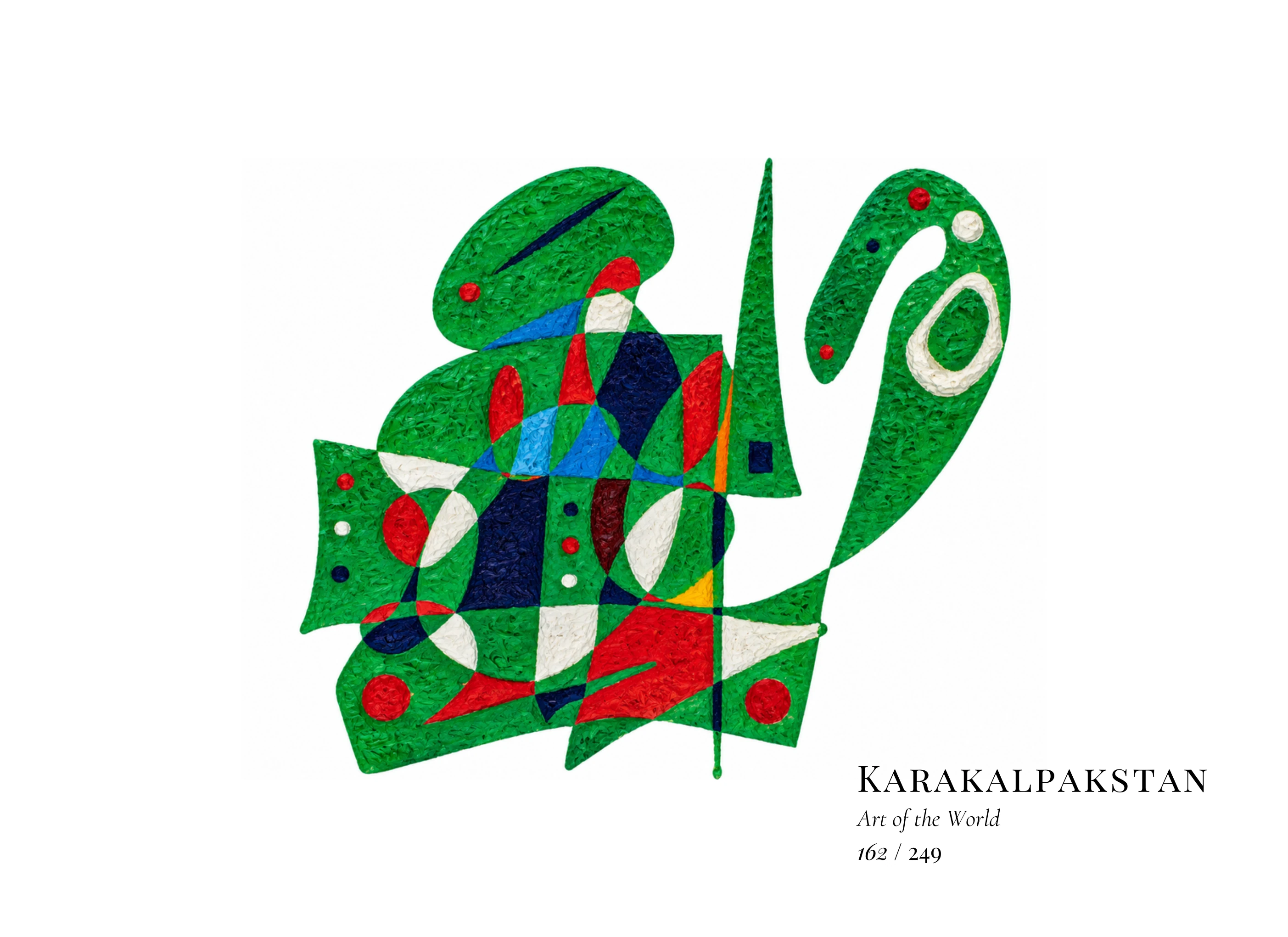
Description
The artwork is dominated by vivid green, structured by crimson, deep blue, turquoise and white. Broad irregular masses interlock with pointed verticals, circular accents and a striking detached form on the right. Dense impasto gives the green field exceptional continuity, while contrasting compartments create an internal rhythm of separation and return. White negative space cuts deeply through the silhouette, making distance part of the composition. The work suggests cultural endurance through changing environments: distinct forms remain connected by a visual structure that is flexible, expansive and firmly held together.
Cultural Context
Karakalpakstan is an autonomous republic within Uzbekistan, occupying the country’s north-west around the lower Amu Darya and the southern reaches of the Aral Sea. Its landscape of delta, desert and ancient settlement lies within a historic corridor connecting Central Asian societies. Karakalpak communities developed through interactions among Turkic and steppe peoples, while the wider region preserves important archaeological traces of Khwarazmian civilisation. Karakalpakstan became part of the Uzbek Soviet Socialist Republic in 1936 and retains autonomous status within independent Uzbekistan.
Karakalpak identity is sustained through the Karakalpak language, closely related to Kazakh and Nogai, alongside Uzbek and other languages. Oral epics, poetry and music preserve extensive historical memory, while embroidery, weaving, jewellery, yurt decoration and traditional dress reveal a highly developed ornamental culture. Nukus is internationally known for its remarkable museum collections and has become an important centre for preserving regional heritage and twentieth-century art.