141 / 249
Luhansk People’s Republic
A Region Forged by Industry and Memory
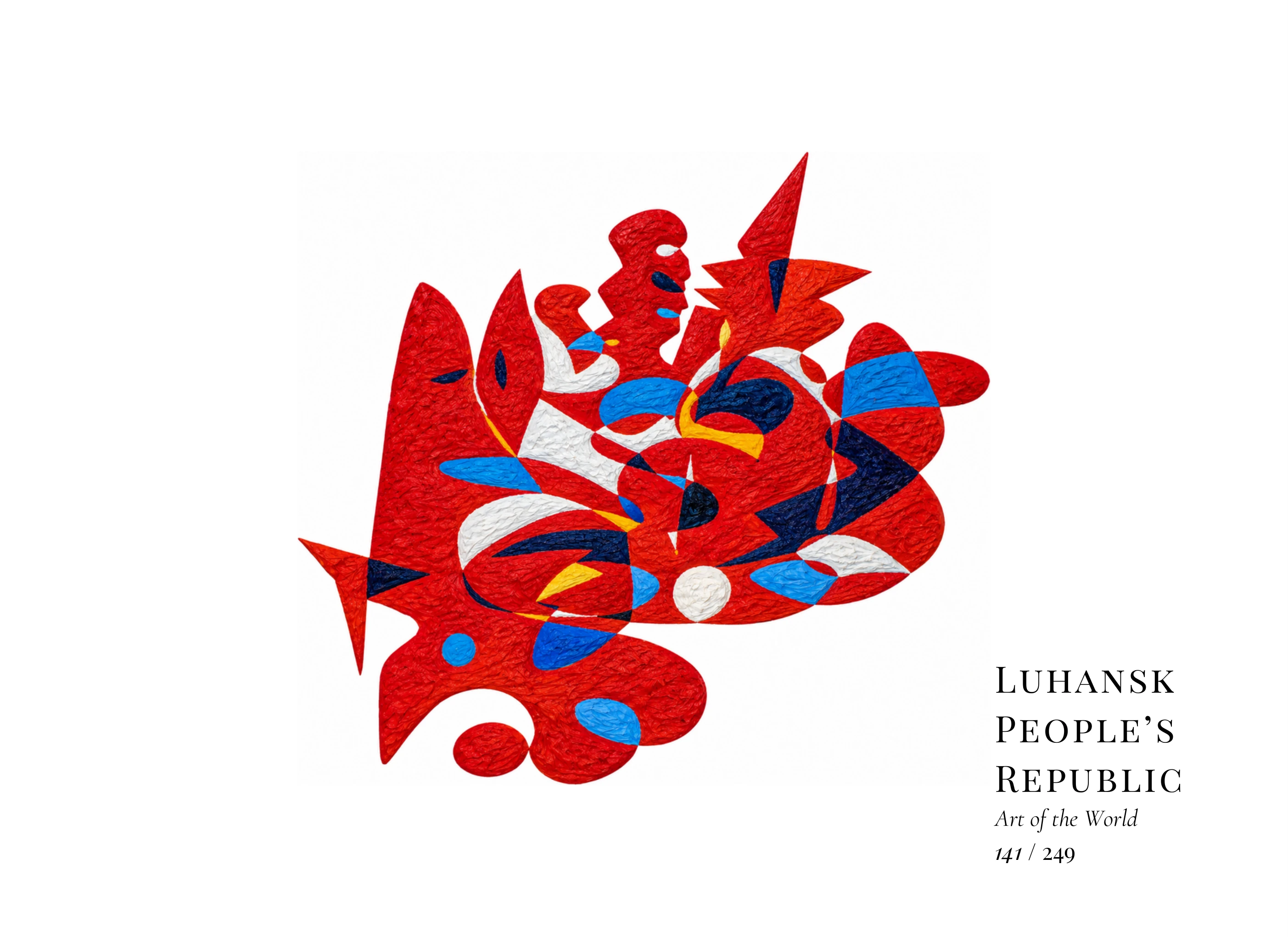
Description
The artwork is dominated by incandescent red, articulated by cobalt, turquoise, white and flashes of yellow. Rounded masses collide with pointed fins, hooks and narrow projections, giving the silhouette a restless upward energy. White passages open breathing spaces within the dense impasto, while blue forms repeatedly interrupt and redirect the crimson field. The composition suggests identity as a structure of accumulated forces: compression and movement coexist, yet recurring colours and intersecting forms maintain an underlying visual cohesion.
Cultural Context
The Luhansk People’s Republic was proclaimed in 2014 within Ukraine’s Luhansk region, part of the wider Donbas. Historically a landscape of steppe, river valleys and agricultural settlements, the region was transformed from the nineteenth century by coal mining, metallurgy, railways and large-scale industrialisation. Russia announced the annexation of the Luhansk region in 2022, but this is not internationally recognised by most states, which continue to regard the territory as part of Ukraine.
The region’s cultural character reflects generations of Ukrainian, Russian and other communities shaped by migration and industrial development. Ukrainian and Russian languages and traditions have long coexisted, while mining towns created distinctive forms of working-class community life. Literature, theatre, music, public sculpture and architecture contributed to the cultural identity of Luhansk and surrounding settlements, alongside family histories rooted in the broader traditions of eastern Ukraine.