26 / 249
Mount Athos
The Discipline of Sacred Continuity
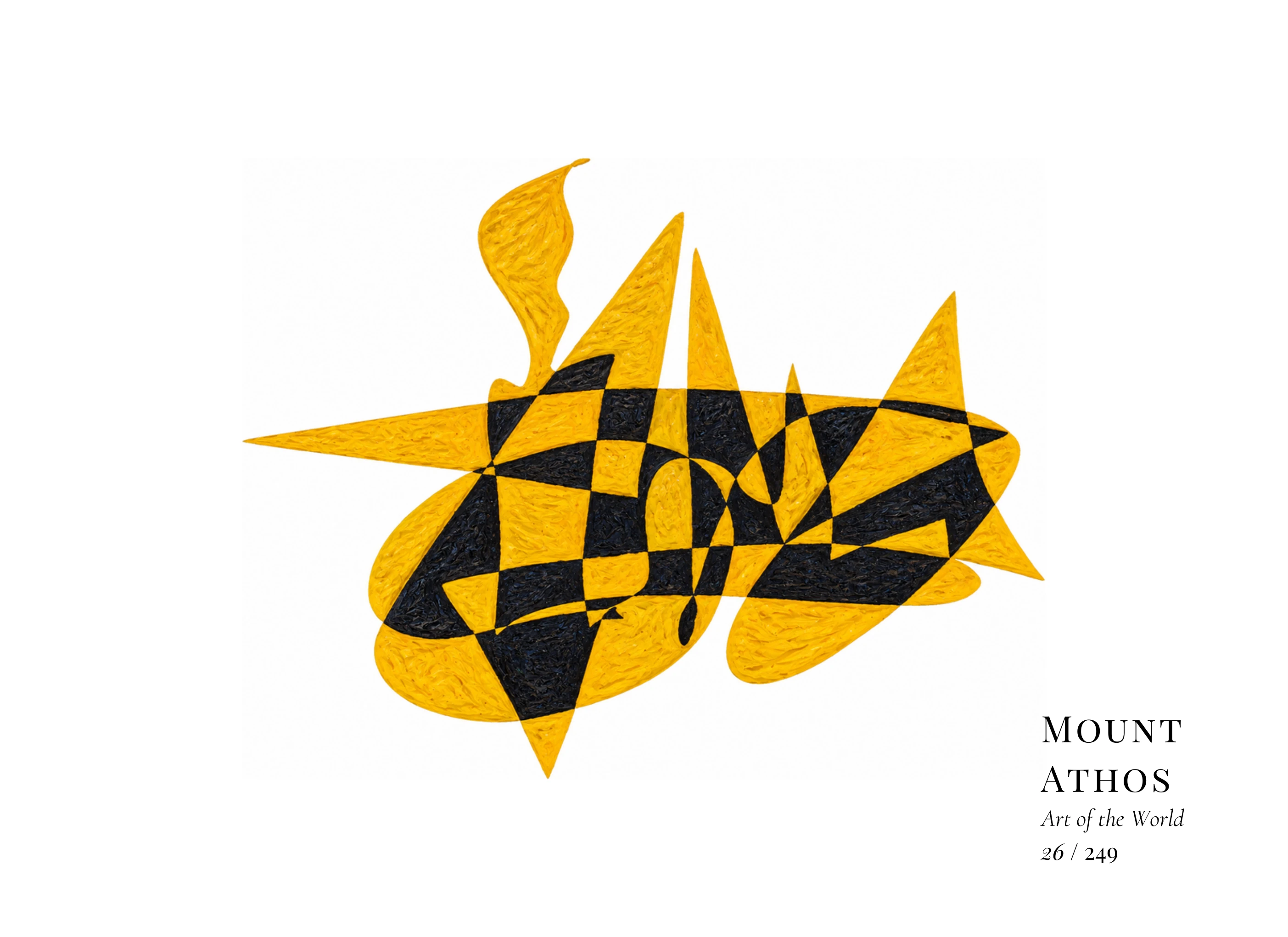
Description
The artwork adopts a strikingly restricted palette of golden yellow and black. Broad fields are divided into angular compartments, intersecting bands and sharply pointed forms, while tall vertical extensions rise above the dense horizontal body. Heavy impasto gives the two colours almost architectural solidity. The severe chromatic contrast is balanced by irregular curves and asymmetrical divisions, preventing the structure from becoming rigid. The composition suggests disciplined continuity: variation occurs within a powerful governing order, evoking a cultural world whose vitality has been sustained through repetition, concentration and enduring forms of practice.
Cultural Context
Mount Athos occupies the easternmost peninsula of Chalkidiki in northern Greece, projecting into the Aegean beneath the mountain from which it takes its name. Known as the Autonomous Monastic State of the Holy Mountain, it has been a major centre of Eastern Orthodox monasticism for more than a millennium. Byzantine emperors granted privileges to its monasteries, and despite successive political transformations, Athos preserved an exceptional degree of religious and institutional continuity. Today it remains a self-governing monastic territory under Greek sovereignty.
Its cultural importance extends far beyond its small population. Greek, Serbian, Bulgarian, Georgian, Romanian, Russian and other Orthodox traditions have contributed to its monastic inheritance. The monasteries preserve remarkable collections of Byzantine and post-Byzantine icons, illuminated manuscripts, metalwork, textiles, frescoes and ecclesiastical architecture. Chant, calligraphy and manuscript scholarship remain part of a living spiritual culture shaped by contemplation, discipline and continuity.