249 / 249
Nagorno-Karabakh
Inheritance Across Boundaries
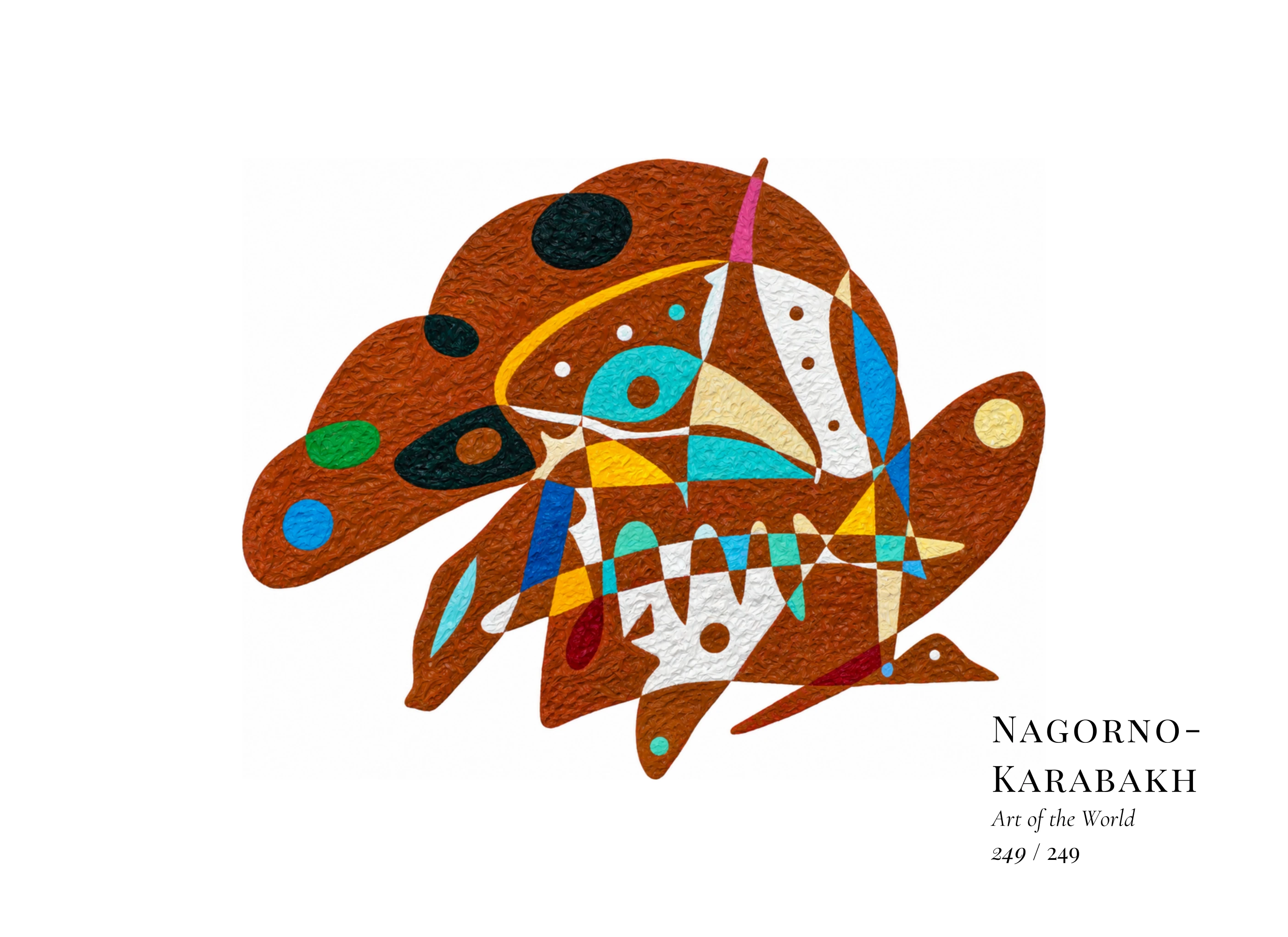
Description
The artwork is grounded in an unusually dominant field of earthy brown, animated by turquoise, blue, white, yellow, green and dark accents. Rounded masses overlap with narrow projections, arcs and a dense central network of divided forms. Heavy impasto makes the surface appear almost geological, while isolated circles and small coloured fragments create a dispersed visual rhythm. White passages open through the compact structure, preventing its many intersections from closing completely. The composition can be read as an image of accumulated memory: distinct forms remain visible while continually entering, crossing and reshaping a larger, interconnected whole.
Cultural Context
Nagorno-Karabakh is a mountainous region of the South Caucasus whose historical landscape reflects centuries of Armenian, Azerbaijani, Persian, Russian and wider Caucasian connections. Its highlands contain ancient settlements, monasteries, fortifications and routes linking communities across a complex geographical crossroads. The region’s modern political history has been profoundly contested; today it is internationally recognised as part of Azerbaijan, while its Armenian cultural inheritance remains an important dimension of its historical memory.
The cultural landscape carries traditions shaped by Armenian and Azerbaijani communities and by the broader Caucasus. Religious architecture, stone carving, manuscript culture, carpet weaving, music, poetry and oral storytelling form part of this layered inheritance. Churches, mosques, cemeteries and historic settlements testify to different periods of settlement and cultural expression, giving the region a heritage whose significance extends beyond any single historical moment.