23 / 249
New Caledonia
The Grammar of an Archipelago
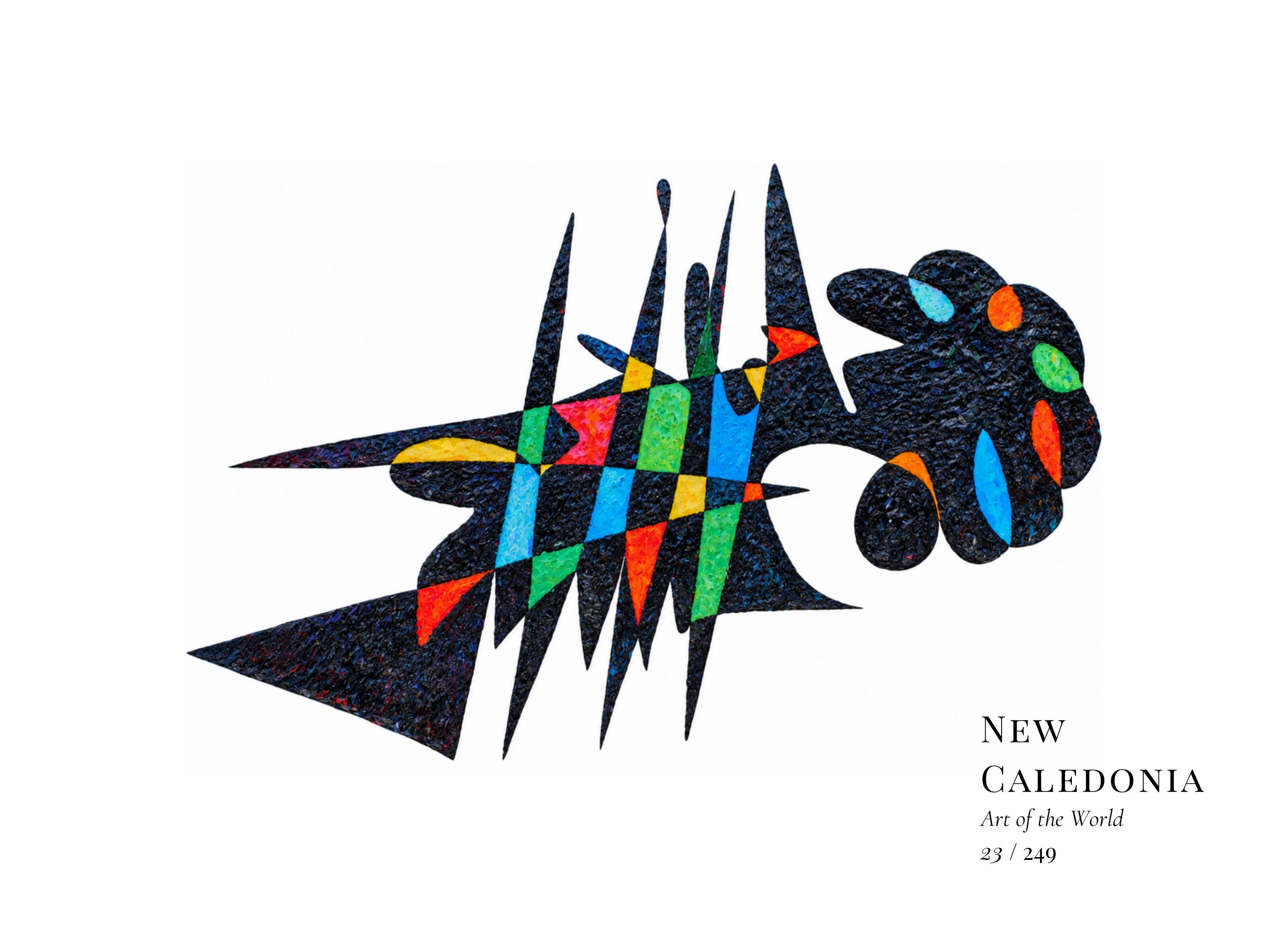
Description
The artwork is dominated by near-black blue, broken by concentrated passages of turquoise, green, orange, yellow and pink. A central grid of irregular compartments creates a compressed structural core from which long pointed extensions project vertically and horizontally. To the right, rounded clustered forms counterbalance the sharp geometry, while large areas of white isolate the silhouette and intensify its rhythm. Thick impasto gives even the darkest passages considerable physical energy. The composition suggests plurality held within a shared structure: contrasting forms remain distinct yet interconnected, evoking an archipelagic identity shaped by both separation and enduring cultural exchange.
Cultural Context
New Caledonia lies in the south-west Pacific, east of Australia, comprising Grande Terre and numerous surrounding islands. Long inhabited by Kanak communities, its history developed through distinctive clan societies and extensive Pacific exchange. France took possession in 1853, and the territory later evolved towards substantial political autonomy within the French Republic, shaped by continuing dialogue over identity and its institutional future.
Kanak culture remains fundamental to New Caledonia’s identity, alongside communities of European, Polynesian and Asian heritage. More than two dozen Kanak languages coexist with French. Oral history, customary ceremony, carved architecture, sculpture, weaving, dance and contemporary creative practice sustain connections between ancestry, community and place while contributing to a culturally plural Pacific society.