49 / 249
Norfolk Island
A Small Island, Many Inheritances
Description
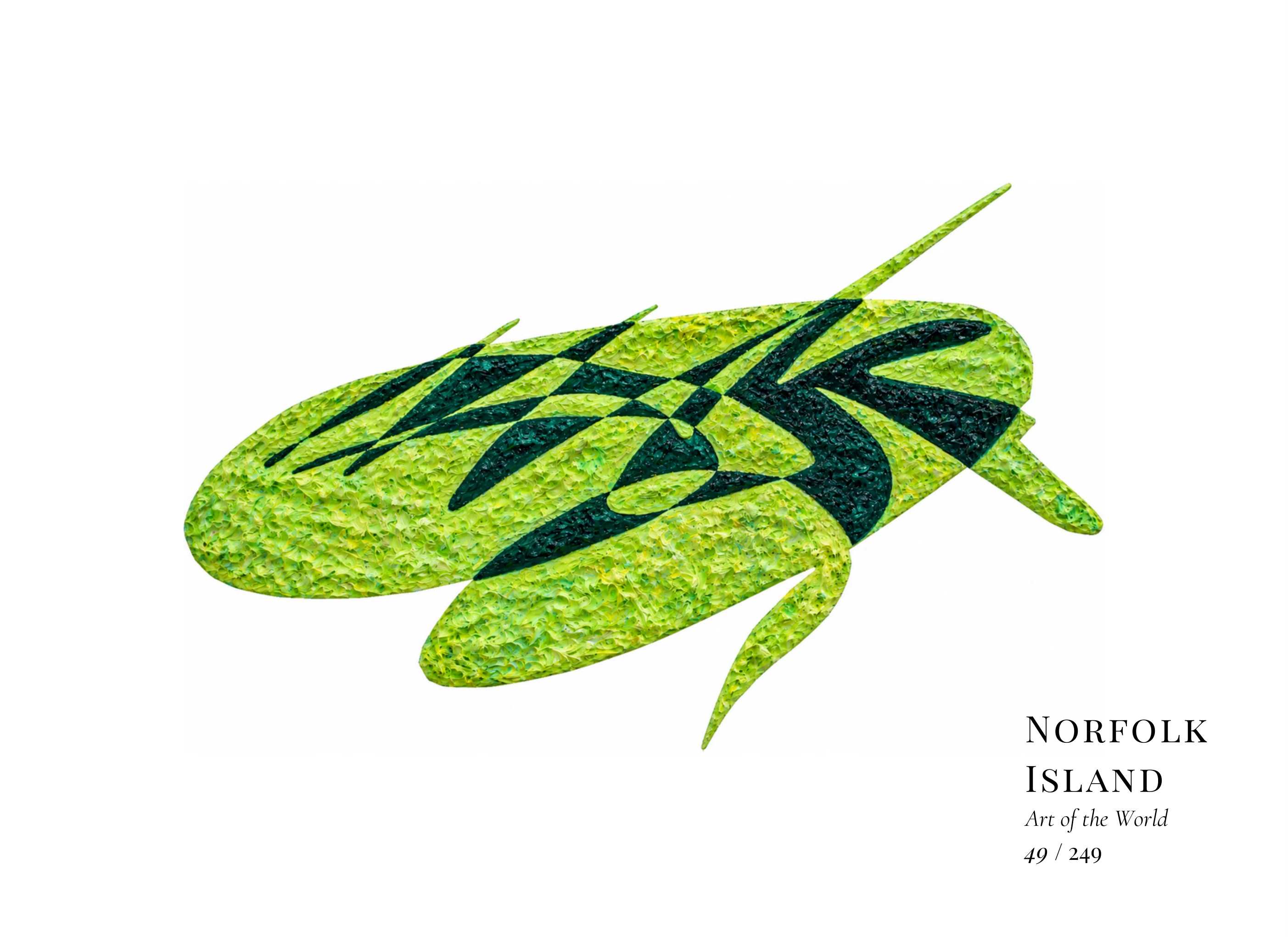
The artwork is remarkably restrained, built almost entirely from pale green and deep blue-green. Its broad horizontal silhouette is crossed by sharp diagonals, curved compartments and exceptionally long, narrow extensions. Dense impasto gives the limited palette considerable depth, while the dark internal geometry creates a branching visual rhythm across the lighter ground. The absence of additional colours intensifies the work’s coherence. Its interlocking divisions can be read as an image of concentrated identity: multiple inheritances gathered within a small physical space, held together by strong internal connections while projecting decisively outward.
Cultural Context
Norfolk Island lies in the South Pacific between Australia, New Zealand and New Caledonia. Earlier Polynesian settlement preceded British occupation, after which the island became associated with colonial penal settlements. In 1856 descendants of the Bounty mutineers and their Tahitian companions arrived from Pitcairn Island, establishing a community whose history remains central to Norfolk Island’s distinctive identity. Today it is an external territory of Australia.
The island’s culture combines Polynesian, Pitcairn and British inheritances. English and Norf’k, a language shaped principally by English and Tahitian, express this layered history. Family traditions, oral storytelling, music, craft, commemorative practices and local cuisine sustain a strong sense of community, while the island’s historic architecture and cultural landscape preserve connections between generations.