119 / 249
Northern Mariana Islands
Memory Carried Across Generations
Description
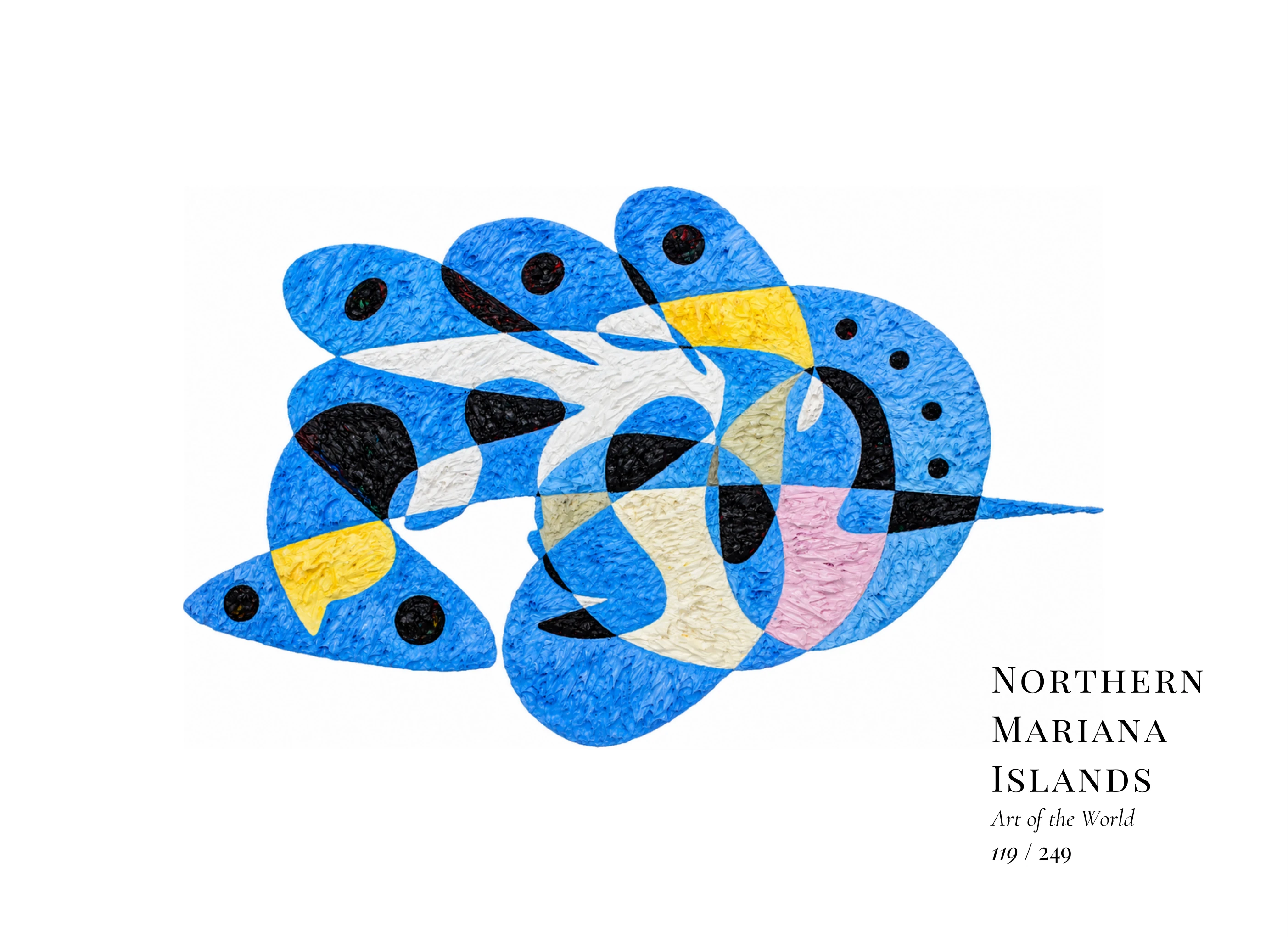
The artwork is dominated by luminous blue, organised through overlapping rounded forms and broad passages of white. Black circular and crescent-like elements create strong visual punctuation, while pale yellow, cream and pink introduce quieter tonal intervals. The dense impasto gives the composition an almost tidal physical rhythm. Curves repeatedly intersect and separate, with a long fine extension carrying the structure outward to the right. White negative spaces penetrate the central mass rather than simply surrounding it. The work suggests an identity formed through continuity and movement, where distinct cultural memories remain visible within an interconnected island world.
Cultural Context
The Northern Mariana Islands form a Pacific archipelago stretching north from Guam. Indigenous Chamorro settlement reaches deep into Pacific history, later joined by Carolinian communities whose migrations added another enduring cultural inheritance. Spanish, German and Japanese administrations preceded the islands’ post-war association with the United States; today they form a self-governing US commonwealth with their own local institutions.
Chamorro and Carolinian traditions remain central to the islands’ cultural identity alongside a diverse contemporary population. Chamorro, Carolinian and English are widely recognised languages, while navigation knowledge, oral history, dance, weaving, food traditions and communal celebrations sustain connections between ancestry and present-day life. Archaeological latte stones provide an especially significant material record of early Chamorro society.