222 / 249
Novorossiya
A Historical Name Recast
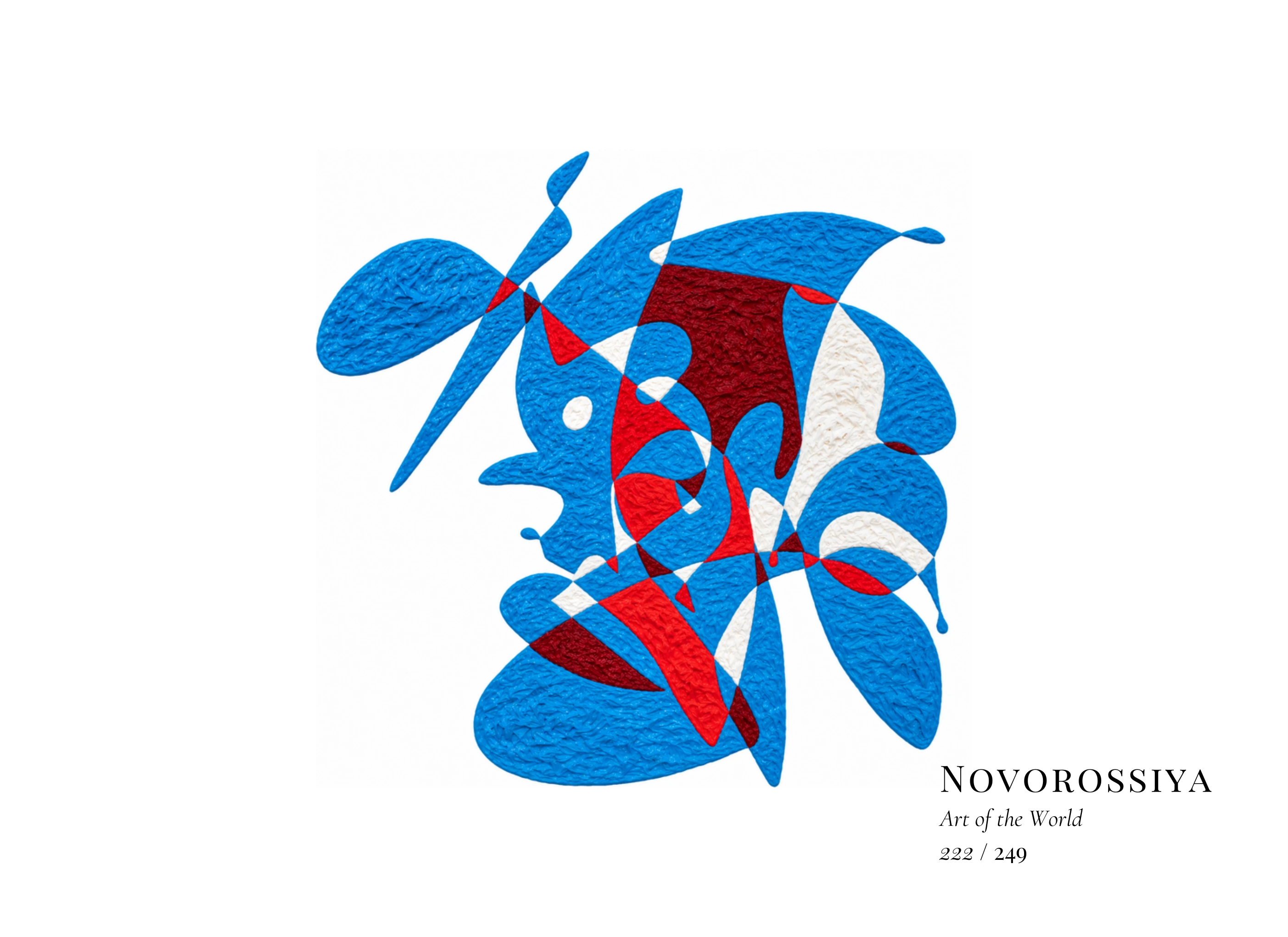
Description
The artwork is dominated by brilliant blue, interrupted by deep burgundy, red-orange and sharply defined white. Rounded masses collide with pointed projections, narrow extensions and tightly interlocking internal divisions. Heavy impasto gives the blue field remarkable physical density, while white openings and detached forms keep the silhouette visually unsettled. A dark central block anchors the composition, yet surrounding curves continually penetrate and fragment it. The structure can be read as evoking a contested idea assembled from overlapping histories: visually forceful, internally divided and resistant to any simple or singular interpretation.
Cultural Context
Novorossiya, or “New Russia”, originated as an imperial Russian designation for territories north of the Black Sea incorporated during the eighteenth century. The term covered changing administrative boundaries and gradually receded from official use. It re-emerged prominently in 2014 as a political concept associated with Russian-backed separatist movements in parts of eastern and southern Ukraine, without becoming an internationally recognised state.
The territories associated with the modern concept belong to a culturally complex region shaped by Ukrainian, Russian, Greek, Jewish, Tatar and other communities. Ukrainian and Russian linguistic traditions, industrial cities, Black Sea commerce, literature, music and architecture reflect generations of exchange and migration. The name therefore carries historical and political meanings rather than describing a single, separate cultural tradition.