109 / 249
Pitcairn Islands
Inheritance at the Edge of the Pacific
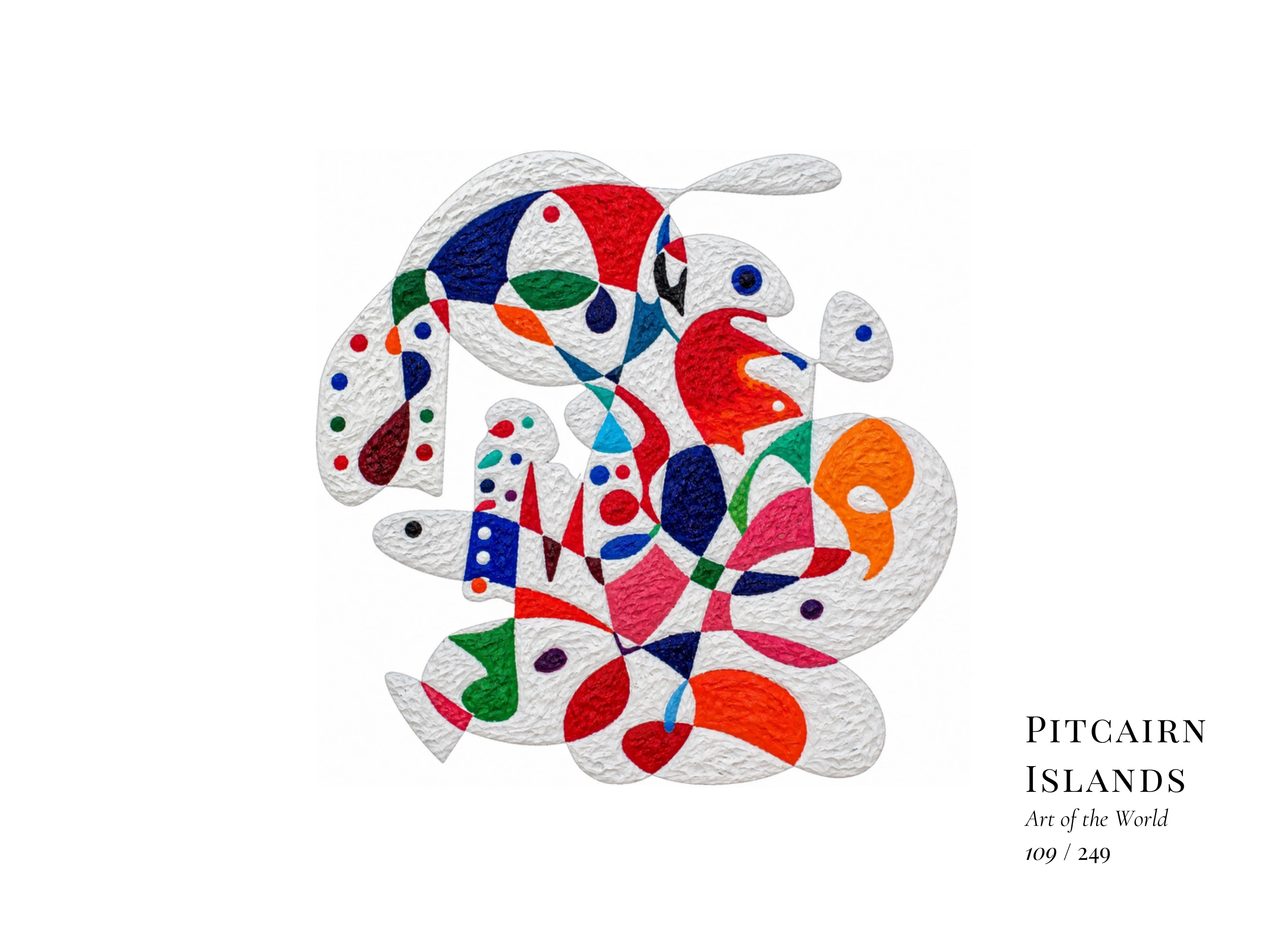
Description
The artwork is built around a textured white field animated by crimson, orange, green, blue, violet and pink. Rounded compartments gather into a dense, irregular silhouette, while narrow bridges connect forms that sometimes appear almost detached. Small coloured circles punctuate larger masses, producing a rhythm of concentration and dispersal. Heavy impasto unifies the many internal divisions, while surrounding white space gives each extension unusual clarity. The composition suggests a community formed through convergence: separate histories, journeys and inheritances brought into close relationship within a geographically isolated world.
Cultural Context
The Pitcairn Islands form a remote British Overseas Territory in the southern Pacific, comprising Pitcairn, Henderson, Ducie and Oeno. Polynesian peoples inhabited the islands centuries before European arrival, leaving archaeological evidence of wider regional exchange. Pitcairn was settled permanently in 1790 by Bounty mutineers and their Tahitian companions, whose descendants established the community from which the territory’s modern identity developed.
Pitcairn culture combines Polynesian and British inheritances within an exceptionally small island community. English and Pitkern, derived principally from eighteenth-century English and Tahitian, preserve this distinctive history. Family memory, storytelling, music, carving, weaving, food traditions and maritime knowledge remain important expressions of belonging. The island’s cultural identity is also sustained through strong connections with descendants living overseas.