95 / 249
Sahrawi Arab Democratic Republic
Identity Beyond the Horizon
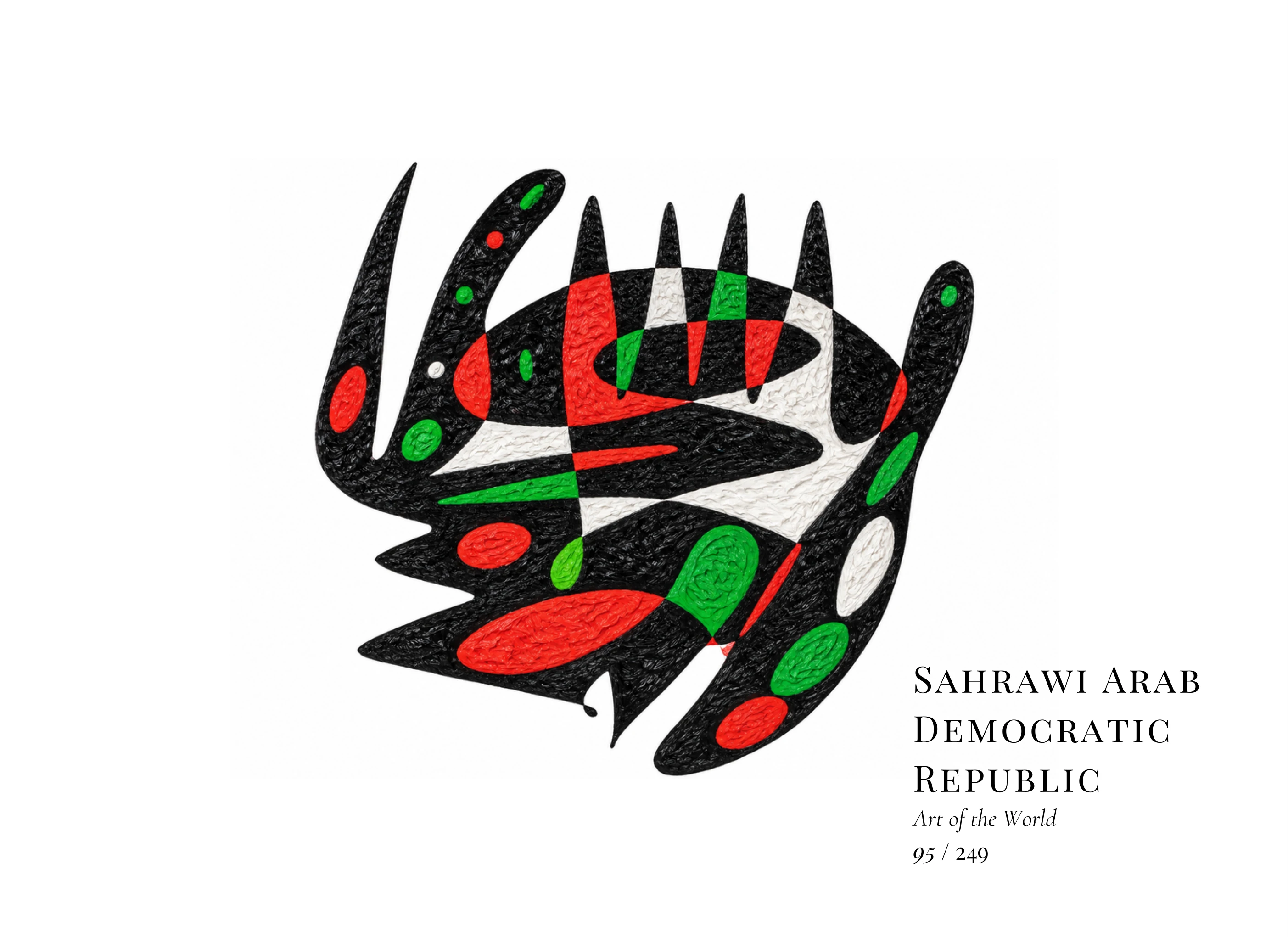
Description
The artwork is dominated by dense black impasto, dramatically interrupted by red, green and white. Its compact silhouette rises into numerous narrow points, while elongated outer forms create a protective yet outward-reaching structure. Oval colour fields and sharp internal divisions establish a rhythm between enclosure and movement. White passages cut through the darkness, opening the composition and intensifying its contrasts. The work suggests identity maintained through persistence: a visually concentrated structure whose separate elements remain strongly connected despite tension, distance and fragmentation.
Cultural Context
The Sahrawi Arab Democratic Republic was proclaimed in 1976 and claims Western Sahara, a largely desert territory on Africa’s Atlantic coast. Historically inhabited by Sahrawi communities connected through Saharan pastoral life and trans- desert exchange, the region later became Spanish Sahara. Its modern political status remains unresolved: Morocco administers most of the territory, while the Sahrawi Arab Democratic Republic is recognised by a number of states and is a member of the African Union.
Sahrawi culture draws upon Arab, Amazigh and wider Saharan inheritances. Hassaniya Arabic, oral poetry, music, storytelling, textile traditions and the social rituals surrounding tea are important expressions of collective identity. Knowledge adapted to desert environments, strong family networks and traditions transmitted across generations have sustained cultural continuity among communities living both within the region and beyond it.