169 / 249
Sealand
Sovereignty as an Idea
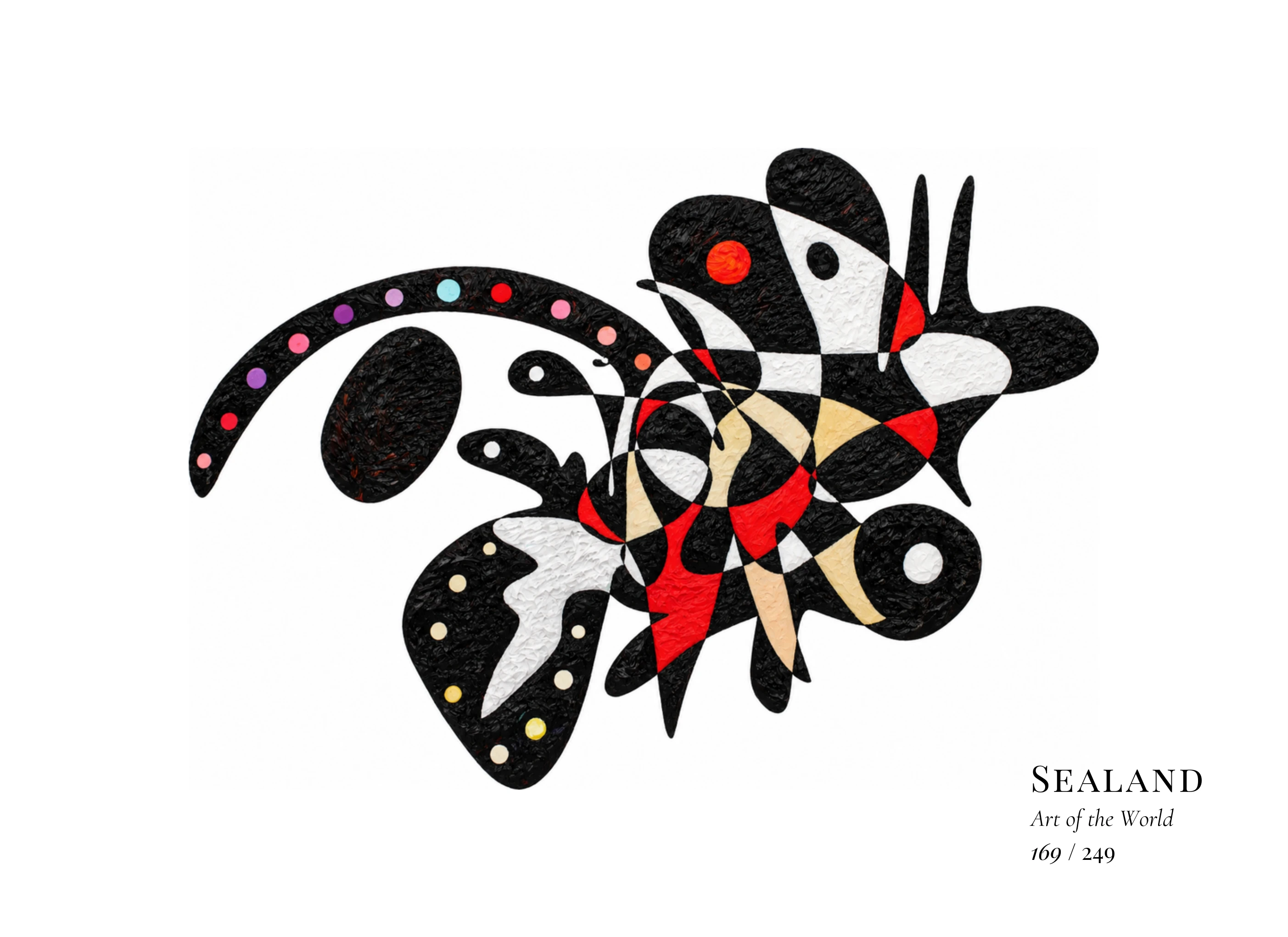
Description
The artwork concentrates black, white, cream and red into an intricate structure of interlocking forms. Heavy impasto gives the dark areas considerable weight, while white passages create abrupt openings and strong internal contrast. A long curved extension, punctuated by small coloured circles, reaches away from the dense centre; isolated ovals and narrow vertical projections further disrupt the silhouette. The composition suggests sovereignty as an act of concentration: a compact visual territory asserting coherence against surrounding white space, while its detached elements evoke the tension between physical isolation and an identity projected far beyond its boundaries.
Cultural Context
Sealand occupies a former Second World War sea fort in the North Sea, off the coast of eastern England. Established as a self- declared principality in 1967, it is not recognised internationally as a sovereign state. Yet its unusual history has made it an enduring example of how territory, jurisdiction and political identity can be imagined at an exceptionally small scale.
Its cultural character has developed less through inherited ethnicity or language than through narrative, symbolism and self- definition. Titles, flags, stamps, coins and other emblems have contributed to a distinctive micronational identity. Sealand consequently occupies an unusual place in popular culture, where questions of independence, legal status and individual initiative intersect with the physical legacy of twentieth-century maritime infrastructure.