40 / 249
South Ossetia
Identity Across the Caucasian Threshold
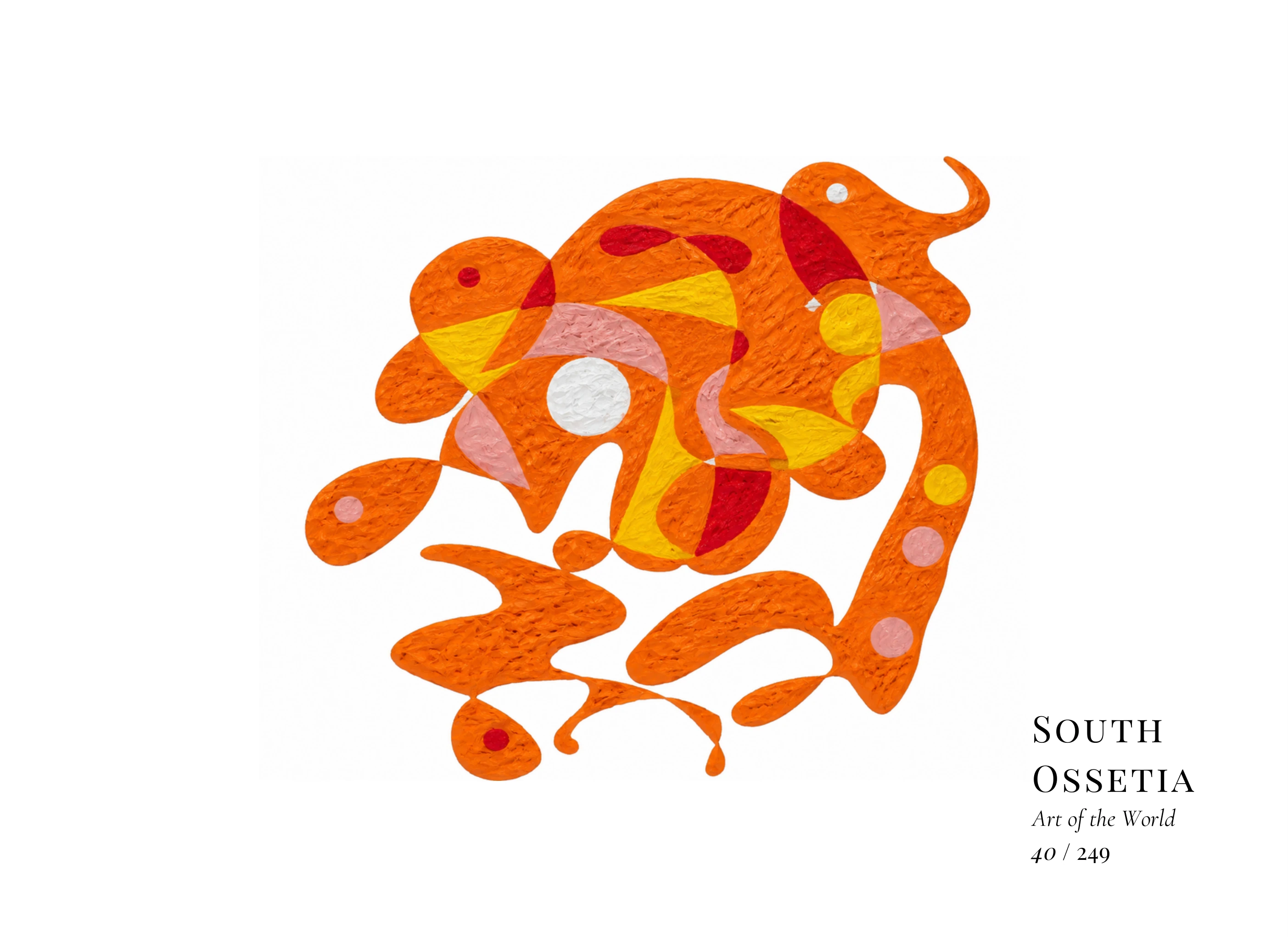
Description
The artwork is saturated with luminous orange, punctuated by yellow, crimson, pink and a concentrated white disc. Rounded masses dominate the upper structure before dissolving into elongated curves, suspended droplets and narrow connecting lines below. Thick impasto unifies these irregular fragments despite the expanses of white between them. The composition suggests identity maintained across discontinuous space: forms separate, return and reconnect, creating a visual rhythm in which cohesion depends not upon uniformity, but upon persistent relationships between individual parts.
Cultural Context
South Ossetia lies on the southern slopes of the Greater Caucasus, within territory internationally recognised as part of Georgia. Historically connected with Ossetian communities north and south of the mountains, the region passed through imperial Russian and Soviet political structures before becoming the focus of competing claims after the Soviet Union’s dissolution. Today it operates under a de facto administration recognised by only a small number of states.
Ossetian cultural identity draws strongly upon the Ossetian language, an Iranian branch of the Indo-European family, alongside Georgian and Russian influences shaped by centuries of regional contact. Oral epic traditions, particularly the Nart sagas, preserve a rich imaginative inheritance. Music, dance, communal celebrations, cuisine and distinctive traditions of hospitality connect contemporary society with the broader cultural history of the central Caucasus.