188 / 249
Transnistria
Identity in a Narrow Territory
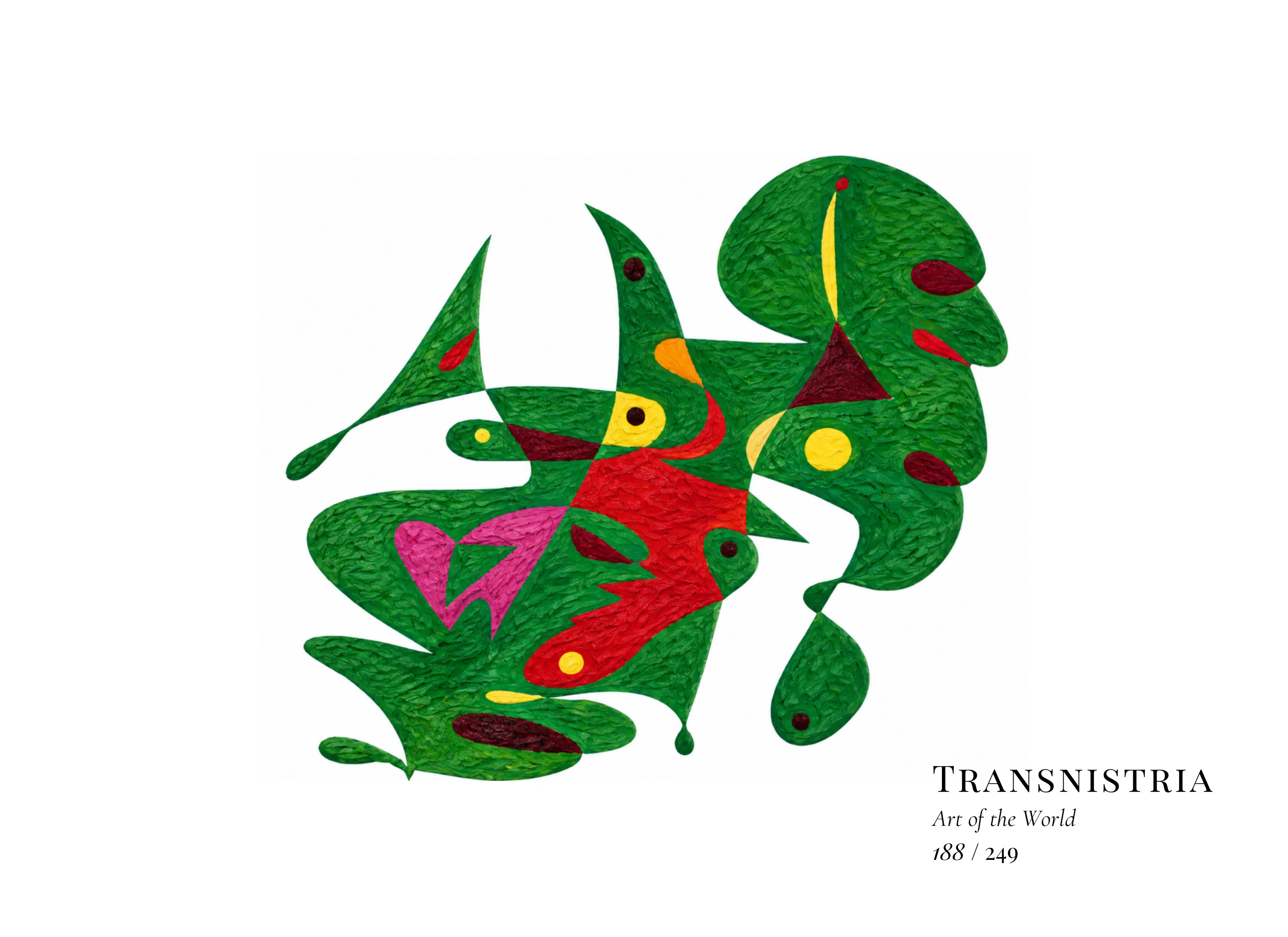
Description
The artwork is dominated by vigorous green, interrupted by crimson, burgundy, yellow, orange and pink. Rounded masses coexist with sharp vertical points, narrow bridges and detached teardrop forms, producing a silhouette that feels simultaneously connected and fragmented. Dense impasto gives the green field physical unity, while white negative spaces cut deeply through the structure. The composition can be read as an exploration of identity sustained within complex boundaries: separate elements remain visually dependent upon one another, creating coherence through tension, proximity and repeated colour.
Cultural Context
Transnistria extends along the eastern bank of the Dniester, internationally recognised as part of Moldova and bordering Ukraine. Its history reflects the movement of peoples and political frontiers across Eastern Europe, including periods within the Russian Empire and Soviet Union. Following the Soviet collapse, Transnistria established a de facto administration in 1990–92 and has since maintained separate institutions without broad international recognition.
Moldovan/Romanian, Russian and Ukrainian communities contribute to a notably multilingual cultural landscape. Orthodox traditions, Soviet-era architecture and monuments, regional cuisine, folk music and domestic crafts coexist with contemporary cultural life. Cities such as Tiraspol and Bender embody the territory’s layered historical inheritance, where different linguistic and social traditions remain closely intertwined.