1 / 249
Wallis and Futuna
Three Kingdoms, One Living Inheritance
Description
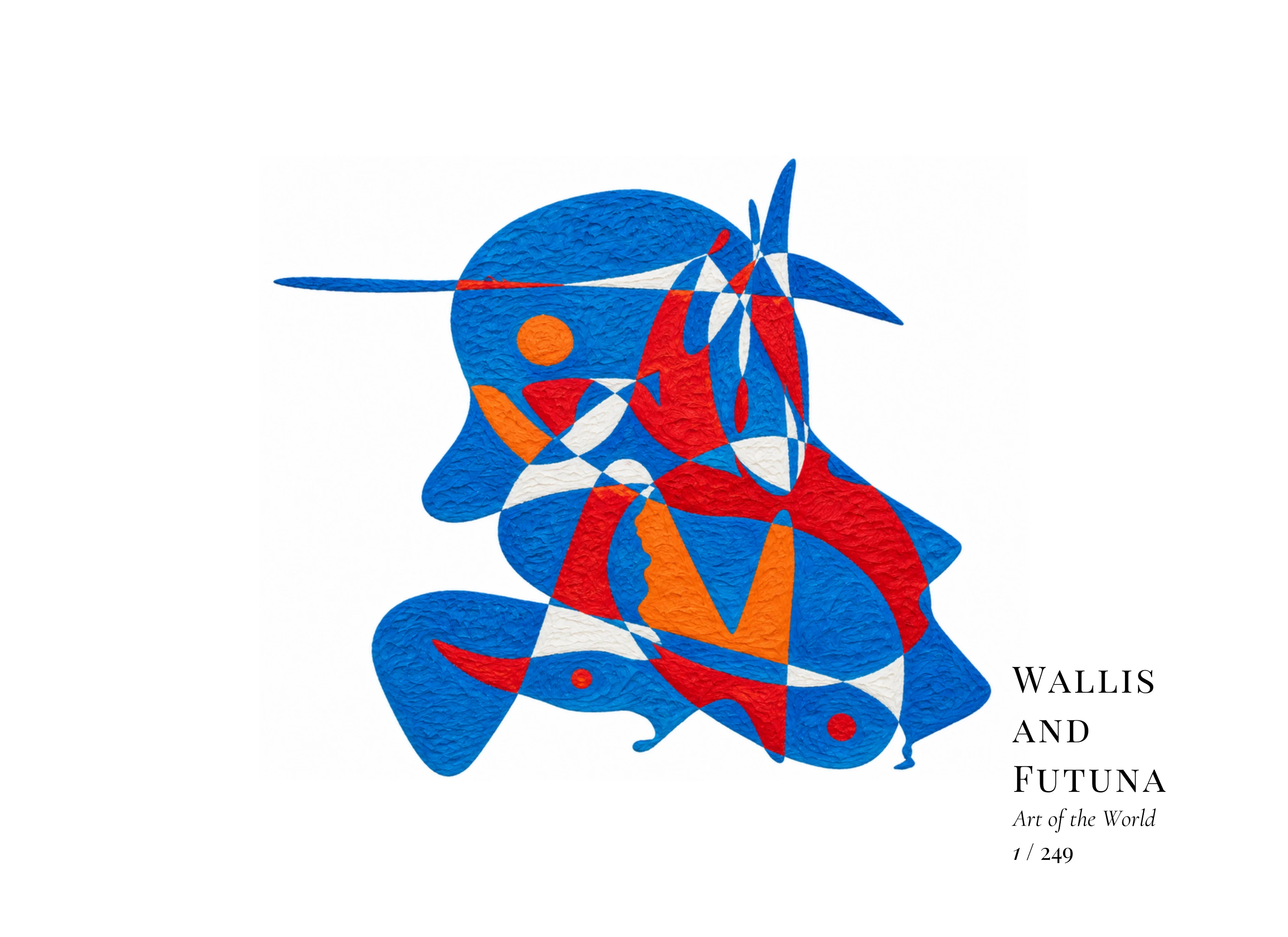
The artwork is dominated by brilliant blue, animated by crimson, orange and sharply defined white passages. Its dense impasto gives the surface a powerful material unity, while curved masses are crossed by narrow lines, pointed extensions and interlocking internal divisions. Small suspended tips and elongated projections create movement beyond the principal silhouette. The composition suggests plurality held within a shared structure: distinct forms retain their character while repeatedly intersecting, evoking communities connected through kinship, custom and an enduring Polynesian cultural memory.
Cultural Context
Wallis and Futuna is a French overseas collectivity in the South Pacific, comprising the islands of Wallis, Futuna and Alofi. Settled by Polynesian peoples, the islands developed distinctive chiefly societies shaped by wider connections with Tonga and Samoa. French influence expanded during the nineteenth century, while traditional authority endured; today three customary kingdoms coexist with the institutions of the French Republic.
Wallisian and Futunan languages remain central to everyday cultural identity alongside French. Extended family, customary leadership and Catholic traditions structure much communal life. Oral genealogy, dance, song, weaving, woodcarving and ceremonial exchange preserve knowledge across generations, while the islands maintain strong cultural relationships with Polynesia and communities overseas.