164 / 249
Western Sahara
Memory Written Across Open Ground
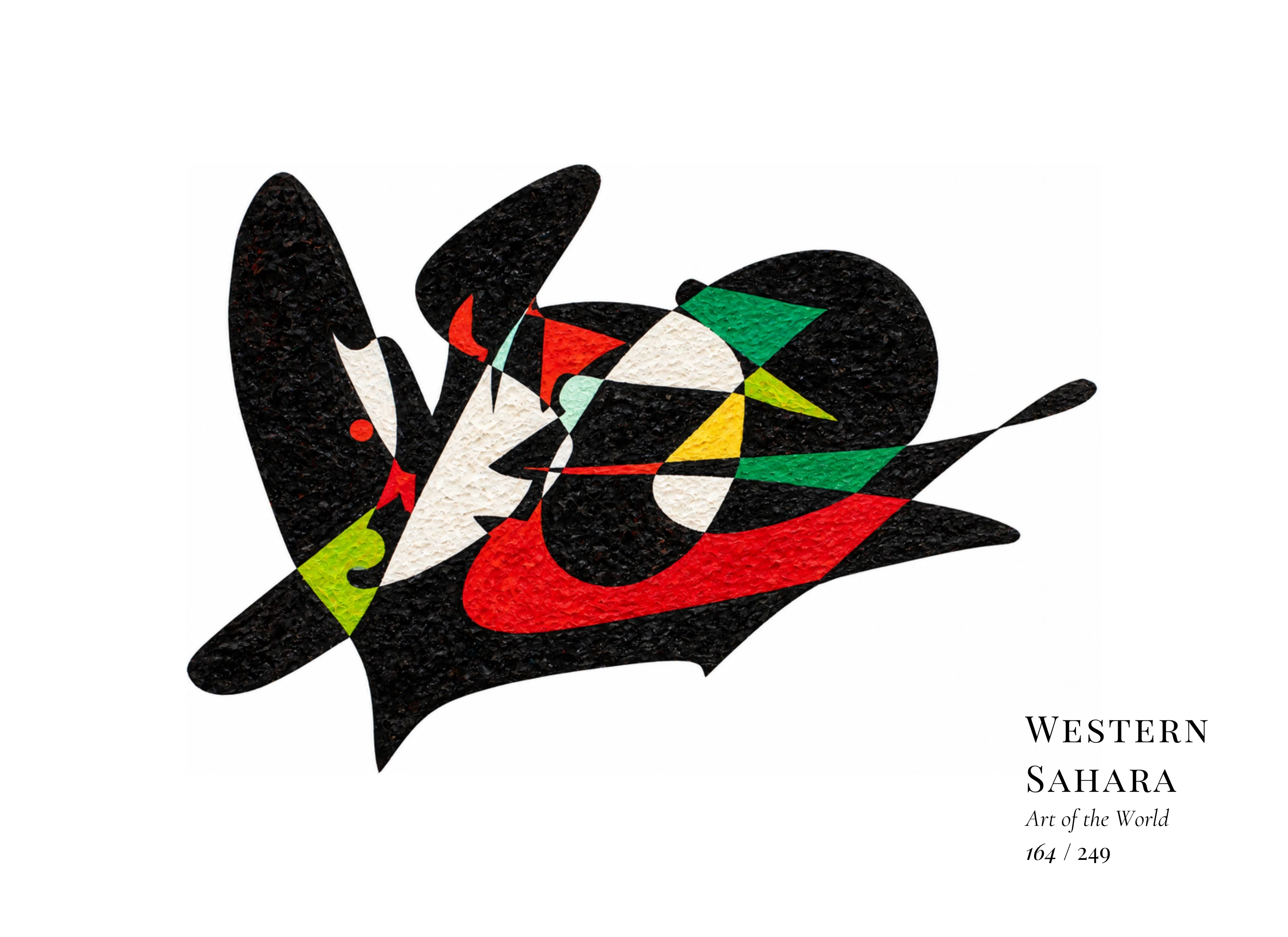
Description
The artwork builds an imposing silhouette from dense black impasto, penetrated by white, crimson, green, turquoise and muted yellow. Large curved masses are crossed by sharp triangular divisions and narrow linear connections, while elongated projections stretch beyond the compact centre. White passages open dramatic fractures within the darkness, and the sweeping crimson form creates a powerful internal trajectory. The composition suggests memory maintained through separation and continuity: distinct fragments remain bound within a larger visual structure, evoking an identity carried across contested space without losing its coherence.
Cultural Context
Western Sahara lies on the Atlantic edge of north-west Africa, where desert plateaux and coastal plains form part of the greater Sahara. Historically inhabited by Sahrawi communities connected through pastoral life and trans-Saharan exchange, the territory became Spanish Sahara in the nineteenth century. Its political status remains unresolved through an ongoing United Nations process; Morocco administers most of the territory, while the Sahrawi Arab Democratic Republic claims sovereignty.
Sahrawi culture draws upon Arab, Amazigh and wider Saharan inheritances. Hassaniya Arabic, oral poetry, genealogy, music and storytelling carry collective memory across generations. Traditions of hospitality, textile work, leathercraft and communal ceremony remain important expressions of identity, sustained both within the territory and among Sahrawi communities elsewhere.