
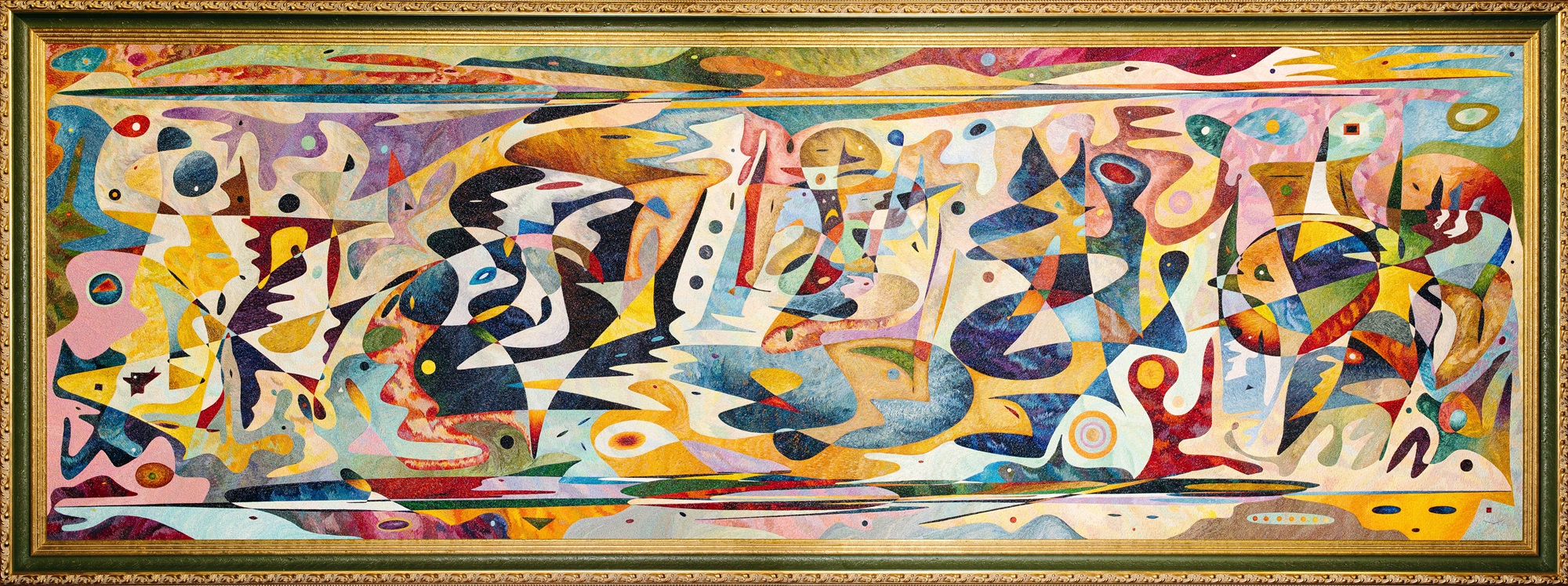
Caodaism, 2021 Oil on canvas2.0 m X 6.0 m
The Architecture of Spiritual Unity
Concept & Meaning
The work’s commanding scale and immersive spatial construction extend it beyond representation, positioning it as a contemporary meditation on the universal tenets of Caodaism — grace, transcendence, suffering, and renewal.
Artistic Context & Inspirations
Developed over an extended period of research and studio inquiry, the painting reflects a sustained engagement with layered systems of meaning rather than overt sacred narrative. Drawing on historical iconographic conventions while maintaining a distinctly contemporary visual language, the work embeds symbolic encodings that require active interpretation. Meaning is not immediately disclosed but gradually revealed through the viewer’s attentive decoding of visual cues, structural relationships, and material choices. Its scale, material presence, and stratified symbolism establish a deliberate dialogue between inherited forms and present-day perception.
Scale & Spatial Impact
At 2 meters by 6 meters, the work establishes a formidable spatial presence, transforming its architectural environment into a field of immersive contemplation.
Materiality & Technique
Executed in oil on linen canvas, the painting balances chromatic depth with subtle surface articulation. Layered glazes and restrained impasto cultivate a tactile presence that rewards sustained and reflective viewing.
Immersive in Size and Theme
Through layered symbolism and spiritual narrative, the work articulates a contemporary reflection on Caodaism philosophy. Scale and spatial orchestration transform the act of viewing into a contemplative and immersive encounter.
Institutional & Collector Context
Equally suited to ecclesiastical, institutional, or distinguished private collections, the painting combines scale, conceptual rigor, and immersive presence, offering enduring visual authority and intellectual depth.
Closing Statement
Monumental in scale and rich in theological resonance, the abstract piece transforms Caodaism narratives into a contemporary visual meditation, leaving a profound and lasting spiritual impression.
Artist Insights
Learn more about the artist’s background, practice, and professional journey.
View Artist ProfileExplore the Work
Navigate through documentation, critical essays, and collection placement for Caodaism, 2021.
Position Within the Collection
Caodaism forms part of The Architecture of Belief, a body of work examining the historical development and cultural influence of major belief systems. Within the collection, the work contributes to a comparative study of religion as a framework for ethics, meaning, cultural identity, and civilizational continuity.
Historical Context
Created in 2021, Caodaism was developed as part of an ongoing investigation into the historical emergence, evolution, and cultural significance of religious traditions. Founded in southern Vietnam in 1926, Caodaism represents one of the most significant modern syncretic religions, integrating elements of Buddhism, Taoism, Confucianism, Christianity, and indigenous Vietnamese spiritual traditions into a unified religious framework.
Intellectual Framework
Comparative religion and history of religions, informed by the scholarship of Mircea Eliade, Ninian Smart, Wilfred Cantwell Smith, and Huston Smith.
Research Value
Contributes to interdisciplinary research on religion, cultural transmission, social organization, and the relationship between belief and civilization.
Relationship to Other Works
Part of The Architecture of Belief, a series examining major religious traditions through a comparative framework, alongside works including Hinduism, Buddhism, Islam, Christianity, Judaism, Shintoism, Taoism, and Jainism.
Collection Status
Permanent Collection of El Arte Monumental. This work is not available for acquisition and is being preserved as part of the foundation's future institutional collection.
𐰘𐰙𐰖𐰢𐰡𐰘𐰟𐰞𐰜𐰛𐰡𐰘𐰚𐰝𐰡𐰖𐰡𐰖𐰝𐰤𐰙𐰖𐰝𐰘𐰘𐰣𐰤𐰡𐰘𐰣𐰘𐰢𐰝𐰘𐰡𐰥𐰞𐰘𐰣𐰤𐰞𐰢𐰖w𐰘𐰝𐰙𐰢𐰟𐰞𐰛𐰤𐰝𐰖𐰟𐰖𐰣𐰚𐰝𐰠𐰛𐰟𐰖𐰣𐰢𐰖𐰡𐰟𐰤𐰖𐰣𐰚𐰖𐰣𐰛𐰟𐰟