
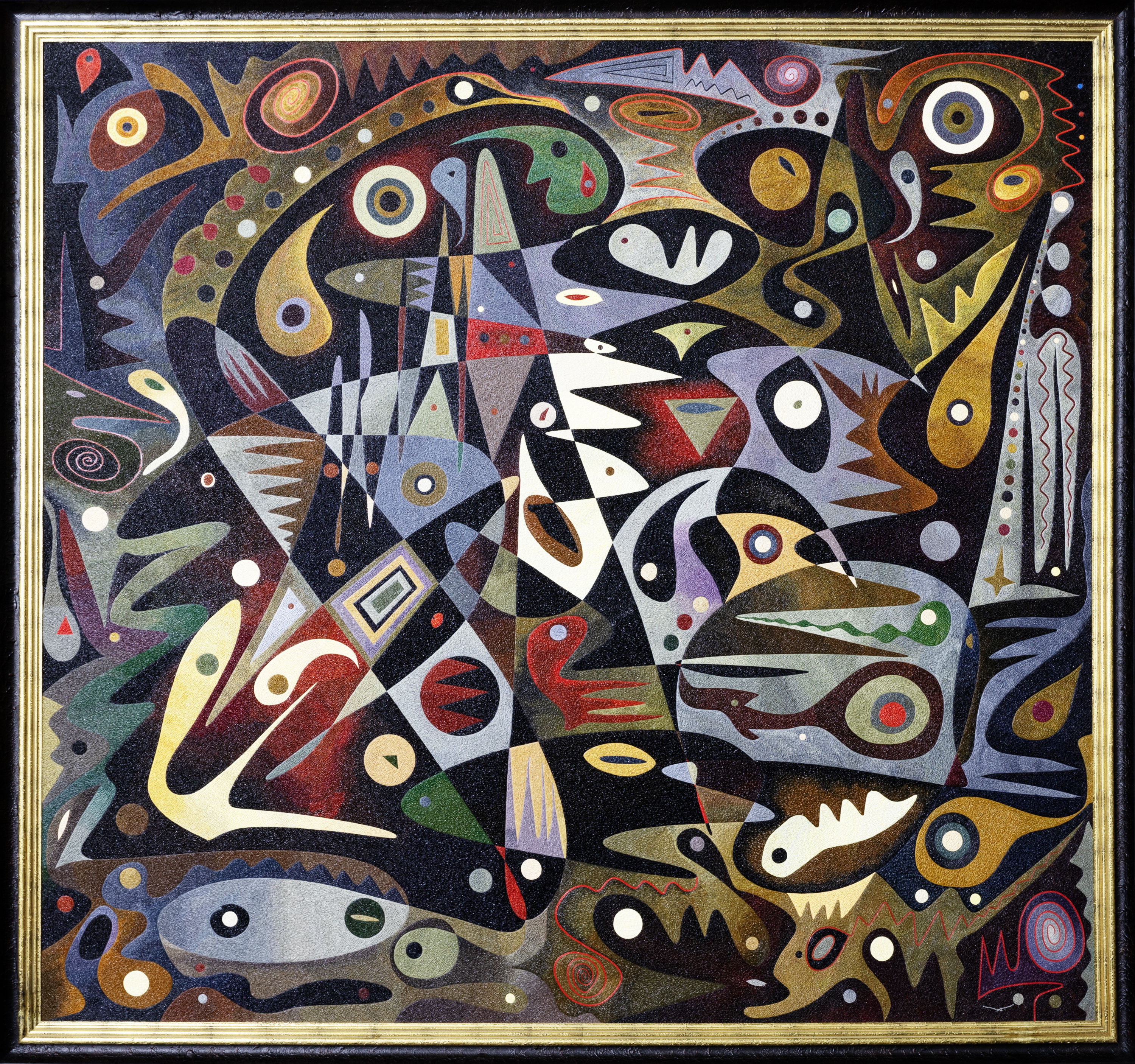
Battle of Gaugamela, 2012 Oil on canvas3.44 m X 3.23 m
The Convergence of Two Worlds
Concept & Meaning
The painting interprets the decisive clash between Alexander the Great and Darius III through abstraction. It moves beyond literal battlefield imagery, emphasizing strategic movement, human determination, and the dynamics of power.
Virtosu presents Gaugamela as a visual language of conflict and coordination, where compositional flows mirror the interplay of armies, leaders, and chance events that shaped history.
Rather than illustrating individual soldiers, the work embodies the collective forces, chaos, and order of battle through layered rhythms, convergences, and interruptions.
Scale & Spatial Impact
At 3.0 m height and 3.6 m width, the painting engages the viewer physically, inviting movement alongside the work to experience its shifting visual densities and dynamic tension.
From a distance, the composition conveys clarity of strategy and formation; up close, it dissolves into energetic brushstrokes, reflecting the simultaneous vastness and immediacy of battle.
Artistic Context & Inspirations
Created in 2012, Battle of Gaugamela emerged from a period of exploration into historical narrative, abstraction, and large-scale painterly engagement.
The work demonstrates careful orchestration of composition and texture, offering viewers an immersive encounter with both history and form.
Materiality & Technique
Executed in oil on canvas, the surface reflects layered application, compression, and dynamic brushwork. Materiality conveys the weight and force of historical events.
Paint functions structurally rather than illustratively, emphasizing duration, energy, and deliberate engagement with the medium.
Institutional & Collector Context
Battle of Gaugamela, 2012 aligns with discussions of historical narrative, post-abstraction, and monumental painting, making it suitable for:
- Museum or institutional collections
- Architectural or site-specific installations
- Major private collections focused on historical statement works
The work’s singular presence underscores its rarity and lasting value.
Closing Statement
Battle of Gaugamela, 2012 asserts presence and endurance. Through scale, material, and structure, it presents painting as a carrier of history and encoded meaning—timeless, physical, and resonant.
A work to study, move alongside, and return to.
Explore the Work
Navigate through documentation, critical essays, and collection placement for Battle of Gaugamela, 2012.
Position Within the Collection
Battle of Gaugamela forms part of The Architecture of Conflict, a body of work examining warfare as a transformative force in the development of civilizations, political systems, and historical change. Within the collection, the work focuses on a decisive military encounter whose consequences reshaped the political landscape of the ancient world.
Historical Context
Created between 2000 and 2002, Battle of Gaugamela examines the decisive battle fought in 331 BCE between Alexander III of Macedon and Darius III of Persia. Widely regarded as one of the most consequential military engagements in history, the battle led to the collapse of the Achaemenid Empire and established the foundations for the spread of Hellenistic culture across the Near East and beyond.
Intellectual Framework
Military history, ancient history, and classical studies, informed by the writings of Arrian, Plutarch, and Robin Lane Fox.
Research Value
Contributes to interdisciplinary research on warfare, imperial expansion, leadership, state formation, and the role of conflict in historical transformation.
Relationship to Other Works
Part of The Architecture of Conflict, a series examining warfare, political struggle, revolution, and the forces that shape historical change across civilizations and eras.
Collection Status
Permanent Collection of El Arte Monumental. This work is not available for acquisition and is being preserved as part of the foundation's future institutional collection.
𐰘𐰙𐰖𐰢𐰡𐰘𐰟𐰞𐰜𐰛𐰡𐰘𐰚𐰝𐰡𐰖𐰡𐰖𐰝𐰤𐰙𐰖𐰝𐰘𐰘𐰣𐰤𐰡𐰘𐰣𐰘𐰢𐰝𐰘𐰡𐰥𐰞𐰘𐰣𐰤𐰞𐰢𐰖w𐰘𐰝𐰙𐰢𐰟𐰞𐰛𐰤𐰝𐰖𐰟𐰖𐰣𐰚𐰝𐰠𐰛𐰟𐰖𐰣𐰢𐰖𐰡𐰟𐰤𐰖𐰣𐰚𐰖𐰣𐰛𐰟𐰟