
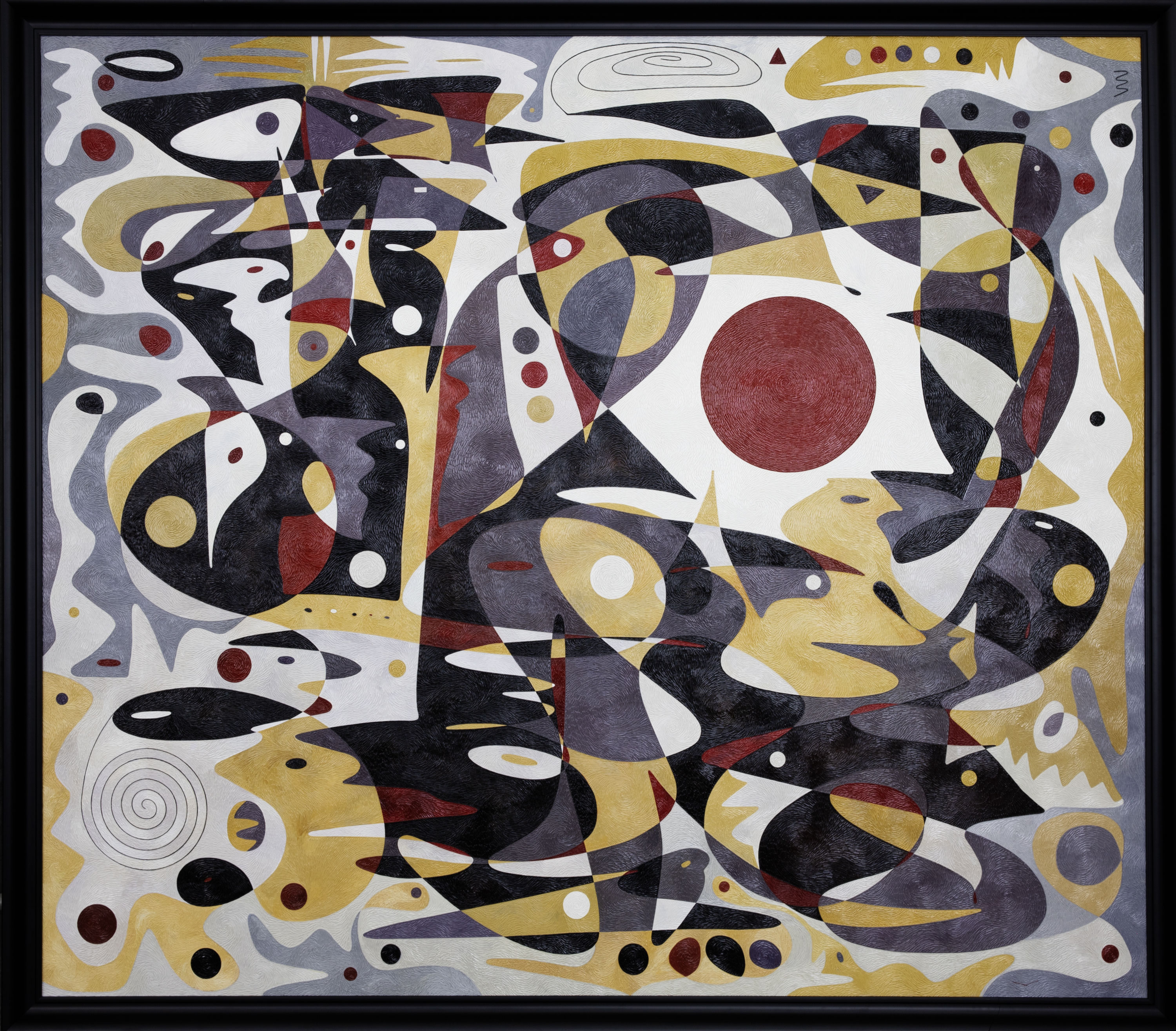
Hawai Sakusen, 2004 Oil on canvas3.05 m X 3.51 m
The Architecture of Surprise
Concept & Meaning
The painting interprets the dynamics of the Hawai Sakusen operation through abstraction, emphasizing movement, planning, and the human dimension of conflict.
Virtosu presents the operation as a visual language of strategy and coordination, where composition mirrors the interaction of forces, timing, and decision-making.
Rather than depicting individual combatants, the work embodies the collective tension, urgency, and decisive turns of the historical event.
Scale & Spatial Impact
At 3.0 m height and 3.6 m width, the painting engages the viewer physically, inviting movement alongside the canvas to experience shifting densities and operational dynamics.
From afar, the composition communicates strategy and coordination; up close, it dissolves into energetic brushwork, reflecting immediacy and tension.
Artistic Context & Inspirations
Created in 2004, Hawai Sakusen emerges from a period of reflection on historical military operations, large-scale composition, and immersive painterly exploration.
The work demonstrates orchestration of form, movement, and texture, providing viewers an encounter with both history and abstraction.
Materiality & Technique
Executed in oil on canvas, the surface reflects layered application, compression, and energetic brushwork. Materiality conveys both force and precision, mirroring operational intensity.
Paint functions structurally rather than illustratively, emphasizing duration, energy, and deliberate engagement with the medium.
Institutional & Collector Context
Hawai Sakusen aligns with discussions of historical narrative, post-abstraction, and monumental painting, making it suitable for:
- Museum or institutional collections
- Architectural or site-specific installations
- Major private collections focused on historical statement works
Its singular presence reinforces rarity, authority, and lasting significance.
Closing Statement
Hawai Sakusen asserts presence and endurance. Through scale, material, and structure, it presents painting as a carrier of history and encoded meaning—timeless, physical, and resonant.
A work to study, move alongside, and return to.
Explore the Work
Navigate through documentation, critical essays, and collection placement for Hawai Sakusen, 2004.
Position Within the Collection
Hawai Sakusen forms part of The Architecture of Conflict, a body of work examining warfare as a transformative force in the development of civilizations, political systems, and historical change. Within the collection, the work focuses on a military operation whose execution altered the course of the Second World War and the geopolitical balance of the twentieth century.
Historical Context
Created between 2002 and 2004, Hawai Sakusen examines the Japanese operation that culminated in the attack on Pearl Harbor on 7 December 1941. Conceived as a preemptive strike against the United States Pacific Fleet, the operation marked the formal entry of the United States into the Second World War and transformed the conflict into a truly global war.
Intellectual Framework
Military history, Second World War studies, Pacific War studies, and strategic studies, informed by the work of Gordon W. Prange, John Toland, Mitsuo Fuchida, and Eri Hotta.
Research Value
Contributes to interdisciplinary research on warfare, military strategy, geopolitical transformation, decision-making, and the role of conflict in historical change.
Relationship to Other Works
Part of The Architecture of Conflict, a series examining warfare, political struggle, revolution, and the forces that shape historical change across civilizations and eras.
Collection Status
Permanent Collection of El Arte Monumental. This work is not available for acquisition and is being preserved as part of the foundation's future institutional collection.
𐰘𐰙𐰖𐰢𐰡𐰘𐰟𐰞𐰜𐰛𐰡𐰘𐰚𐰝𐰡𐰖𐰡𐰖𐰝𐰤𐰙𐰖𐰝𐰘𐰘𐰣𐰤𐰡𐰘𐰣𐰘𐰢𐰝𐰘𐰡𐰥𐰞𐰘𐰣𐰤𐰞𐰢𐰖w𐰘𐰝𐰙𐰢𐰟𐰞𐰛𐰤𐰝𐰖𐰟𐰖𐰣𐰚𐰝𐰠𐰛𐰟𐰖𐰣𐰢𐰖𐰡𐰟𐰤𐰖𐰣𐰚𐰖𐰣𐰛𐰟𐰟