
South Africa: Art, Cultural Identity and the Formation of Visual Memory
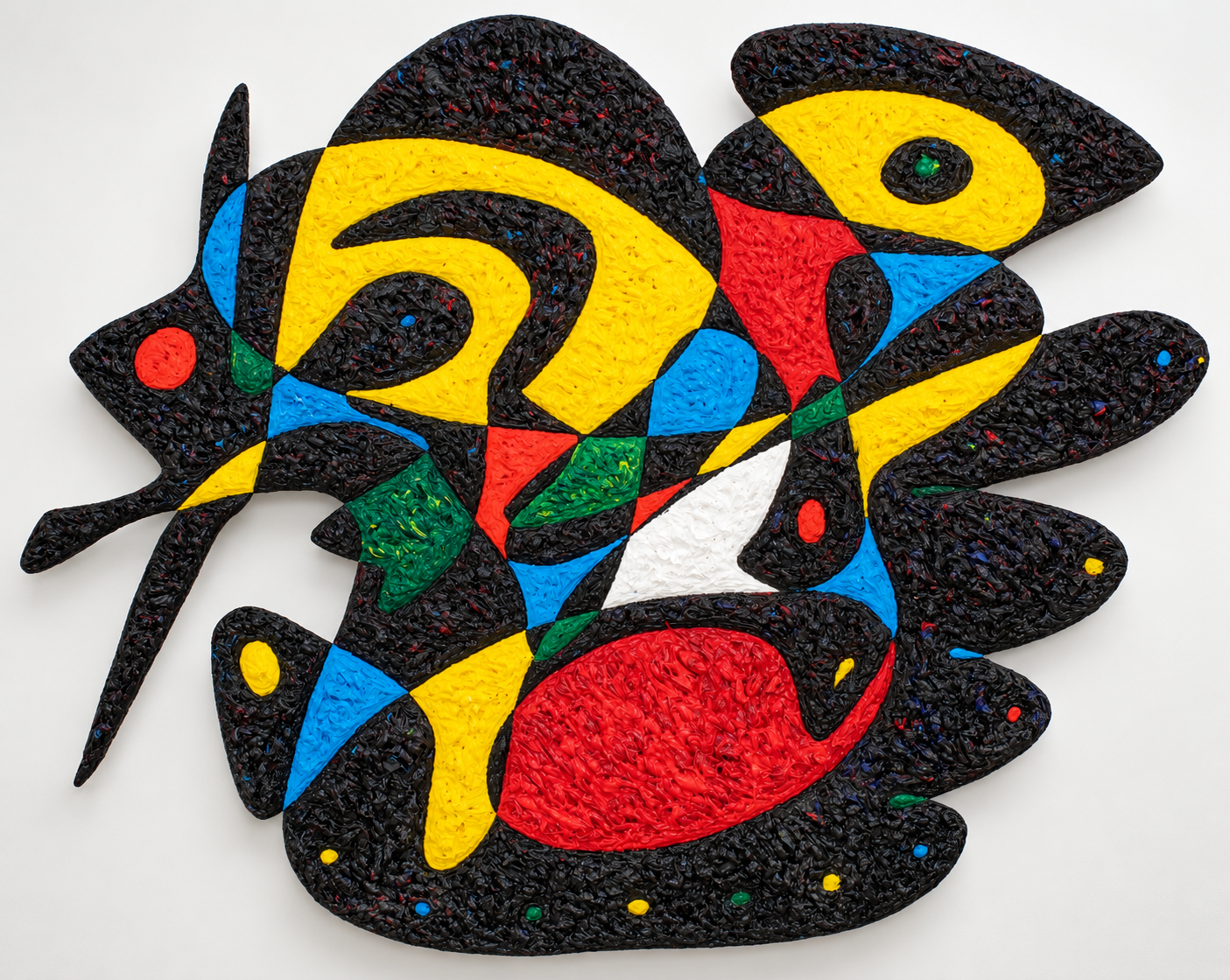
05 Sep 2026 | NewsWithin Art of the World, South Africa is approached through a single contemporary artwork by Gheorghe Virtosu: an autonomous abstract image whose relationship with the country is established through sustained association rather than literal representation. The work belongs to a larger visual system in which individual countries and territories are given distinct forms while remaining connected to a broader international structure.
The South Africa image also appears within Divine DNA, where it is identified as Nation 10 of 249. The publication describes the larger work as a monumental visual system developed between 2010 and 2016, in which national and territorial identities are reconfigured through an original iconographic language rather than through conventional political geography. It also states that the individual entities do not reproduce official emblems, flags or established systems of national representation.
That distinction is central to understanding South Africa within Art of the World. The artwork does not claim to summarize South African culture, replace familiar national imagery, or function as an official symbol. Its significance lies elsewhere: in the possibility that a contemporary abstract image can become increasingly associated with a place through repetition, circulation and recognition.
The project therefore concerns not only the production of images, but the formation of visual memory.
An Image Without a Literal Map
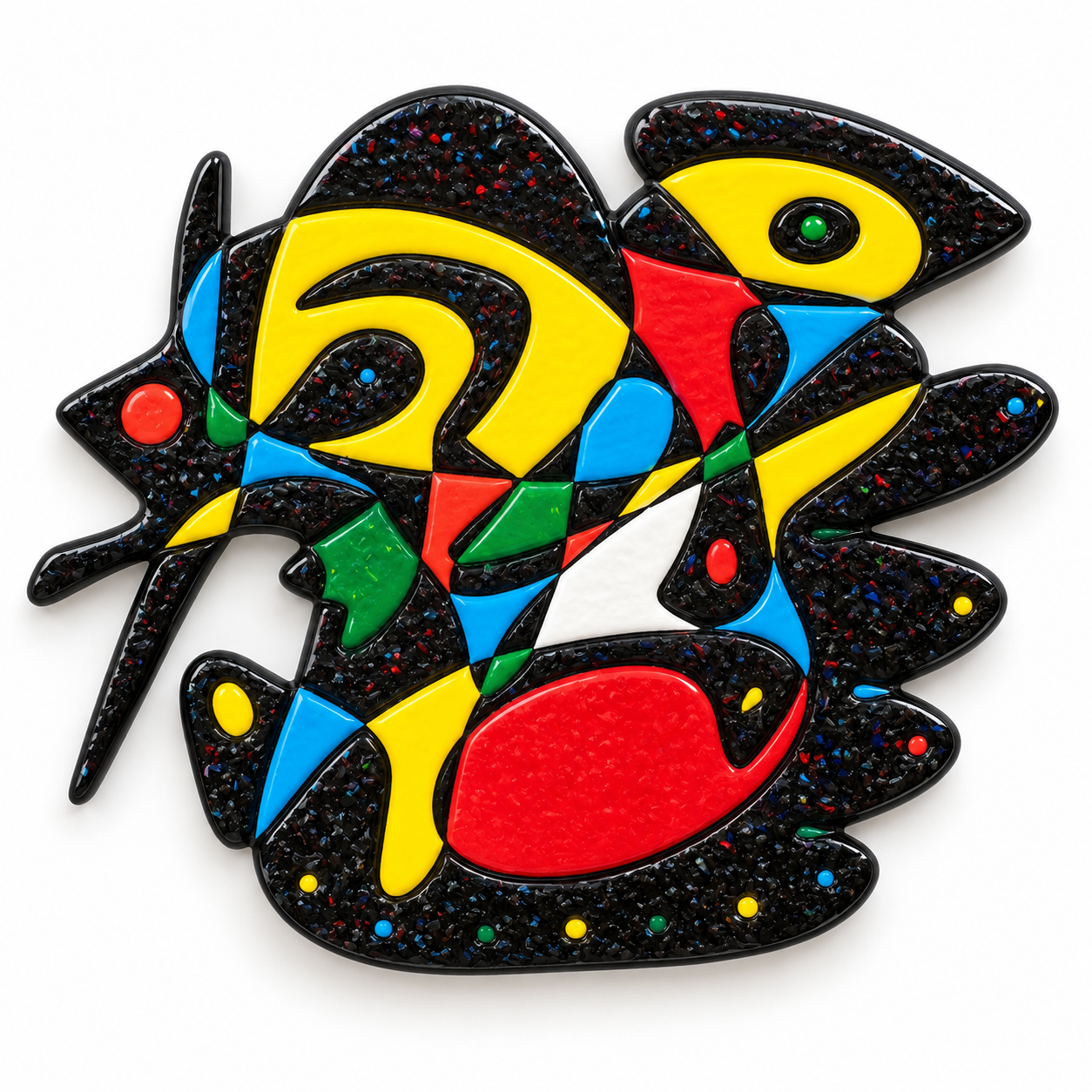
The South Africa composition is immediately recognizable as a highly concentrated abstract structure. A predominantly black field contains and connects areas of saturated yellow, red, blue and green, with a sharply contrasting white passage near the lower centre. Small coloured points are scattered through several of the dark peripheral forms.
The composition does not conform to a rectangle. Its irregular perimeter is formed by projections, lobes, pointed extensions and rounded masses. This gives the image the character of an autonomous visual object rather than a conventional picture contained by a background.
Several large yellow passages dominate the upper half. One curves inward in a broad spiral-like movement; another surrounds a small dark circular centre containing green. Red enters the composition in strongly concentrated areas, particularly through the large rounded form toward the lower centre and the angular red passage above it. Blue and green operate in smaller segments between the larger masses.
The dark structure is equally important. Black is not simply a background against which the colours have been placed. It forms much of the body of the composition itself, separating colours, establishing contours and connecting distant sections. The result is a dense arrangement in which figure and ground are difficult to separate.
This density gives the image considerable visual force. Yet the structure is not static. Diagonal intersections, narrowing passages, circular forms and elongated projections repeatedly redirect the eye. Large areas are balanced against tiny chromatic incidents; broad curves encounter sharp triangles; heavy dark masses are interrupted by bright colour.
These relationships allow the image to remain visually active without requiring a literal subject.
Cultural Identity and the Limits of Representation
A project associating one artwork with one country inevitably raises the question of representation. South Africa, like any country, cannot be compressed into a single image without substantial loss. Its histories, communities, languages, landscapes, institutions and cultural traditions cannot be adequately summarized by one visual form.
Art of the World does not require the artwork to perform that impossible task.
Instead, it distinguishes between representing a country and developing an association with a country. The first suggests that an image can stand for a national totality. The second describes a cultural process: an image is repeatedly encountered alongside a place name until the relationship between the two becomes familiar.
This distinction allows abstraction to occupy an interesting position within contemporary visual culture. Conventional national identification usually depends upon an established vocabulary: flags, maps, monuments, animals, landscapes, architecture, coats of arms or other familiar motifs. Such images have accumulated meaning through history and repetition.
An abstract artwork begins from a different position. It does not necessarily provide immediate geographic information. Its connection to South Africa must instead be learned.
That apparent limitation is also what makes the experiment significant. If recognition develops, it develops through memory rather than literal description.
Abstraction Beside Established Symbols
The colours visible in the South Africa artwork inevitably create possible associations because red, blue, green, yellow, black and white are all familiar within South Africa’s existing national visual environment. Yet similarity of colour should not be confused with evidence of direct symbolic intention.
What can be established visually is that the artwork uses these colours in a complex abstract structure. They are distributed unevenly, separated and connected by extensive black forms, and organized through curved and angular geometries rather than through a flag-like arrangement.
The image therefore occupies a different category from an official national symbol.
This matters because contemporary cultural identity does not need to depend exclusively on replacing one image with another. Visual cultures expand through accumulation. New images can exist alongside established ones. A contemporary artwork associated with South Africa does not diminish the continuing role of flags, historic imagery, architecture, landscapes or other recognizable references.
Instead, it adds another possible visual register: abstraction.
Within Art of the World, this coexistence is essential. The project asks what happens when a country name is repeatedly connected with a form that cannot be reduced to familiar tourist or national iconography. Recognition then depends less upon immediate decoding and more upon repeated encounter.
From Artwork to Cultural Image
An artwork and a cultural image are related but different conditions.
The artwork exists as a specific visual composition. A cultural image emerges through circulation. It is encountered in different contexts, remembered, reproduced, compared with previous encounters and gradually connected to a larger field of associations.
This process does not occur automatically. Nor can recognition simply be declared.
Visual memory is cumulative.
The South Africa artwork can therefore be understood as an image whose association with the country develops over time. Each appearance reinforces the possibility of recognition, provided the visual identity remains sufficiently consistent. The name South Africa and the same underlying composition repeatedly encounter one another.
The principle is simple, but culturally important: repetition produces familiarity without requiring duplication of context.
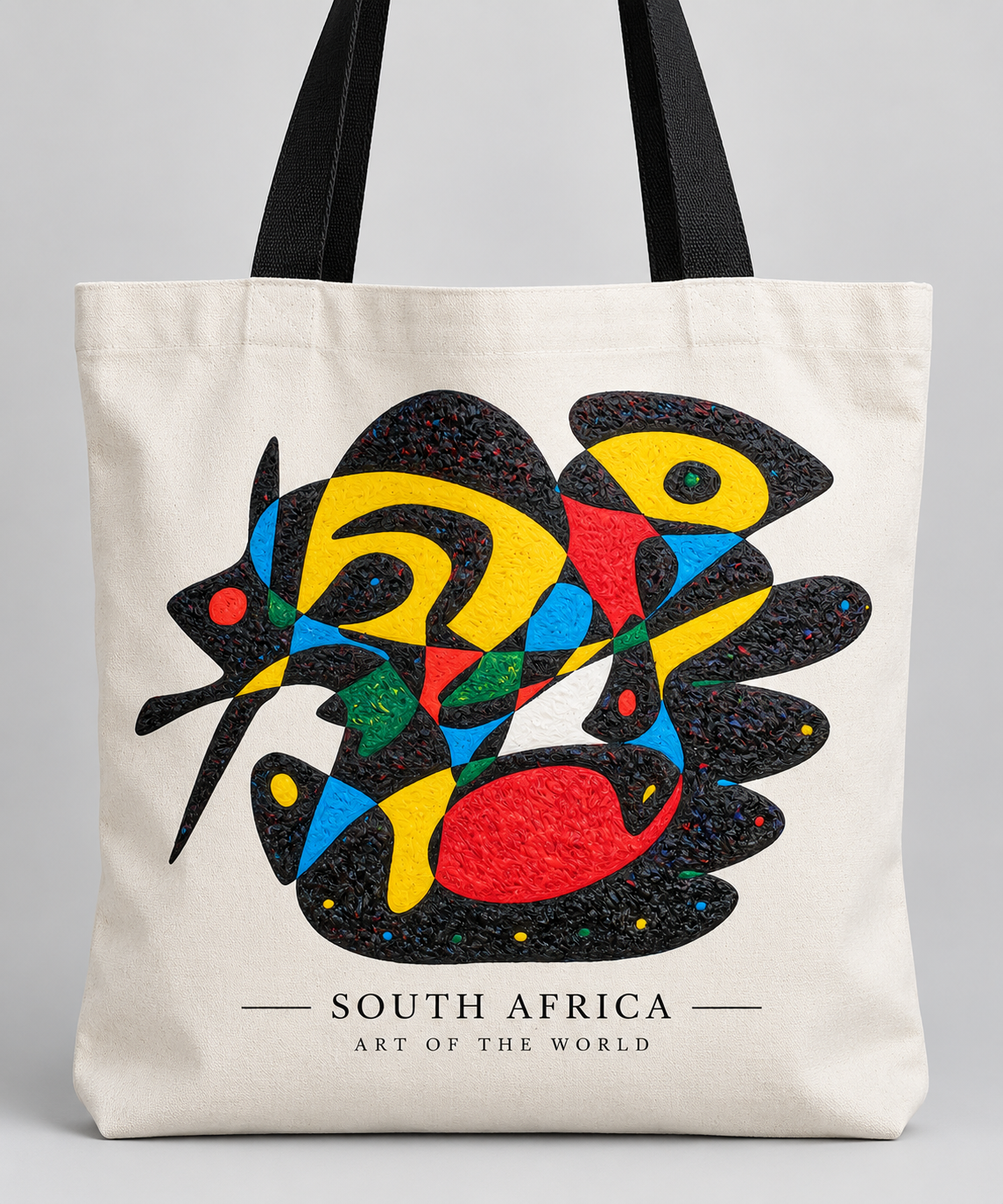
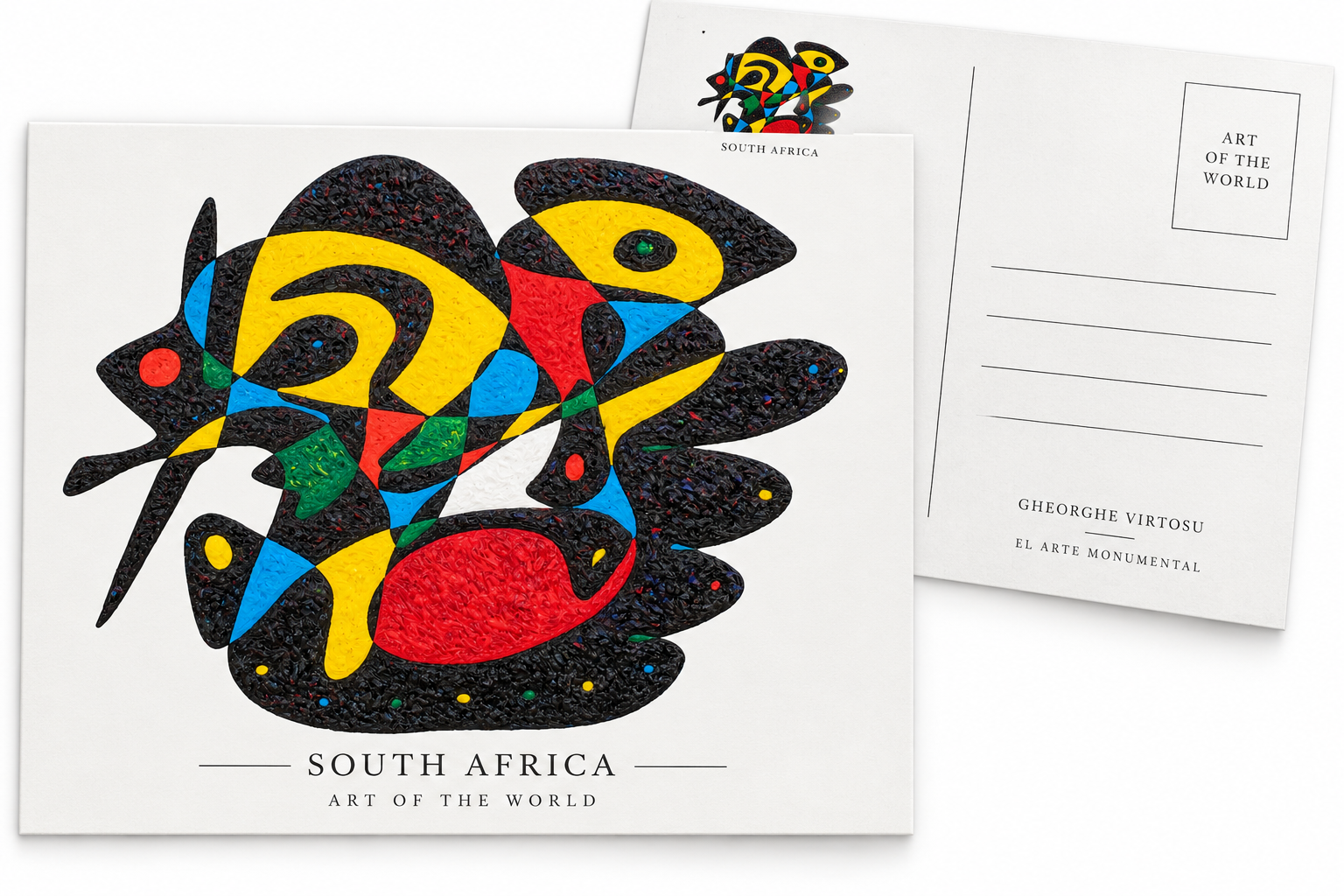
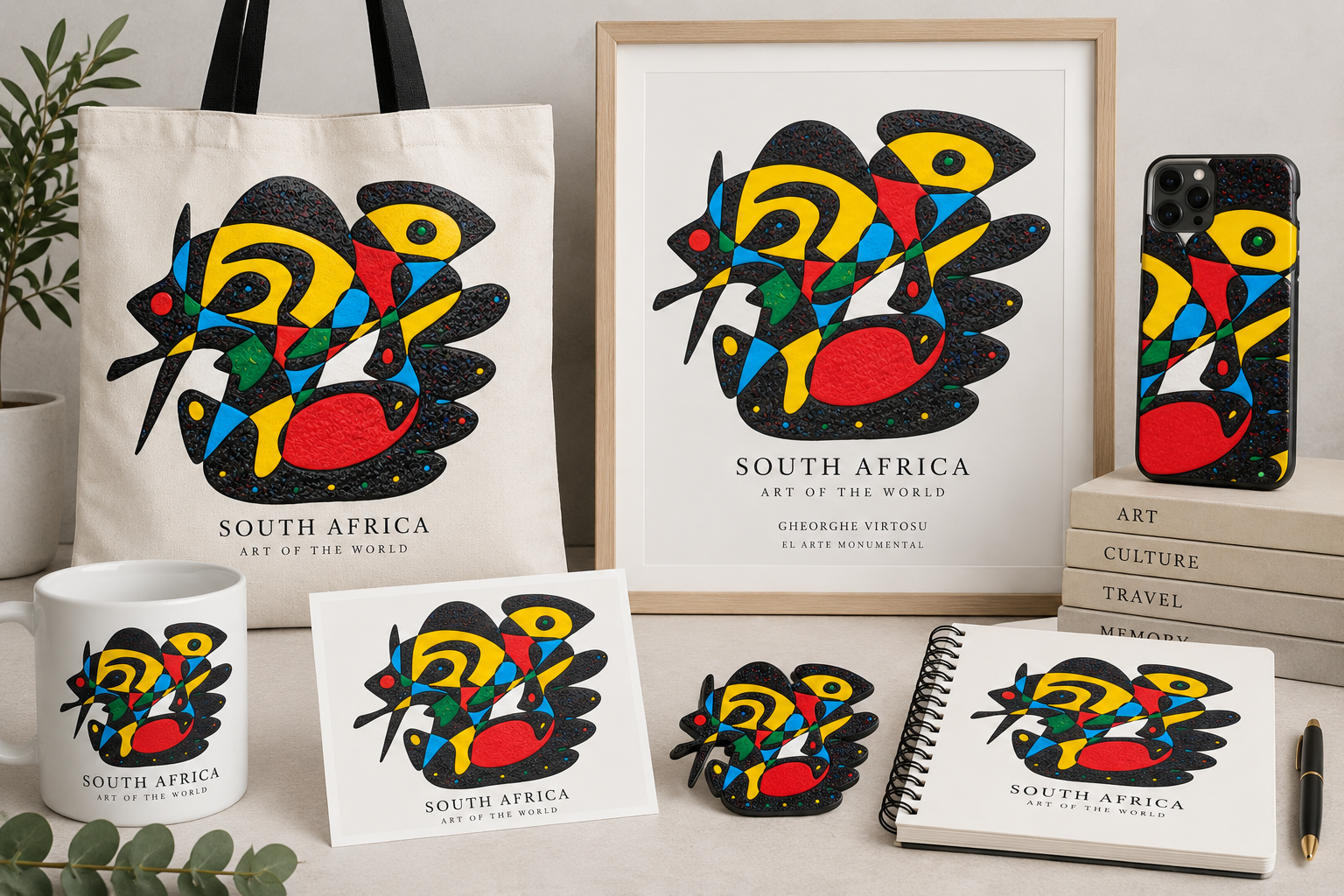
The artwork may appear as a full image in one setting and as a detail in another. Its scale may change dramatically. A large printed reproduction, a postcard, a phone case and a textile surface produce different encounters. Yet recognizable relationships of colour, contour and structure can remain.
This is repetition without visual stagnation.
Visual Memory Through Repetition
Much of what becomes culturally recognizable does so through recurrence. Images gain familiarity because people encounter them more than once and under different circumstances.
Art of the World applies this principle deliberately while avoiding the claim that familiarity has already been achieved. The relevant process is gradual: association is proposed, repeated and allowed to accumulate.
For the South Africa artwork, certain formal features are particularly capable of surviving changes of scale. The broad black structure creates a strong silhouette. The large yellow arcs remain conspicuous from a distance. The red lower mass provides a substantial chromatic anchor. Blue and green passages produce internal variation, while the white triangular area creates a sharp point of contrast.
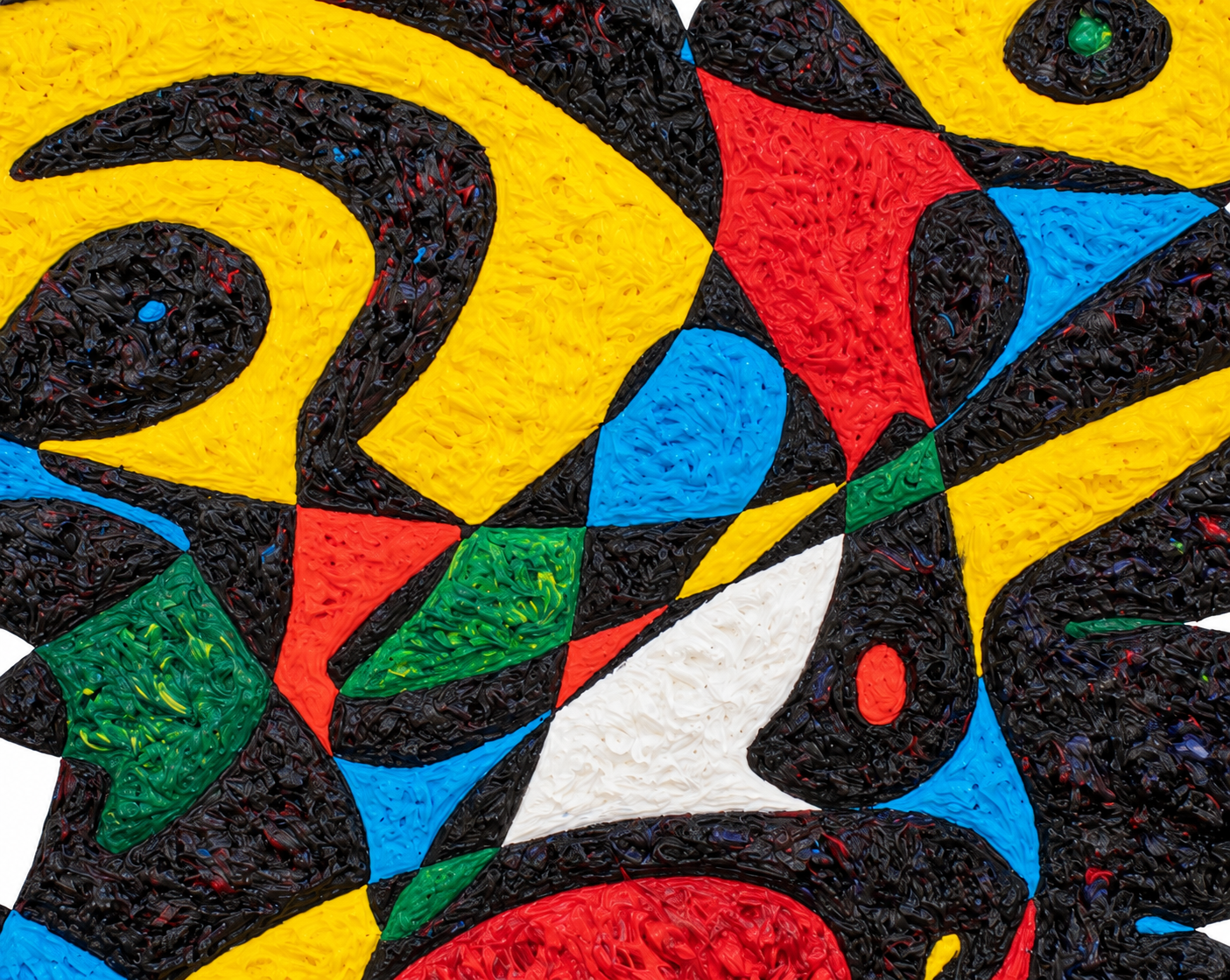
At close range, the textured surface becomes more evident. At reduced scale, texture recedes and the larger chromatic architecture becomes dominant.
This change is important because visual memory rarely preserves every detail. People often remember images through simplified characteristics: dominant colours, contours, directional movement, contrasts and unusual internal relationships. The South Africa image contains several such features.
Repeated exposure can strengthen those features as recognition cues.
Objects as Carriers of Images
Images circulate through more than museums, catalogues and screens. They also move through ordinary material culture.
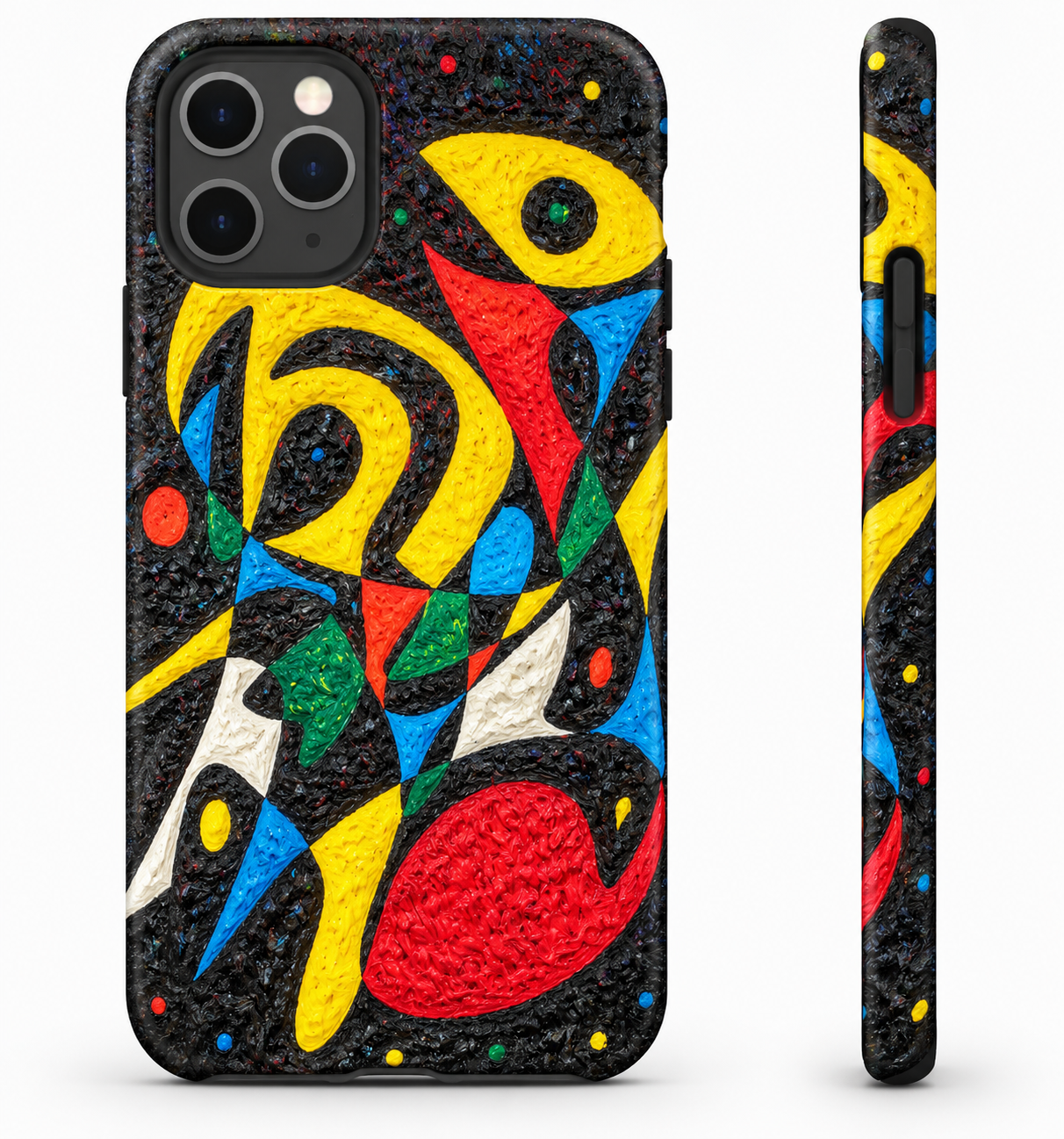
Within Art of the World, applications on postcards, magnets, phone cases, tote bags, textiles, stationery and related cultural objects can be understood primarily as carriers of visual memory. Their importance lies in the different conditions under which they allow an image to be encountered.
A postcard compresses the artwork into a small frontal field. A magnet places it within an everyday domestic environment. A phone case wraps the composition around an object handled repeatedly. A tote bag introduces movement and public visibility. Textile applications alter scale and repetition while preserving characteristic colour relationships.
These transformations do not turn the artwork into several unrelated images. They create multiple physical circumstances for encountering the same visual identity.
The distinction is important. If every format substantially reinvented the composition, accumulated recognition would weaken. If every application reproduced it mechanically without sensitivity to scale or surface, the image could become visually inert.
The challenge is consistency without monotony.
The artwork remains identifiable while its material environment changes.
Recognition Across Different Scales
Scale has a particularly important role in the South Africa composition because its visual structure operates at both macro and micro levels.
From a distance, the image can be perceived as a compact, irregular dark mass punctuated by large zones of yellow, red and blue. Closer inspection reveals numerous smaller elements: coloured dots, narrow divisions, textured surfaces, small circular centres and tightly interlocking boundaries.
This layered readability makes the image adaptable to different modes of encounter. A small-format application emphasizes silhouette and colour distribution. A larger reproduction makes internal texture and structural complexity more visible.
The same artwork can therefore be remembered differently depending on where it is encountered, while maintaining a stable visual core.
This is one reason circulation matters to the formation of visual memory. Recognition does not depend upon repeatedly seeing an image under identical conditions. It can develop precisely because the image survives changes in size, material, setting and use.
The constant is the visual relationship with South Africa.
South Africa Within a Wider Visual Atlas
No country in Art of the World exists entirely alone. Each artwork is autonomous, but the project acquires another dimension when the works are considered collectively.
This principle has a precedent in the structural framework documented around Divine DNA. The publication describes its entities as visually distinct while simultaneously contributing to a unified composition, with meaning emerging through relationships of placement, proportion, rhythm and continuity.
Art of the World develops the country image in another direction. The individual artwork can circulate independently, associated consistently with its country, while remaining one element within a much larger visual atlas.
South Africa therefore has two simultaneous conditions within the project. It is a distinct image with its own colour structure, silhouette, rhythm and internal organization; and it is one country within an international field of equally distinct images.
The resulting atlas does not depend upon visual uniformity. Its coherence comes from a shared method rather than identical appearance: one country, one artwork, one evolving visual memory.
Such an atlas differs fundamentally from a conventional map. Geography organizes countries through territory and borders. Art of the World organizes them through visual difference and association.
The country remains named. The image remains abstract. The relationship between them develops through recurrence.
An Evolving Visual Memory
The South Africa artwork demonstrates the central proposition of Art of the World with particular clarity because its formal identity is strong while its imagery remains non-literal.
Its dense black architecture, broad yellow curves, concentrated red forms, blue and green passages, white interruption and irregular silhouette establish a composition capable of being recognized without requiring an explanatory national symbol.
Whether that recognition becomes culturally durable depends upon circulation over time.
Art of the World therefore treats visual memory as a process rather than an accomplished fact. Each encounter can contribute to familiarity. Each repetition can strengthen the connection between image and country. Each change of format tests whether the underlying visual identity remains coherent.
South Africa becomes part of this evolving visual atlas through the sustained association of country and artwork, rather than through any claim of comprehensive or official representation.
Through Art of the World, Gheorghe Virtosu and El Arte Monumental establish a framework in which contemporary abstraction can enter the continuing formation of cultural imagery: one country, one artwork, and one visual memory developing through time.