
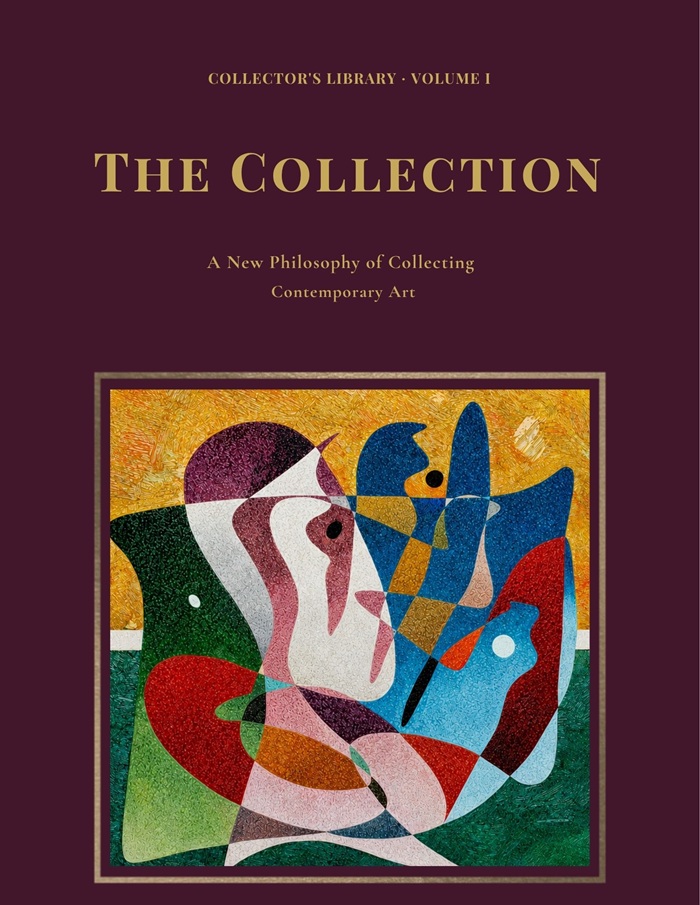
The Collection: A New Philosophy of Collecting Contemporary Art — New Publication for Art Collectors, Museums, Foundations and Curators
28 Aug 2026 | Press ReleasesNew Collector’s Library publication explores contemporary art collecting, collection development, curatorial thinking, provenance, research, stewardship, artificial intelligence, museums and cultural memory
Barcelona, 2026
El Arte Monumental Research Publications announces The Collection: A New Philosophy of Collecting Contemporary Art, the first volume in the Collector’s Library, a new publication series dedicated to the intellectual, practical and cultural dimensions of building and understanding contemporary art collections.
Created for private and institutional art collectors, museums, art foundations, cultural associations, curators, art consultants, collection managers, museum professionals and researchers, The Collection proposes a fundamental shift in how contemporary art collecting is understood.
Rather than treating a collection primarily as an accumulation of valuable objects, the book considers it an architecture of relationships: a structure that develops as individual artworks interact across artists, periods, media, histories and ideas.
What transforms a group of artworks into a collection?
The answer moves contemporary art collecting beyond acquisition alone. Selection, knowledge, judgement, research, coherence, documentation, conservation and stewardship all contribute to the development of a collection capable of generating meaning beyond any individual artwork.
A New Philosophy of Contemporary Art Collecting
Across eleven chapters, The Collection follows the development of collecting from the encounter with an individual artwork to the construction of a coherent cultural and intellectual structure.
The book examines why humanity collects; how collections develop coherence; how artworks generate knowledge when studied in relation to one another; how collectors develop independent judgement; how provenance, authenticity and documentation should inform acquisition; and how research and stewardship affect the long-term significance of a collection.
Later chapters address museums, cultural memory and the future of collecting, placing private and institutional collections within a broader cultural context.
The result is neither an investment manual nor a conventional guide to buying contemporary art. Instead, The Collection presents collecting as an evolving intellectual practice.
A significant acquisition is therefore considered not only in terms of the quality or importance of the artwork itself, but also through a second question:
What will this work change within the collection?
This relational approach has implications for both private and institutional collections. It encourages collectors and curators to consider connections, contradictions, absences and concentrations across a collection rather than evaluating every object in isolation.
For Collectors, Curators and Collection Professionals
For contemporary art collectors, the book provides a framework for moving from individual acquisitions towards a collection with a recognisable point of view.
For museum curators, collection managers, art advisers and consultants, it provides a language for examining collection coherence, identifying structural relationships between artworks and considering how research can change the interpretation of existing holdings.
For museums, foundations and cultural associations, the argument extends further. Collections are presented not merely as inventories of objects but as environments through which knowledge can be preserved, interpreted and transmitted.
This becomes particularly important as collections mature. Documentation, provenance, conservation records, exhibition histories, correspondence and technical information can preserve evidence that might otherwise disappear as artists, studios, galleries, technologies and institutions change over time.
As The Collection argues, collecting therefore involves more than acquiring knowledge about artworks. Collectors and institutions can also preserve the conditions through which future knowledge remains possible.
Contemporary Art Collecting in the Age of Artificial Intelligence
The publication also addresses one of the most rapidly developing questions facing contemporary art collectors and museums: how should originality, authorship and material evidence be understood in the age of artificial intelligence?
Digital, generative and technologically dependent artworks can require forms of documentation extending far beyond conventional provenance.
Files, software dependencies, hardware, datasets, certificates, editions, installation instructions, migration permissions and records of artistic decisions may all become important to determining what has actually been acquired and what must be preserved for an artwork to remain itself.
The book consequently treats technological change not as a reason to abandon established collecting principles, but as a reason to apply them with greater precision.
From Private Collection to Cultural Memory
The later chapters examine the relationship between private collections, museums and cultural memory.
Artworks can survive their original owners, environments and historical circumstances. When collections are researched, documented and responsibly preserved, they can become resources for future exhibitions, scholarship and public understanding.
This introduces a fundamental question for established collectors, museums and foundations: not simply what a collection contains today, but what knowledge it may allow future generations to recover tomorrow.
The book therefore positions stewardship as an intellectual as well as a physical responsibility. Preserving an artwork means protecting the object, but it can also mean protecting the information necessary to understand its history, context and significance.
The Collection as an Architecture of Knowledge
The publication ultimately advances a broader proposition: collections can become structures through which artworks produce new relationships and new forms of understanding.
An individual artwork retains its autonomy. Yet when works are brought together over time, connections can emerge between different artistic practices, generations, materials, cultural contexts and historical conditions.
This is where accumulation becomes architecture.
The question changes from simply “What does this artwork mean?” to “What becomes visible when these particular artworks are understood together?”
The book’s Afterword extends this relational philosophy toward The Architecture of Humanity, El Arte Monumental’s wider research and exhibition framework examining identity, belief, conflict, power and influence as interconnected dimensions of human experience.
A Publication for the Contemporary Art Ecosystem
The Collection is intended for readers working across the contemporary art ecosystem, including art collectors, emerging collectors, established private collections, museum professionals, museum directors, curators, collection managers, registrars, art foundations, cultural foundations, cultural associations, art advisers, art consultants, galleries, researchers, conservators and professionals responsible for developing or preserving art collections.
Its purpose is not to prescribe what a collection should contain.
Instead, it provides a framework for understanding how a collection becomes meaningful.
A collection begins with individual artworks. It becomes meaningful through what they reveal together.
About The Collection
The Collection: A New Philosophy of Collecting Contemporary Art
Collector’s Library · Volume I
First Edition, 2026
El Arte Monumental Research Publications
Barcelona, Spain
The publication comprises eleven chapters addressing collection architecture, knowledge, judgement, originality and authorship, research, coherence, stewardship, museums, cultural memory and the future of collecting.
The cover features Gheorghe Virtosu’s Kenau (2016), oil on canvas, 110 × 106 cm.
About El Arte Monumental Research Publications
El Arte Monumental Research Publications develops research and publications examining contemporary painting, collecting, visual knowledge and the structural relationships through which artworks participate in wider cultural and intellectual systems.
Press enquiries · Review copies · Institutional enquiries · Museum and foundation enquiries
El Arte Monumental Research Publications
Barcelona, Spain
www.elartemonumental.com
Digital Flipbook
Press Enquiries and Digital Edition
Press enquiries · Review copies · Institutional enquiries · Museum and foundation enquiries
El Arte Monumental Research Publications
Barcelona, Spain
Email: dv@elartemonumental.com
Website:
www.elartemonumental.com
Read the Digital Edition:
The Collection: A New Philosophy of Collecting Contemporary Art