
Courage and Memory: Gheorghe Virtosu on Kenau
A conversation on courage, historical memory, and why some individuals become symbols long after their lives have ended.
22 Jun 2017Summary
In this interview, Gheorghe Virtosu discusses Kenau as part of his World Famous Personalities series, exploring courage not as heroic spectacle but as a quality preserved through historical memory. Rather than reconstructing the life of Kenau Simonsdochter Hasselaer, Virtosu examines how remarkable individuals gradually become enduring cultural symbols whose significance extends beyond documented history. The conversation reflects on the relationship between history, collective memory, and myth, while revealing the artist's personal admiration—and quiet envy—for Kenau's unwavering determination. For Virtosu, the painting ultimately becomes an inquiry into whether courage is an innate human quality or something discovered only when life demands it.Interview Transcript
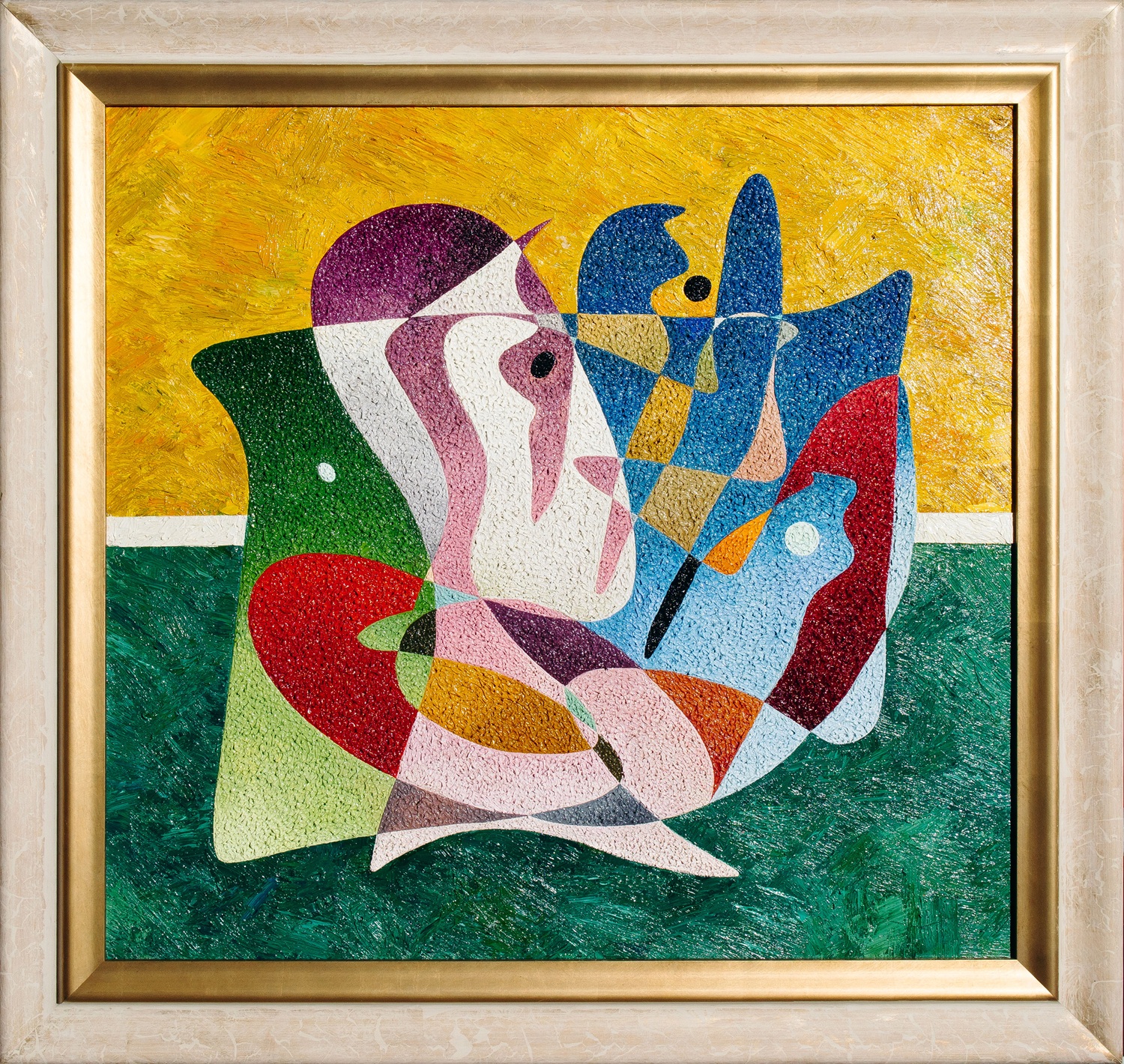
Most people imagine Kenau carrying a sword on the walls of Haarlem. Instead, you paint her almost beyond recognition. Why?
Because courage has no appearance. You can paint armour, weapons, or a battlefield, but none of those things are courage. They are only the circumstances in which courage becomes visible. I wasn't interested in reconstructing Kenau's face. I wanted to paint the state of mind that allows someone to step forward when everyone else steps back.
So the abstraction wasn't simply an aesthetic choice.
No. It was the only honest way I could approach the subject. The moment I tried to imagine what Kenau looked like, the painting became historical illustration. I wasn't interested in illustration. I was interested in something that cannot be photographed or reconstructed because it exists inside a person rather than outside them.
Historians still debate how much of Kenau's story is actually true.
That debate never discouraged me. If anything, it made the painting more interesting. There comes a point when a person begins existing in two different ways. One belongs to history, the other belongs to memory. I wasn't trying to decide which one was correct. I was interested in the space where those two versions meet.
So this isn't really a portrait of Kenau.
No. It's a portrait of an idea that people have attached to Kenau for centuries. Whether every detail happened exactly as we are told is less important than the fact that generations continued returning to her story. That tells me she came to represent something larger than herself.
The figure feels almost anonymous.
Deliberately. The less she resembled one particular woman, the more she could become an idea. Once viewers stop asking whether this is what Kenau looked like, they can begin asking what courage itself might look like. That question interested me much more.
What did painting Kenau make you think about personally?
It made me realise how easily we admire courage in other people because we never experience their uncertainty. History usually remembers decisions, not hesitation. I began wondering whether courage is really the absence of fear or simply the decision to continue despite it.
There seems to be something personal in that observation.
Of course. Every portrait is personal, even when it isn't autobiographical. I wasn't comparing myself with a woman who lived centuries ago. I was comparing myself with an idea. I admired the certainty history seemed to give her, while knowing that no human life is ever that simple.
Would you say the painting is about courage?
Not courage alone. It is about the moment before courage. The moment when a person still has the possibility of turning away. That invisible moment interested me far more than the heroic act itself, because I think that is where character is formed.
Where does Kenau sit within your series of historical personalities?
It was one of the paintings that convinced me historical figures don't have to be treated as biographies. They can become ways of investigating ideas. In this case, Kenau became the means through which I could think about courage, memory, and the strange relationship between history and imagination.
Finally, what question does Kenau leave with the viewer?
I think it asks a question that history can never answer. When people act with extraordinary courage, are we witnessing something exceptional, or are we seeing something that already exists within ordinary people but only appears when circumstances demand it? I don't know. That's why I painted Kenau.
Editorial Note (2025)
In 2025, Gheorghe Virtosu added the following reflection regarding his original motivation for painting Kenau, which was not discussed in the original interview:
"Before I painted Kenau, I wasn't thinking about the Siege of Haarlem. I was thinking about courage. I realised I admired something that I wasn't sure I possessed myself. Not fearlessness, but the ability to move forward despite doubt. Perhaps that is why I chose abstraction. I wasn't trying to paint Kenau's face. I was trying to paint the question she left behind. In many respects, the painting became less about a historical woman and more about my own search for the courage to keep moving forward."
Kenau by Gheorghe Virtous
Representation Status
Available for Representation