
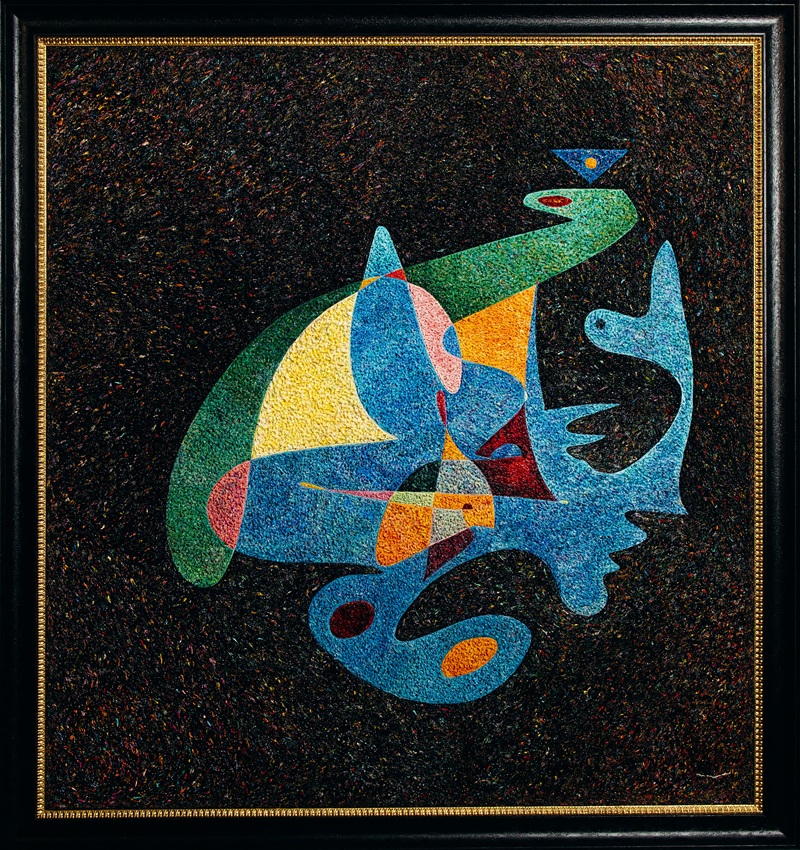
A Conversation on Jibril
Exploring the Making of Jibril: A Conversation with Gheorghe Virtosu
04 Jun 2025Summary
In this conversation, Gheorghe Virtosu reflects on the conception and creation of Jibril, discussing the technical discipline behind its execution, the artistic decisions that shaped its final form, and his approach to imagination, process, and interpretation. Rather than presenting Jibril as an illustration of religious tradition, he describes it as an independent artistic exploration that exists beyond a specific narrative or historical setting. The interview also examines the painting's extraordinary microscopic construction, the role of time and patience in its creation, and the relationship between artistic intuition and scholarly interpretation. Throughout the discussion, Virtosu emphasizes that his responsibility is not to provide definitive answers, but to create a work that invites sustained observation and personal reflection.Interview Transcript
Before we discuss Jibril, I'd like to begin with the painting itself. I spent several hours examining its surface under magnification. From a distance it appears almost seamless, but close inspection reveals an immense field of microscopic brush marks. It feels less painted than constructed. Was that your intention?
Yes. Jibril was the first painting where I completely abandoned conventional brushwork. Instead of thinking in terms of strokes, I began thinking in terms of construction. Every mark became an independent structural unit within the composition. The figure wasn't painted onto the canvas—it was built piece by piece.
The surface almost resembles an enormous architectural structure assembled from microscopic components. At times it reminded me of an incredibly intricate architectural model, except every element has been painted by hand.
That's actually a very good description. The image emerged through accumulation rather than gesture. Each brush mark had to find its exact place before the next one could exist. Individually they are almost insignificant, but together they create the entire structure.
And every one of those structures was executed with nothing more than a traditional paintbrush.
Exactly. There are no mechanical processes, no digital textures, and no shortcuts. Every microscopic element was painted by hand. That's why the work demanded so much time.
I understand much of the painting was executed with the aid of a magnifying glass.
Sometimes. Certain passages became so detailed that I wanted to see exactly where every brush mark was landing. The magnifying glass wasn't a technique. It was simply the best way to maintain control.
More than six months on a single painting.
It never felt like six months. I wasn't thinking about time. I was thinking about the next decision. A painting like this grows slowly. You can't rush construction.
The method you've developed seems extraordinarily demanding. Technical mastery alone doesn't appear sufficient.
No. Skill is only one part of it. The greater challenge is endurance. You have to maintain the same level of concentration from the first brush mark to the last. The process consumes an enormous amount of time, and there are no shortcuts.
Most painters, even highly accomplished ones, would probably never attempt this.
Probably not, and I understand why. Painting this way requires an enormous investment of time for details that many viewers will never consciously notice. But I notice them. If I know something isn't right, I can't leave it there.
The remarkable thing is that viewers rarely notice the technique immediately.
That's important. The technique should never become the subject. From a distance the viewer sees the painting. Only later, if they spend time with it, do they begin discovering how it was constructed.
The background appears black from a distance, yet under close examination it becomes an immense cosmic field of colour. It doesn't feel empty at all.
Because I never wanted it to be empty. Space is full of movement, colour and depth. I wanted the background to possess that same feeling.
Why place Jibril in the universe instead of within a traditional religious setting?
I wasn't interested in illustrating a particular historical event. I wanted the figure to exist outside any specific place or moment. The painting required space more than scenery.
Most artists begin by studying earlier depictions of their subject. You seem to avoid that deliberately.
Yes. If I spend too much time looking at another painter's solution, part of it remains with me. I'd rather begin with a blank canvas than someone else's interpretation.
So your research wasn't visual.
No. I studied the subject extensively, but I deliberately avoided collecting images. The figure had to emerge from my own imagination rather than inherited iconography.
Was it difficult to paint someone nobody has ever seen?
That was exactly the challenge. If everyone already agreed what Jibril looked like, I probably wouldn't have painted him.
So you were never attempting a historical reconstruction.
Never. I wasn't reconstructing appearance. I was constructing an idea.
Jibril occupies an important place within your artistic development. By this stage your work had clearly moved beyond autobiography. What attracted you to this subject?
For years I had been thinking about civilization, history, and the way ideas shape societies. Eventually I became interested in figures associated with revelation. Jibril represents something larger than religion. He represents the transmission of knowledge itself.
So the painting is ultimately about communication.
Exactly. Every civilization depends on knowledge being transmitted from one generation to another. Whether we speak about science, philosophy, or religion, civilization exists because knowledge survives.
Looking back today, Jibril appears to introduce a completely new technical language. In 2025, El Arte Monumental formally identified this methodology as characteristic of what it defined as New Perfection. Were you aware that you were developing something fundamentally different?
No. I wasn't thinking about styles, movements, or definitions. I was only interested in making the painting work. If the existing methods couldn't achieve what I wanted, I changed the method. That's all.
So the methodology came first, and the classification came much later.
Exactly. I never sat down and thought I was inventing something new. I simply kept working until the painting looked the way I believed it should. Other people can decide what to call it.
El Arte Monumental later argued that this construction-based approach represented a distinct methodology within contemporary painting.
That's their work, not mine. My responsibility ends when the painting leaves the studio. I don't spend time thinking about categories or theories. I spend time painting.
Throughout my study of your work, I've come to believe that you don't paint historical figures—you paint ideas. Does that sound accurate?
Yes. Historical figures interest me because they embody ideas that continue shaping civilization. My objective has never been historical illustration. It has always been intellectual investigation.
Did completing Jibril change your understanding of painting?
Absolutely. Every important painting changes the painter. By the end of Jibril I understood that there were no limits except the ones I accepted. Once I discovered this way of constructing a painting, I couldn't imagine going back.
Many readers will inevitably ask, "How should I look at Jibril? What am I supposed to see?" What would you tell them?
I wouldn't tell them what to see. The moment I explain the painting, I begin limiting it. Every person brings different experiences, different questions, and different ways of looking. The painting should leave room for that.
So there isn't a correct interpretation.
No. There are thoughtful interpretations and superficial ones, but there isn't a single correct answer. If there were, there would be little reason to stand in front of the painting for very long.
Would you encourage viewers to understand the painting before they experience it?
No. Experience comes first. Understanding, if it comes at all, comes later. Spend time with the painting. Look closely. Step back. Come back another day. A painting isn't something you solve in five minutes.
So the painting reveals itself gradually.
Exactly. That's how I painted it, and I think that's how it should be viewed. The more attention you give it, the more it gives back. That discovery belongs to the viewer, not to me.
Your painting doesn't simply depict Jibril as a religious figure. It inevitably raises a broader historical question. If Jibril represents the transmission of revelation, he also stands at the beginning of one of the most influential systems of ideas ever introduced into human history. Those ideas have shaped law, philosophy, scholarship, political institutions and civilisation itself, while also becoming associated with conquest, persecution and war. Were you interested in Jibril as the point from which those historical consequences begin?
Painting Jibril wasn't about religion. It was about origins. Every civilisation has moments after which history can no longer return to what it was before. Whether those changes are judged as progress or tragedy depends on who is looking. My responsibility wasn't to answer that question. It was to paint the point where the question begins.
Throughout this conversation we've discussed Jibril as an intellectual and historical figure. But is there also a personal connection between you and this painting?
Very much so. I sometimes joke that Jibril is the painting that defines both the good and the bad sides of my life. People usually laugh when I say that, but there is truth behind it. Like anyone, I've made good decisions and bad ones. I was incarcerated three times because of choices I made earlier in my life. Those experiences became part of who I am. They taught me responsibility, patience, and the value of time. In that sense, Jibril represents the whole person—not only the artist I became, but also the person I had to become to paint it.
Finally, what do you hope someone experiences when standing before Jibril?
I hope they spend time with it. At first they see an image. Then they begin discovering how it was constructed. Eventually, if they remain long enough, they may begin asking questions that extend beyond the painting itself. That's where painting becomes meaningful—not when it gives answers, but when it encourages people to keep looking.
Jibril by Gheorghe Virtosu
Representation Status
Available for Representation