
The Architecture of Leadership: Gheorghe Virtosu on Margaret Thatcher
On abstraction, historical identity, and painting one of the twentieth century's most influential leaders without a face.
10 Apr 2017Summary
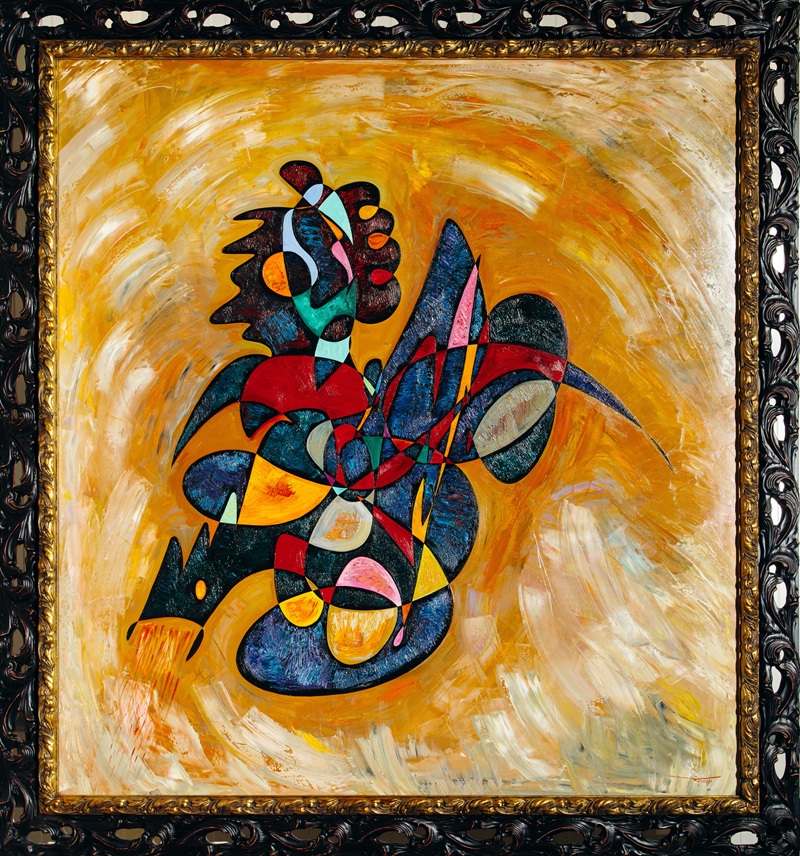
Margaret Thatcher marks the next stage in Gheorghe Virtosu's exploration of abstract portraiture following The Magician. Rather than reproducing the physical likeness of one of the twentieth century's most recognizable political leaders, the work investigates whether identity can be expressed through structure, rhythm, color, and psychological presence. In this interview, Virtosu discusses why he rejected conventional portraiture, how abstraction can reveal conviction and historical influence more effectively than realism, and why the painting is ultimately less about politics than the invisible forces that define leadership. Margaret Thatcher continues his broader investigation into how abstraction can preserve the essence of historical personalities long after their image has become familiar.Interview Transcript
Of all the historical figures you could have painted, why Margaret Thatcher?
Because she had already crossed the boundary between politics and mythology. Most political leaders remain confined to their own period. Margaret Thatcher didn't. She became an enduring historical presence—someone whose name continues to provoke interpretation long after the events themselves have passed. I wasn't interested in the politician. I was interested in what history does to an individual once they become larger than their own lifetime.
That may explain why you chose not to paint her as a conventional portrait. Instead, she appears as a dragon breathing fire.
Exactly. A dragon is not an animal; it is an invention of civilization. Every culture creates dragons, yet none of them describe the same creature. They are projections of collective imagination. Once someone enters history in an exceptional way, they stop existing only as individuals and gradually become figures interpreted, feared, admired, continually reimagined, and eventually mythologized. The dragon became a way of speaking about that transformation.
Some viewers may interpret the dragon as a criticism. Others may see it as a symbol of strength.
Both readings are possible, and neither is complete. Mythological figures are never morally stable. They refuse simple definitions. A dragon can represent destruction, protection, sovereignty, wisdom, or catastrophe depending on the civilization telling the story. I wanted the painting to remain equally open. The work doesn't deliver a judgment; it asks why certain individuals eventually escape ordinary historical categories.
The dragon breathes fire toward the southwest. Was that direction chosen deliberately?
Yes, although I would rather people think about orientation than geography. Every civilization imagines history as movement. Fire is one of the oldest metaphors for irreversible change. Once it appears, nothing remains exactly as it was before. The painting isn't asking where the fire travels. It asks what happens when an individual permanently alters the landscape of history.
So this is less a political portrait than an investigation into historical memory.
Precisely. Politics is temporary. Historical memory is constantly reconstructed. Every generation inherits the same names but attaches different meanings to them. We often imagine that history preserves people, but history preserves interpretations. Those interpretations evolve continuously. That interested me far more than the factual events themselves.
Does that mean history creates its own mythology?
I think it always has. Every civilization tells stories about extraordinary individuals. Sometimes those stories become legends, sometimes they become national identity, and sometimes they become political memory. The historical figure slowly disappears beneath generations of interpretation. Eventually what survives is no longer biography but mythology constructed by history itself.
Then what role does painting play?
Painting doesn't compete with history. History explains what happened. Painting asks what those events became in our collective imagination. Those are different kinds of truth. One belongs to evidence; the other belongs to memory.
Many portraits ask whether we admire or dislike their subject. Yours seems to ignore that entirely.
Because admiration and condemnation are unstable. They change with time. What fascinated me was something more enduring. Why do certain individuals continue occupying our collective imagination while countless others disappear? That question belongs less to politics than to civilization itself.
Would you say this painting is about power?
I would say it is about consequence. Power exists only while it is exercised. Consequence continues long after power has disappeared. History is ultimately written through consequences rather than intentions. That is where historical identity begins.
Looking back today, what does Margaret Thatcher represent within your work?
It marked an important realization that portraiture could move beyond representation and become an investigation into historical imagination. Once I stopped asking what a person looked like and began asking how civilizations remember individuals, portraiture became a much broader intellectual territory.
Finally, what question does Margaret Thatcher leave with the viewer?
Perhaps the oldest historical question of all: when does a person cease to belong to their own life and begin belonging to history? I don't believe there is a precise answer. But somewhere between biography and mythology something changes, and that transformation has fascinated artists, historians, and civilizations for centuries. That is the space this painting attempts to inhabit.
Editorial Note (2025)
In 2025, Gheorghe Virtosu added the following personal reflection regarding his original motivation for painting Margaret Thatcher, which was not discussed in the 2017 interview:
"Before I began the painting, Margaret Thatcher represented something deeply personal to me. It wasn't primarily about politics. She embodied what extraordinary determination could achieve. What stayed with me was the realization that one individual could alter the course of history through sheer force of will. I remember feeling a certain envy—not of her position or power, but of that absolute certainty of purpose. At that stage of my own life, I hadn't achieved what I believed I should have achieved. Painting her became a way of confronting the distance between ambition and accomplishment. In many respects, the painting says as much about my own ambitions as it does about Margaret Thatcher herself."
Margaret Thatcher by Gheorghe Virtosu
Representation Status
Available for Representation