
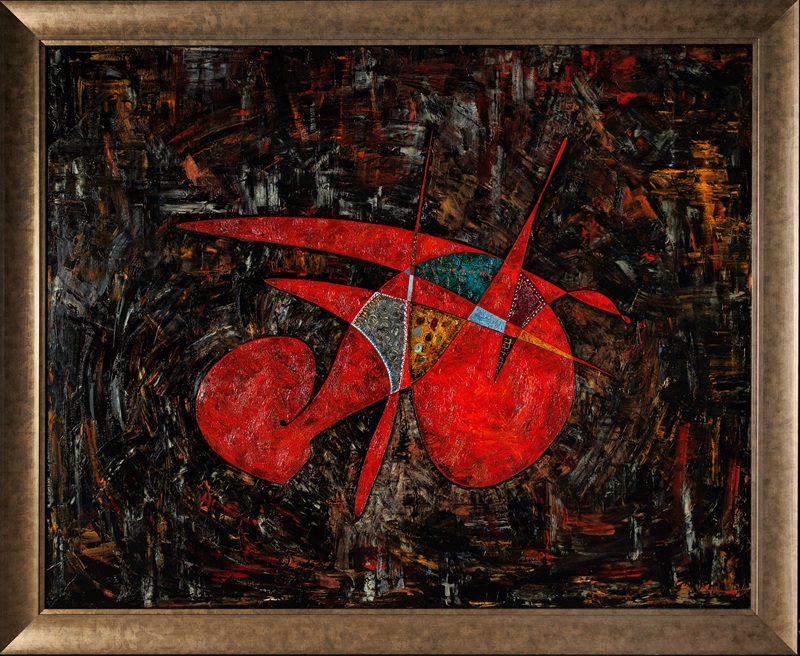
From Personal Experience to Painting: Gheorghe Virtosu Discusses Fatimah bint Muhammad
The artist reflects on the personal experiences, historical research, and philosophical questions that shaped one of the earliest paintings of his career, revealing how it laid the conceptual foundations for his later artistic practice.
11 Apr 2014Summary
In this interview, Gheorghe Virtosu reflects on the origins of Fatimah bint Muhammad, one of the earliest paintings to emerge directly from his personal experiences and a formative work in the development of his artistic practice. He discusses how a period of solitary confinement in France during 2004–2005, combined with the emotional impact of personal loss, led him to explore the ideals of devotion, loyalty, and resilience embodied by Fatimah. Looking back, Virtosu explains how a deeply personal experience gradually evolved into a broader philosophical inquiry, establishing the research-driven approach and recurring themes that would come to define his later painting.Interview Transcript
Before discussing Fatimah bint Muhammad, I would like to return to its origins. You have mentioned that the idea was conceived long before the painting was made. How did it first emerge?
The conceptual foundation dates back to 2004 and 2005, during a period of solitary confinement in France. By that time, I had already been producing paintings for several years, beginning in 1998. However, this work emerged from a different source. Its origins lay in a deeply personal experience that compelled me to reconsider ideas of loyalty, commitment, and human relationships. Those reflections gradually developed into the conceptual basis of Fatimah bint Muhammad, making it one of the first paintings in which personal experience became a defining intellectual and emotional force.
What was the emotional catalyst behind the work?
The central experience was the collapse of my marriage. During one of the most difficult periods of my life, when I most needed emotional support, my wife chose to leave. That experience became a profound psychological wound. Solitary confinement has a way of stripping away distractions. You begin examining every memory, every decision, every relationship with uncomfortable clarity.
How did that personal experience become connected to the historical figure of Fatimah?
While reflecting on devotion and loyalty, I found myself reading extensively about different religious and historical traditions. The figure of Fatimah fascinated me, not simply because of her place in Islamic history, but because she represented an ideal of unwavering devotion to family during periods of hardship.
What specifically drew you to Fatimah as a symbol?
She remained beside those she loved when circumstances were at their most difficult. That idea stayed with me. It stood in complete contrast to my own experience. I wasn't interested in illustrating a religious figure. I was interested in exploring what she had come to symbolize: steadfastness, sacrifice, dignity, and loyalty under pressure.
So the painting is not simply biographical.
No. The painting became less about biography and more about an enduring human ideal.
Some viewers might assume the work is religious in nature.
Religion provides the historical reference, but the subject is universal. Every civilization has figures who embody certain virtues. Fatimah became the vehicle through which I could examine devotion as a timeless human value.
What question does the painting ask for you?
For me, the painting asks a very simple question: what does genuine commitment look like when life becomes difficult? It is easy to remain devoted during prosperity. Character reveals itself during suffering.
Is it fair to say that the work became, in part, a response to personal loss?
Inevitably. Artists often transform experiences they cannot otherwise resolve. The painting allowed me to investigate an absence rather than simply describe it.
What kind of absence?
I was not interested in creating a portrait of grief. I wanted to construct an image representing the opposite of abandonment. In that sense, the work became an aspiration rather than a memory.
Although the concept originated years earlier, the painting itself was produced much later. Why did it take so long?
Because the idea arrived before I possessed the means to express it.
What happened during those intervening years?
During those years I accumulated observations, studied history, religion, symbolism, and painting itself. The concept matured alongside my understanding of what painting could achieve. By the time I finally executed the work, it no longer belonged solely to the original experience. It had become something much broader.
Looking back now, where does Fatimah bint Muhammad stand within your artistic development?
It belongs among the earliest paintings I produced, and certainly among the first to emerge directly from personal experience. Until then, painting had not yet become the language through which I understood my own life. This work marked the moment when private experience began transforming into artistic inquiry.
How important was this work for your later artistic development?
Everything that followed—the historical research, the philosophical investigations, and the later monumental paintings—can be traced back to the questions first explored here. Although my subjects expanded far beyond autobiography, this painting established the method that would define my work: beginning with a personal experience and allowing it to develop into a broader reflection on history, culture, and the human condition.
So the painting was not only an early work, but also the beginning of your artistic method.
Exactly. It taught me that painting could transform personal experience into something universal. In that sense, Fatimah bint Muhammad was less an answer than the first serious question I asked through painting, and much of my later work has continued that same conversation.
Fatimah bint Muhammad by Gheorghe Virtosu
Representation Status
Representation Closed