
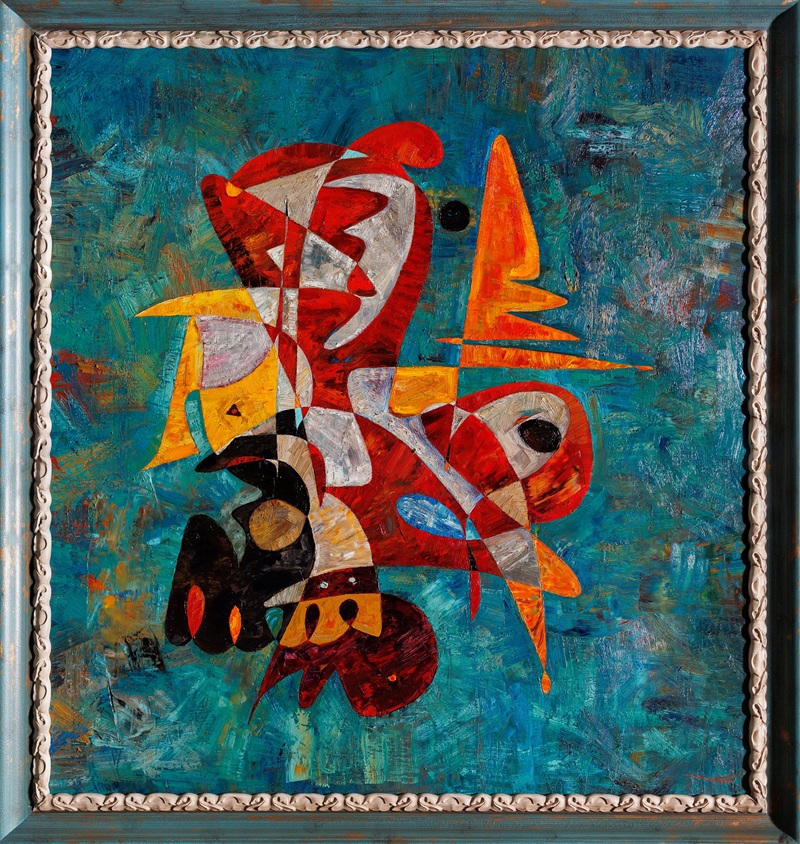
The Century of Dolphins: Gheorghe Virtosu on Prosperity, Civilization, and Artistic Transition
The artist discusses how The Century of Dolphins transformed a deeply personal artistic journey into a broader inquiry into civilization, prosperity, and humanity's future.
10 May 2015Summary
In this interview, Gheorghe Virtosu discusses The Century of Dolphins, the painting he regards as the pivotal transition between his first work, Fatimah bint Muhammad, and the later philosophical vision of The Magician. Reflecting on its conception in 2006, he explains how the work marked a shift from deeply personal themes of loss and abandonment toward a broader exploration of civilization, cooperation, prosperity, and humanity's potential. Looking back, Virtosu describes The Century of Dolphins as the moment his artistic practice moved beyond autobiography and began its enduring inquiry into the future of human society.Interview Transcript
Before we discuss The Century of Dolphins, I'd like to ask where this painting sits within the evolution of your work. Was it already part of the direction that would eventually lead to The Magician?
Yes. I see it as a bridge. Fatimah bint Muhammad was born from personal disappointment and abandonment. The Century of Dolphins marked the moment when my attention shifted away from my own experience toward humanity as a whole. It was the transition between those two worlds.
So the emotional starting point was very different.
Completely different. After spending years reflecting on loss, I reached a point where I no longer wanted to paint absence. I wanted to ask what a flourishing civilization might look like. Instead of examining what people lose, I became interested in what humanity could become.
The title immediately suggests optimism. Why dolphins?
Throughout history dolphins have represented intelligence, cooperation, harmony, protection, and guidance. They are among the few species that appear to help one another without obvious self-interest. For me they became a metaphor for a civilization built on cooperation rather than conflict.
The painting was conceived in 2006. Were you imagining the future?
Not in the sense of making predictions. I wasn't trying to forecast history. I was asking what kind of century humanity should aspire to create. The title is aspirational rather than prophetic.
So "The Century of Dolphins" is not about dolphins themselves.
No. It is about people. The dolphin simply became the symbol through which I could speak about abundance, prosperity, intelligence, and peaceful coexistence.
That represents a remarkable shift from your first painting.
It does. Fatimah bint Muhammad examined devotion through personal pain. The Century of Dolphins moved beyond individual experience. It became an attempt to think about humanity collectively rather than privately.
Would it be fair to describe this as the moment your paintings became philosophical rather than autobiographical?
I think that's accurate. Personal experience remained the catalyst, but it was no longer the destination. From this point onward I became increasingly interested in broader questions that belonged to everyone.
Many of your later paintings investigate civilization, history, identity, and belief. Did those interests begin here?
Yes. Looking back, I can see the foundations already forming. The Century of Dolphins introduced the idea that a painting could explore an entire civilization instead of a single event or individual.
How did this work prepare you for The Magician?
It changed the scale of my thinking. Once I began asking questions about humanity instead of myself, it became possible to explore consciousness, history, religion, and civilization as interconnected systems. The Magician grew naturally from that change in perspective.
So The Century of Dolphins occupies a unique position within your career.
Absolutely. It is the transition. Without it, there would be no direct path from my first painting to The Magician. It represents the moment when my work stopped looking inward and began looking outward.
Looking back twenty years later, what does the painting mean to you today?
I still see it as a statement of hope. Human history is often described through wars, crises, and divisions. I wanted to imagine a different narrative—one centred on cooperation, knowledge, prosperity, and shared progress. Whether humanity reaches that future is another question, but every future begins as an idea.
Finally, if Fatimah bint Muhammad asked what devotion means, what question does The Century of Dolphins ask?
It asks what kind of civilization we choose to build. Every century is remembered for something. I wanted to imagine one remembered not for conquest or destruction, but for wisdom, cooperation, and human flourishing.
The Century of Dolphins by Gheorghe Virtosu
Representation Status
Representation Closed