
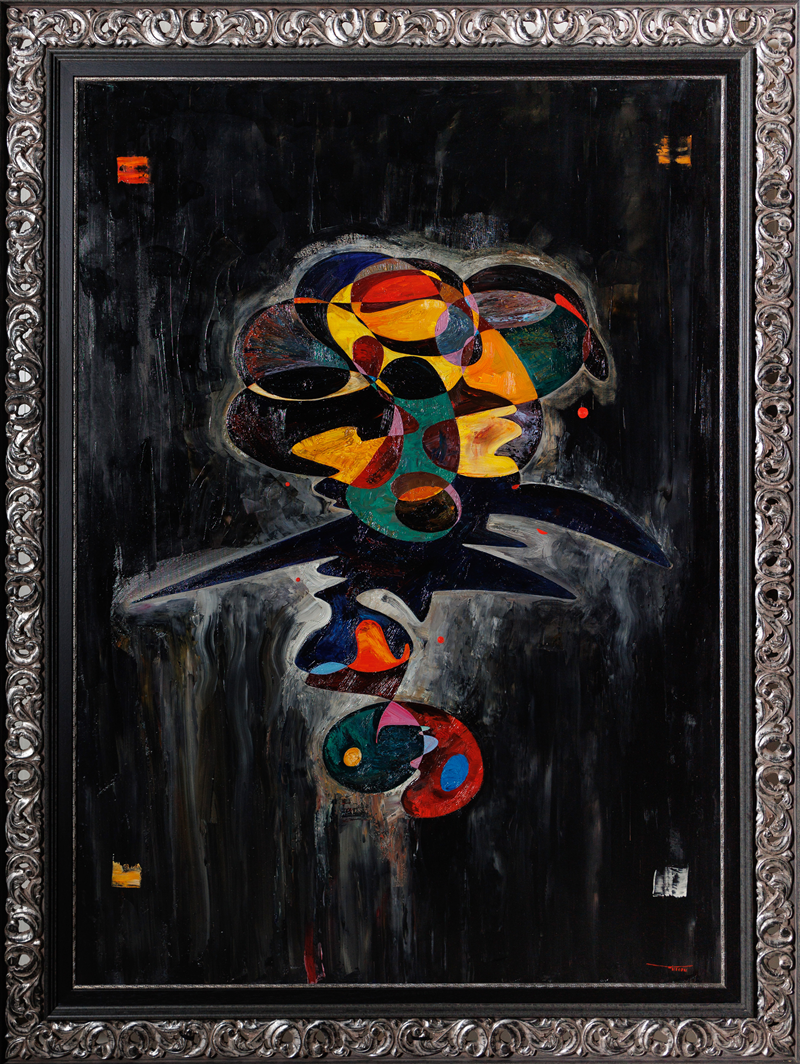
From Vision to Painting: The Origins of The Magician
The Conceptual Origins of The Magician: An Interview with the Artist
07 Nov 2016Summary
In this interview, Gheorghe Virtosu reflects on the conceptual origins of The Magician, tracing its inception to a transformative experience during solitary confinement in 2004. He discusses the series of visions that, in his view, revealed a new mode of perception and the metaphorical "magic gate" through which the conceptual foundations of his artistic practice first emerged. The conversation examines the seven-year development of the painting, the role of abstraction as a method for investigating structures of consciousness and knowledge, and the significance of The Magician as the point of departure for the broader body of research that would later evolve into his sustained exploration of identity, belief, conflict, and power.Interview Transcript
When did the idea for The Magician first emerge?
The conceptual origins of The Magician date to 2004, during a period of solitary confinement. It was then that I experienced a series of visions that fundamentally transformed my understanding of reality and redefined my relationship to painting as a means of inquiry.
I have often described this experience as the opening of a "magic gate" within the subconscious. By this I do not refer to a literal phenomenon, but to a threshold of perception through which previously inaccessible patterns became visible. Relationships between history, identity, belief, conflict, and human civilization appeared not as independent subjects but as manifestations of a single underlying structure.
That experience established the direction of my subsequent artistic practice. At the time, I possessed neither a defined visual language nor the philosophical frameworks that would later inform my work. What emerged instead was a profound conviction that painting could function as a method for investigating structures of knowledge that resist conventional forms of representation.
The years that followed were devoted to sustained artistic production and philosophical research. They constituted a period of exceptional intellectual and creative development during which numerous major projects were conceived and the conceptual foundations of my practice gradually took form.
Although The Magician was completed in 2009, its conceptual origin remains rooted in the experience of 2004. The painting does not depict a magician as a figure; rather, the "magician" signifies the subconscious itself—the faculty through which imagination, intuition, memory, and knowledge converge. It represents the moment in which an internal vision became the foundation of an enduring programme of artistic research.
How did your experiences in solitary confinement shape its conception?
Solitary confinement created conditions of sustained introspection that fundamentally altered my perception. The absence of external distraction directed attention inward, producing a series of experiences that reshaped my understanding of consciousness and its relationship to artistic creation. The Magician emerged from an attempt to translate that transformation into a coherent visual language.
What do you mean by the "magic gate" in your subconscious?
The "magic gate" is a metaphor for a threshold of consciousness. It describes the moment at which previously inaccessible ideas, relationships, and conceptual structures became perceptible with exceptional clarity. It was not an isolated event but the beginning of a sustained process of intellectual and artistic discovery.
Why did you title the work The Magician?
The title does not refer to a magician as an individual or symbolic character. It refers to the transformative capacity of the subconscious—the faculty through which intuition becomes knowledge and invisible conceptual structures assume visual form. In this sense, the painting concerns revelation rather than representation.
Why did it take until 2009 to complete the painting?
Between 2004 and 2009, I undertook extensive artistic experimentation alongside sustained philosophical research. This period was marked by continual discovery and the development of numerous major projects. The painting could only be completed once the conceptual and formal language necessary to articulate its underlying ideas had matured sufficiently.
Why did you choose abstraction to express this idea?
Abstraction was essential because the experience itself could not be represented through narrative or figurative imagery. My objective was not to illustrate an event but to construct a visual system capable of expressing relationships, structures, and states of consciousness that exist beyond direct representation.
How does The Magician relate to your later body of work?
I regard The Magician as the conceptual point of origin for my subsequent practice. The questions first encountered through this work gradually expanded into broader investigations. Many of the structural concerns that define my later research were already present in an initial, intuitive form.
What do you hope viewers discover in The Magician?
I do not expect viewers to reproduce my own interpretation. Rather, I hope the painting encourages sustained observation and critical reflection. If the work prompts viewers to question established assumptions and to recognize relationships that were previously unnoticed, then it has fulfilled its purpose.
Editorial Note (2026)
The following question and response were added in 2026 following a subsequent statement by the artist reflecting on The Magician a decade after the original interview.
In a later statement, you described The Magician as having a hypnotic quality. What did you mean by that?
In recent years, I have found myself thinking about The Magician in a different way. When I spend a longer period looking at the painting, I experience it as almost hypnotic. I do not mean hypnosis in a clinical or supernatural sense. It is simply the closest word I have found to describe the state of mind that prolonged contemplation of the work seems to produce.
For me, it is the kind of state that can arise when I feel lost, when I am searching for a solution to a problem, or when I know I need to take the next step but cannot yet see what it is. Looking at the painting for an extended time sometimes seems to help those thoughts move forward. It does not provide answers or tell me what to do, but it seems to create the conditions in which the next idea or direction becomes clearer.
I cannot explain why this happens, and I do not claim that others will experience the painting in the same way. It is simply something I have noticed over time through my own experience of living with the work.
The Magician by Gheorghe Virtosu
Representation Status
Representation Closed