
The Price of Progress: Gheorghe Virtosu on Henry Ford
On Henry Ford, industrial civilization, and the paradox of progress that transformed—and polluted—the modern world.
12 May 2017Summary
In this interview, Gheorghe Virtosu discusses Henry Ford as part of his World Famous Personalities series, examining the paradox of industrial progress through abstract portraiture. Rather than portraying Ford as simply an inventor or entrepreneur, Virtosu reflects on him as the symbolic figure through whom industrial civilization reshaped the modern world. The conversation explores the tension between innovation and its unintended consequences, arguing that the same industrial vision that expanded mobility, productivity, and prosperity also accelerated humanity's environmental transformation. For the artist, Henry Ford becomes less a historical individual than a metaphor for the achievements and burdens of modern civilization, raising broader questions about whether history can celebrate progress without also confronting its lasting consequences.Interview Transcript
Why Henry Ford?
Because Henry Ford interests me less as an individual than as the beginning of a condition we still inhabit. Very few people alter the rhythm of everyday life on a global scale. Ford did. He changed not simply how people travelled, but how cities expanded, how industries developed, and how modern society organised itself around movement and production.
This isn't a celebration of industrial progress.
No. Neither is it a condemnation. History is rarely that simple. Every major achievement creates possibilities that nobody fully understands at the moment they appear. The automobile expanded freedom while simultaneously transforming landscapes, economies, and eventually the environment. I was interested in that paradox.
You once said there was a very personal reason for choosing Henry Ford.
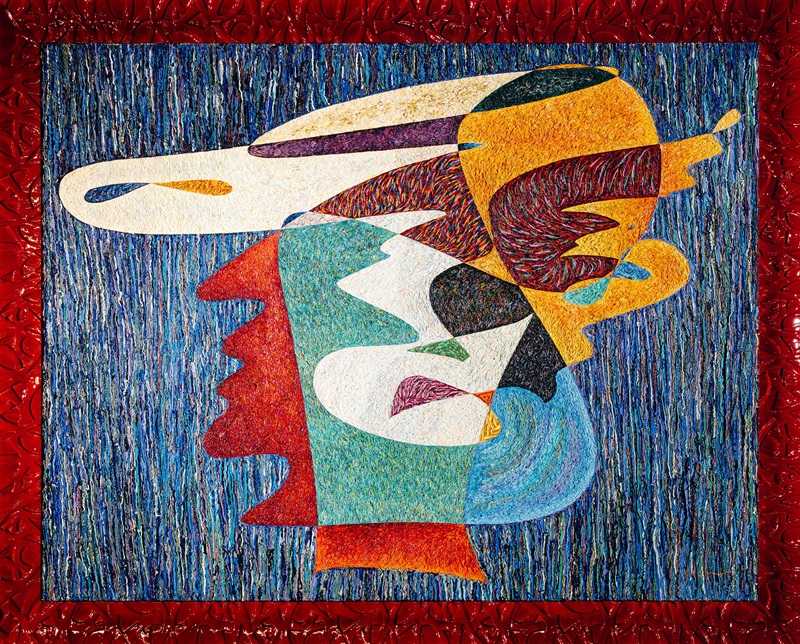
Yes. Before I began the painting, Henry Ford had already become a metaphor in my mind. I saw him as the man through whom the world was polluted. Not because he intended it, or because he alone was responsible, but because he embodied the moment when industrial production escaped human scale. Metal became machines, machines became mass production, mass production became consumption, and eventually the air, the rivers, the soil, and even the rhythm of human life were transformed. To me, Henry Ford wasn't simply the inventor of affordable automobiles. He became the symbolic beginning of a civilization whose achievements and environmental consequences could no longer be separated.
The face appears fragmented, almost as though several identities coexist within it.
I wasn't trying to describe Henry Ford as an individual. I was thinking about the collision between the inventor, the industrialist, the symbol, and the historical figure. Those are not necessarily the same person. History compresses them into one name, but painting allows them to remain unresolved.
Does history simplify extraordinary individuals?
I think it has to. Reality is too complicated to remember in its entirety. We reduce people to inventions, discoveries, or events, even though no individual can be contained by a single achievement. The simplification makes history possible, but it also distances us from the complexity of the person.
Would you describe this as a portrait?
Only if portraiture is understood as an investigation rather than a likeness. I wasn't interested in recording Henry Ford's appearance. I wanted to examine the distance between one individual and the civilization that grew from his work.
What interested you most while making the painting?
The disproportion between cause and consequence. One person makes a decision, but millions eventually live with its effects. That disproportion appears repeatedly throughout history. Henry Ford became one example through which I could think about a much broader question.
Looking back today, where does Henry Ford sit within your work?
It belongs to a period when I was becoming increasingly interested in historical personalities not for who they were privately, but for the civilizations they helped create. The individual gradually became a point of entry into something much larger.
Finally, what question does Henry Ford ask?
It asks whether progress can ever be separated from its consequences. History celebrates those who change the world, but it rarely asks what kind of world they leave behind. I don't think those are separate questions. They are the same question.
Henry Ford by Gheorghe Virtosu
Representation Status
Available for Representation