
Divine DNA Volume II: Iconography, Structure, and Symbolic Order
A Study of Symbolic Systems and Cultural Representation
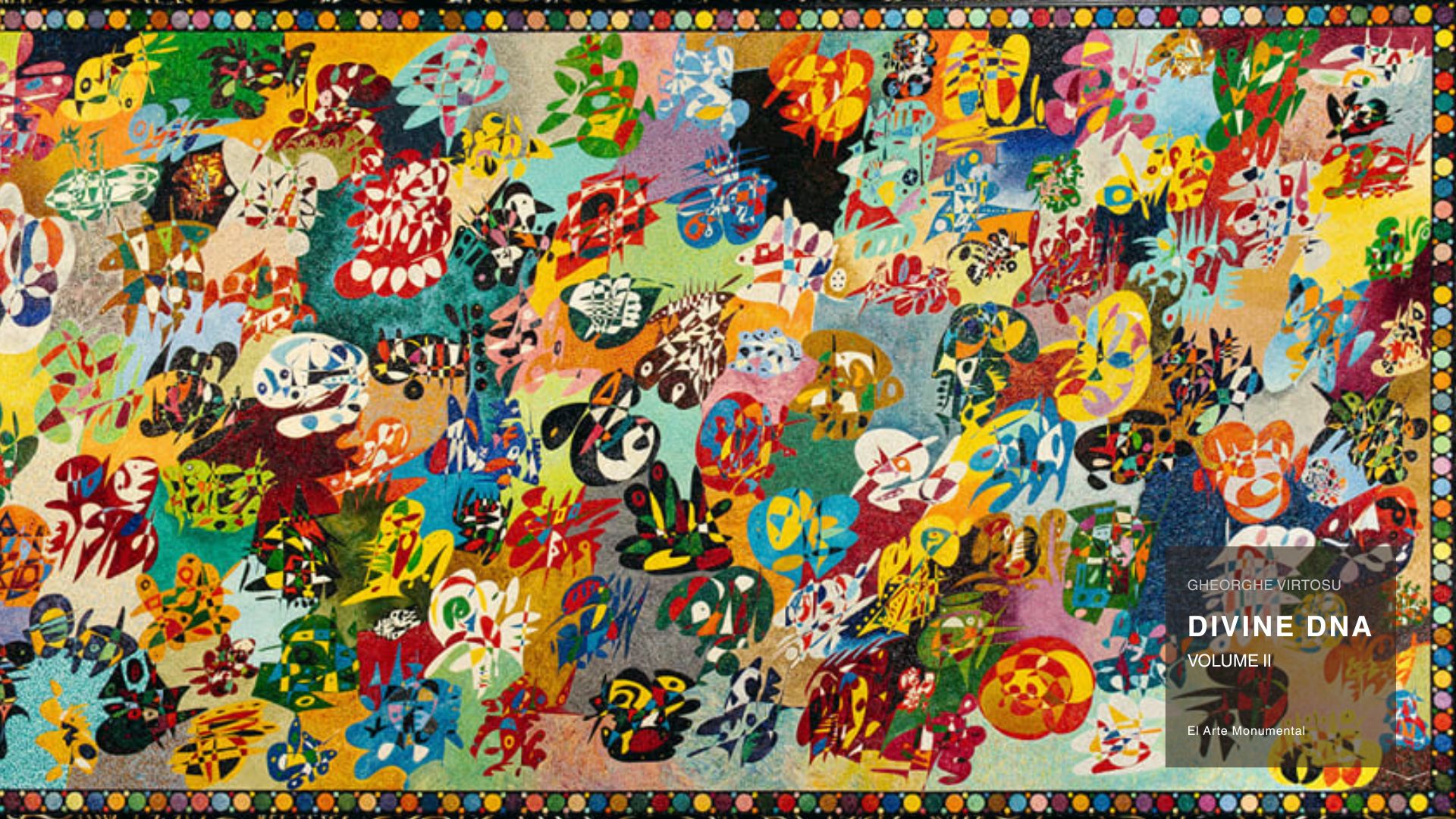
07 Jun 2026Volume II of Divine DNA documents the complete iconographic sequence of the masterwork developed by Gheorghe Virtosu between 2010 and 2016. While the painting itself functions as a unified symbolic structure, this publication provides direct access to its constituent entities, allowing the internal organization of the work to be examined in detail.
The volume should not be understood as a catalogue of independent artworks. The entities reproduced herein are components of a larger visual system whose significance derives from their position within the overall composition. Each form operates as an autonomous symbolic structure while simultaneously participating in a broader iconographic framework.
Central to the project is the transformation of national and territorial identities into an original visual language. Rather than relying upon flags, coats of arms, maps, or official emblems, Divine DNA constructs a new symbolic vocabulary through which cultural identities are translated into abstract visual entities.
Through this process, representation gives way to construction. The entities do not function as illustrations of nations, but as symbolic configurations generated through abstraction, synthesis, and formal invention. Their relationship to political identity is therefore conceptual rather than descriptive.
The publication reveals the structural logic of the masterwork by presenting the complete sequence of entities according to their position within the composition. Meaning emerges not only through individual forms but also through relationships of continuity, adjacency, variation, and visual correspondence.
From an iconological perspective, the volume investigates how plurality may be organized within a coherent symbolic order. Distinct cultural identities remain identifiable, yet they participate in a larger structure whose coherence depends upon the interaction of its constituent parts.
The sequence documented in this volume should therefore be understood as an organizational framework rather than a classificatory inventory. Its significance lies not in the enumeration of nations and territories, but in the visual architecture through which they are brought into relation.
As a documentary and interpretive resource, Volume II provides insight into the conceptual foundations of Divine DNA. By making visible the iconographic structure of the masterwork, the publication contributes to a deeper understanding of its visual language, symbolic organization, and underlying system of relationships.
Research Publications
The research surrounding Divine DNA (2016) is presented through two complementary publications. The first documents the artwork through a curatorial essay, while the second develops its broader theoretical implications as a model of cultural representation and visual systems.
Available through El Arte Monumental Research Publications.
1. Divine DNA (2016): Curatorial Essay and Research Publication
This publication presents the complete curatorial essay accompanying Divine DNA (2016), examining the work's conceptual foundations, historical context, visual structure, and position within The Architecture of Humanity research program.
Citation:
Varzari, D. (2026). Divine DNA (2016): Curatorial Essay and Research Publication. Zenodo.
https://doi.org/10.5281/zenodo.20821620
.
2. Divine DNA: Cultural Representation as a Visual System
This publication expands upon the curatorial essay Divine DNA (2016): Curatorial Essay and Research Publication and establishes the theoretical framework of cultural representation as a visual system, positioning Divine DNA as a model for understanding identity through systemic visual organization.
Citation:
Varzari, D. (2026). Divine DNA: Cultural Representation as a Visual System. El Arte Monumental Research Publications.
https://doi.org/10.5281/zenodo.20832280
.
Related Resources
Masterwork: Divine DNA
Publication: Divine DNA — Volume II: Catalogued System
Notes
- Volume II documents the complete iconographic sequence of the entities that constitute Divine DNA.
- The publication should not be interpreted as a catalogue of autonomous artworks but as a record of the constituent structures of a larger symbolic system.
- Each entity functions simultaneously as an independent symbolic form and as a component within the broader organization of the masterwork.
- The project employs abstraction as a method for translating cultural identities into original visual structures.
- The entities do not reproduce official national iconography, including flags, coats of arms, political maps, or state emblems.
- The publication reveals the internal organization of the work through the presentation of its complete sequence.
- Position within the composition constitutes an essential component of the work's symbolic structure.
- Meaning emerges through relationships among entities as well as through the formal characteristics of individual forms.
- The sequence functions as an ordered iconographic framework rather than a political or geographic classification.
- The publication provides a documentary foundation for the study and interpretation of Divine DNA.
Selected Bibliography
- Cassirer, Ernst. An Essay on Man. New Haven: Yale University Press, 1944.
- Panofsky, Erwin. Studies in Iconology: Humanistic Themes in the Art of the Renaissance. New York: Harper & Row, 1962.
- Gombrich, E. H. Symbolic Images: Studies in the Art of the Renaissance. London: Phaidon, 1972.
- Assmann, Jan. Cultural Memory and Early Civilization. Cambridge: Cambridge University Press, 2011.
- Anderson, Benedict. Imagined Communities: Reflections on the Origin and Spread of Nationalism. London: Verso, 2006.
- Lévi-Strauss, Claude. Structural Anthropology. New York: Basic Books, 1963.
- Luhmann, Niklas. Social Systems. Stanford: Stanford University Press, 1995.
- Ricoeur, Paul. Memory, History, Forgetting. Chicago: University of Chicago Press, 2004.
- Virtosu, Gheorghe. Divine DNA — Volume I: Catalogued System. El Arte Monumental, 2026.
- Virtosu, Gheorghe. Divine DNA — Volume II: The Complete Iconographic Sequence. El Arte Monumental, 2026.